Best Wealth Managers for Business Owners Post-Exit (2026): Wealth Management After Exit, 7 Firms Compared
Wealth management for business owners after exit is best compared on Form ADV: where a schedule is published, $10 million costs $85,500 to $107,500 a year, and five of seven firms name a private equity fund as a major owner.
Quick Answer
On a $10 million portfolio, the published standard schedules in each firm’s 2026 Form ADV Part 2A come to $85,500 a year at Mercer Advisors (Custom Wealth), $86,500 at Creative Planning, $92,500 at Mariner, $100,000 at Wealth Enhancement Group (sample flat rate) and $107,500 at Fisher Investments. CAPTRUST negotiates at $10 million and above, and Beacon Pointe publishes a 0.50% to 1.50% range. We list firms by regulatory assets, not by quality: no public filing measures advice quality.
Thinking about selling your business?
A 15-minute confidential call gives you a real valuation range and the buyers most likely to compete for your business. No cost, no obligation.

Key takeaways
- Fisher Investments bills 1.25% on the first $1 million, 1.125% on the next $4 million and 1.000% above $5 million for equity and blended accounts (Fisher Form ADV Part 2A, Feb 11, 2026).
- Mercer Advisors’ Custom Wealth schedule falls from 1.10% on the first $1 million to 0.50% over $10 million, with a $15,000 minimum fee (Mercer Form ADV Part 2A, Mar 30, 2026).
- On $20 million, Mercer’s schedule comes to $135,500 a year, Creative Planning’s to $156,500 and Fisher’s to $207,500 (CT Acquisitions arithmetic from the three Part 2A schedules).
- Schedule B of the Form ADV names Leonard Green (Mariner), Altas Partners (Mercer), GTCR (CAPTRUST), TA Associates and Onex (Wealth Enhancement Group) and KKR (Beacon Pointe) in the ownership chain (SEC IAPD, accessed November 2026).
- A sale year can trigger the 3.8% net investment income tax above $250,000 of modified AGI for joint filers (IRS), and the 2026 estate basic exclusion is $15,000,000 per person (IRS).
Which wealth managers do business owners compare after an exit?
The seven firms below are the ones this page has covered since May 2026 and the ones searchers compare by name, led by “Mercer Advisors vs Fisher Investments”. Each is an SEC-registered investment adviser, so each files a Form ADV that states its regulatory assets under management (RAUM), owners and fee schedule. The table orders them by RAUM from the latest filing; size is not a quality ranking.
| Firm (legal name, CRD) | HQ on Form ADV | RAUM, Item 5.F | SEC registration | Latest ADV filing | Source |
|---|---|---|---|---|---|
| CAPTRUST (CapFinancial Partners, LLC, CRD 175112) | Raleigh, NC | $1,236.7B ($916.5B non-discretionary) | Jul 11, 2003 | Oct 29, 2026 | IAPD |
| Fisher Investments (Fisher Asset Management, LLC, CRD 107342) | Plano, TX | $386.7B | Mar 26, 1987 | Oct 7, 2026 | IAPD |
| Creative Planning (Creative Planning, LLC, CRD 105348) | Overland Park, KS | $295.6B | Mar 18, 1983 | Jul 10, 2026 | IAPD |
| Mariner (Mariner, LLC, CRD 140195) | Overland Park, KS | $125.4B | Apr 24, 2006 | Oct 2, 2026 | IAPD |
| Wealth Enhancement Group (Wealth Enhancement Advisory Services, LLC, CRD 116407) | Plymouth, MN | $122.2B | Dec 21, 2001 | Nov 9, 2026 | IAPD |
| Mercer Advisors (Mercer Global Advisors Inc., CRD 147363) | Denver, CO | $84.4B | May 30, 2008 | Sep 17, 2026 | IAPD |
| Beacon Pointe (Beacon Pointe Advisors, LLC, CRD 119290) | Newport Beach, CA | $54.9B | Feb 20, 2002 | Aug 31, 2026 | IAPD |
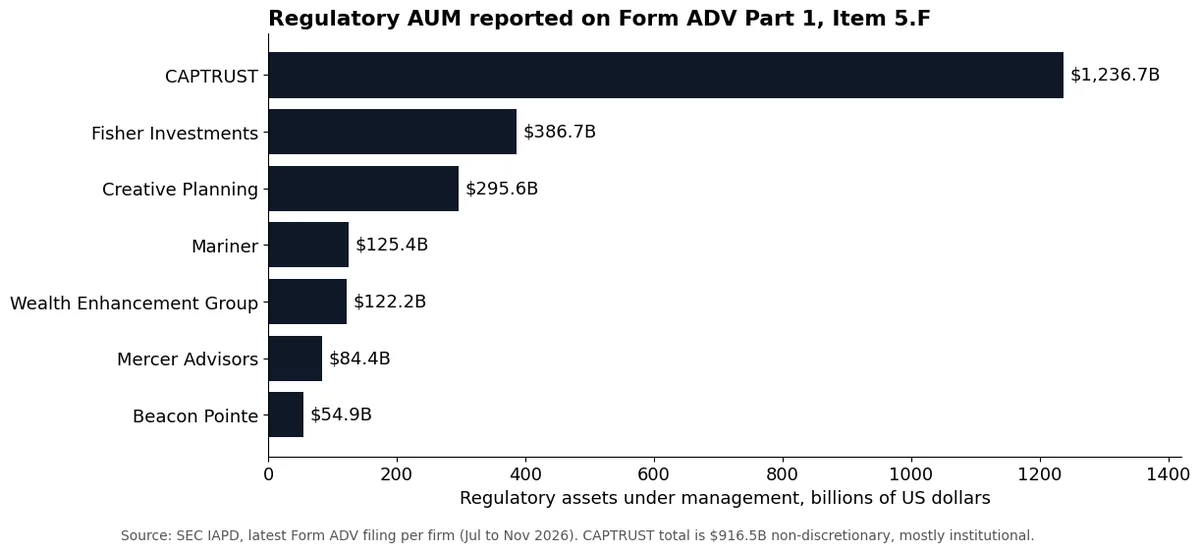
Two RAUM figures need context. CAPTRUST’s $1,236.7 billion includes $916.5 billion of non-discretionary assets, primarily institutional client assets, per its Wealth Client Brochure dated March 27, 2026. Fisher Investments’ $386.7 billion splits into $331.2 billion of private client and $55.4 billion of institutional assets as of December 31, 2025, per its Part 2A. Fisher’s Form ADV now lists Plano, Texas as its main office, not Camas, Washington.
Who owns each wealth management firm, and why does it matter after your exit?
Ownership tells you who can sell the firm under you. Schedules A and B of Form ADV list every owner of 25% or more up the chain with a code (C means 25% to 50%, D 50% to 75%, E 75% or more) and the month the stake was acquired. Five of the seven firms list a private equity fund at 25% or more; Creative Planning and Fisher list private equity as minority holders.
| Firm | Owners named on Form ADV Schedules A and B | Since | Source |
|---|---|---|---|
| Fisher Investments | Fisher Investments, Inc. holds 50% to 75% (code D) and Kenneth Fisher holds 75% or more of that company; Fiji Bidco, Inc. (Advent International GPE X chain) holds 10% to 25%; Black Hook C 2024 LLC (Abu Dhabi Investment Authority chain) holds 5% to 10% | Jan 2025 for the Advent and ADIA vehicles | Form ADV Part 1 |
| Creative Planning | A trust of CEO Peter Mallouk holds 50% to 75% of a Creative Planning holding company; TPG IX Cardiff entities, which the Part 2A calls a minority equity owner and a TPG, Inc. subsidiary | Jan 2020 (trust); Sep 2024 (TPG) | Form ADV Part 1 |
| Mariner | Green Equity Investors VIII (Leonard Green & Partners) through GEI VIII MW Aggregator LLC, 25% to 50% of MWA Holdco, LLC; CEO Martin Bicknell is an elected manager of MWA Holdco | Apr 2021 | Form ADV Part 1 |
| Mercer Advisors | Altas Partners Holdings III funds through APH III Primetime Aggregator, L.P., 25% to 50% of OG Crimson Holdings, L.P., the top of Mercer’s parent chain | Aug 2023 | Form ADV Part 1 |
| CAPTRUST | Halftime Holdings LLC (75% or more owned by GTCR Fund XII/B LP) holds 25% to 50% of The CapFinancial Group, LLC, the adviser’s sole member; CapFinancial Holdings, Inc. holds another 25% to 50% | Aug 2020 | Form ADV Part 1 |
| Wealth Enhancement Group | TA XIII funds (TA Associates) through WEG Parent, LLC and TA-WEG Aggregator, LLC; Onex Partners V through Onex ISO Holdco Corp., a 25% to 50% owner of a WEG holding company | Feb 2019 (TA); Oct 2021 (Onex) | Form ADV Part 1 |
| Beacon Pointe | KKR North America Fund XIII through KKR Polyphony Aggregator and the Polyphony Topco, Holdco and Buyer chain | Nov 2021 | Form ADV Part 1 |
A private equity owner eventually sells its stake, so a firm whose Schedule B shows a fund that bought in April 2021 or November 2021 can change hands while you are still a client. Ask each firm whether your advisory agreement lets you leave without a fee if control changes, and check the Schedule B dates yourself. Our report on who buys RIAs and wealth management firms covers the buyers on the other side of those trades.
What does wealth management cost after a business sale?
Every firm here charges a percentage of assets, billed quarterly, and every schedule steps down as the balance grows. The first-dollar rate runs from 1.10% at Mercer Custom Wealth to 1.50% for Wealth Enhancement Group balances under $1 million, per each firm’s 2026 Form ADV Part 2A, Item 5. All seven say fees are negotiable, so the published schedule is the opening number, not the floor.
| Firm | Published standard schedule (annual) | Minimum | Source |
|---|---|---|---|
| Fisher Investments | 1.25% first $1M; 1.125% next $4M; 1.000% over $5M (equity and blended). Income only over $5M: 0.75% first $5M, 0.50% next $10M, then 0.43%, 0.38%, 0.33%, 0.28% | Targets $1,000,000; smaller accounts billed 1.50% | Part 2A, Feb 11, 2026 |
| Creative Planning | 1.20% first $500,000; 1.00% to $2M; 0.85% to $5M; 0.80% to $10M; 0.70% to $25M; 0.40% to $50M; 0.30% to $100M; 0.25% above | $200,000 for new clients | Part 2A, Mar 31, 2026 |
| Mercer Advisors (Custom Wealth) | 1.10% first $1M; 1.00% next $1M; 0.90% next $3M; 0.75% next $5M; 0.50% over $10M | $15,000 minimum fee; Regis tier over $25M has a $150,000 minimum fee | Part 2A, Mar 30, 2026 |
| Mariner | 1.25% to $1M; 1.00% to $5M; 0.80% to $10M; 0.60% above $10M (“blended tiered”) | $1,875 quarterly minimum fee | Part 2A, Jul 17, 2026 |
| CAPTRUST | Under $10M at initial funding: 1.25% first $1M; 1.00% next $1M; 0.85% next $3M; 0.70% over $5M. Above $10M negotiable | Negotiable | Wealth Client Brochure, Mar 27, 2026 |
| Wealth Enhancement Group | Sample flat rates: 1.50% under $1M; 1.25% from $1M to $2M; 1.00% over $2M; cap of 2% a year | Disclosed per client | Part 2A, Mar 2026 |
| Beacon Pointe | Private clients: 0.50% to 1.50% of assets, no tier table published | $1 million account size; $1,250 quarterly minimum fee | Part 2A, Mar 31, 2026 |
What would you pay on $10 million or $25 million of sale proceeds?
Applied as marginal tiers, the published schedules price $10 million at $85,500 (Mercer Custom Wealth) to $107,500 (Fisher) a year, a $22,000 annual gap. At $25 million the spread widens to $160,500 versus $257,500. These are illustrative figures: CT Acquisitions arithmetic on each firm’s standard schedule, before any negotiated discount, fund expenses or separate account manager fees.
| Portfolio | Mercer Advisors (Custom Wealth) | Creative Planning | Mariner | CAPTRUST | Wealth Enhancement Group (sample flat) | Fisher Investments |
|---|---|---|---|---|---|---|
| $2M | $21,000 | $21,000 | $22,500 | $22,500 | $25,000 | $23,750 |
| $5M | $48,000 | $46,500 | $52,500 | $48,000 | $50,000 | $57,500 |
| $10M | $85,500 (0.855%) | $86,500 (0.865%) | $92,500 (0.925%) | Negotiable | $100,000 (1.00%) | $107,500 (1.075%) |
| $20M | $135,500 | $156,500 | $152,500 | Negotiable | $200,000 | $207,500 |
| $25M | $160,500 (0.642%) | $191,500 (0.766%) | $182,500 (0.730%) | Negotiable | $250,000 (1.00%) | $257,500 (1.030%) |
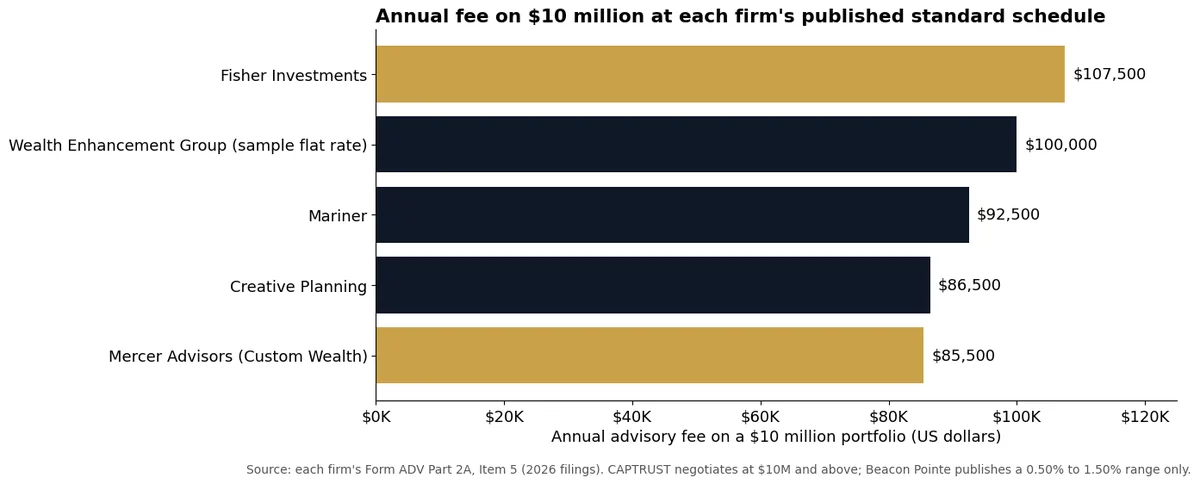
How to read a schedule line: Mercer’s $10 million fee is $11,000 on the first $1 million at 1.10%, plus $10,000 on the next $1 million at 1.00%, plus $27,000 on the next $3 million at 0.90%, plus $37,500 on the next $5 million at 0.75%, which totals $85,500. Fisher’s is $12,500 on the first $1 million at 1.25%, plus $45,000 on the next $4 million at 1.125%, plus $50,000 on the remaining $5 million at 1.000%, which totals $107,500.
Three things move these numbers. Mariner calls its schedule “blended tiered”, so ask whether it bills marginally (as above) or applies one blended rate. Fisher’s income-only schedule would bill a $10 million bond account $62,500. Mariner charges tax preparation separately at up to 0.25% a year, per its Part 2A, so an all-in quote should include it.
Mercer Advisors vs Fisher Investments: which fits a business seller?
Mercer Advisors costs less at every balance we priced, from $21,000 versus $23,750 at $2 million to $160,500 versus $257,500 at $25 million, and bundles more planning through affiliates. Fisher Investments runs a single in-house investment process with a $1,000,000 account target and offers variable prepaid forwards and collars for concentrated stock. The choice turns on whether you want one planning hub or one investment manager.
| Item | Mercer Advisors | Fisher Investments | Source |
|---|---|---|---|
| Fee on $10M (standard schedule) | $85,500 (Custom Wealth) | $107,500 (equity or blended) | Each firm’s 2026 Part 2A |
| Minimum | $15,000 minimum annual fee | Targets $1,000,000; smaller accounts billed 1.50% | Part 2A, Item 5 and Item 7 |
| Tax returns | Affiliate Mercer Advisors Tax Services, LLC, at a negotiated rate | Arrangements with outside firms that prepare returns | Part 2A, Item 4 and Item 10 |
| Estate documents | Foundational trust, will and incapacity documents through Advanced Services Law Group at no added fee for most clients over $1.5 million, at the law firm’s discretion | No document drafting disclosed; a no-cost financial plan is offered to some clients | Part 2A, Item 4 |
| Concentrated stock tools | Not singled out in the brochure | Variable prepaid forwards and collars, with a disclosed conflict because Fisher would manage the proceeds | Part 2A, Item 4 |
| Ownership | Altas Partners funds 25% to 50% of the parent chain since Aug 2023 | Kenneth Fisher’s company 50% to 75%; Advent and ADIA vehicles since Jan 2025 | Form ADV Schedules A and B |
| RAUM | $84.4B | $386.7B | Form ADV Part 1, Item 5.F |
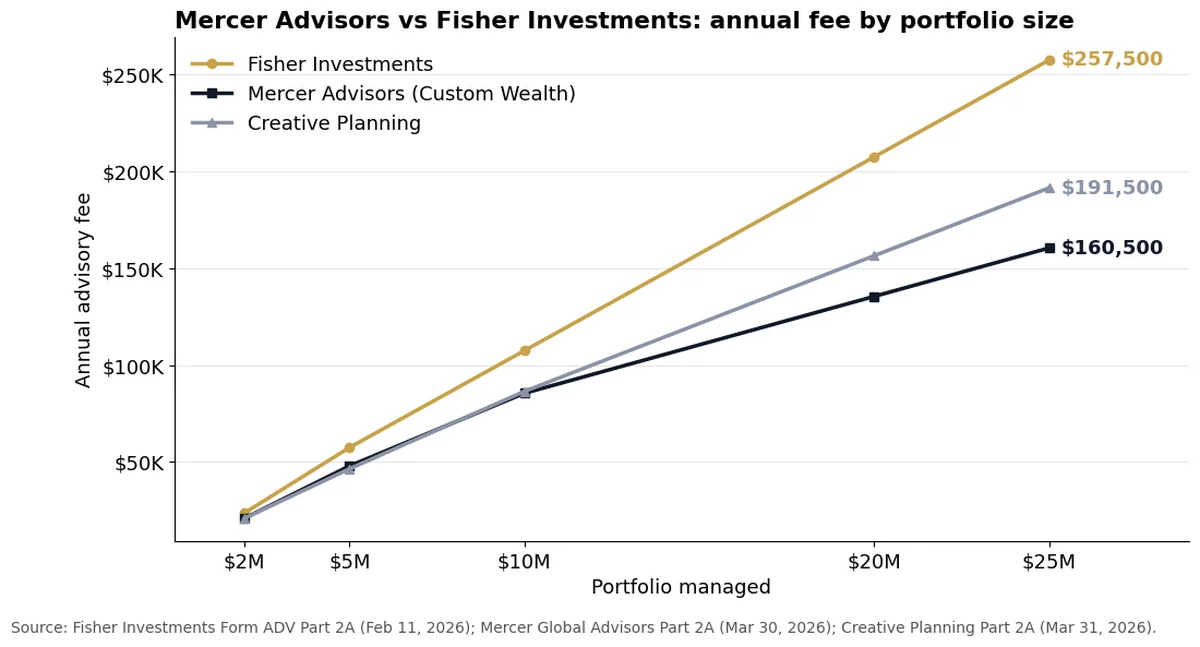
Fisher’s advantage is focus: its Part 2A describes one centralized portfolio management system and a Private Client Group that targets aggregated accounts of at least $1,000,000. Mercer’s advantage is breadth and price: its Ascend Group tier uses the same percentages as Custom Wealth with a $75,000 minimum fee, and its Regis family office tier starts above $25 million. A seller holding acquirer stock after a stock-for-stock deal should ask both firms for a written VPF or collar proposal and the fee on the hedged position.
Creative Planning vs Mercer Advisors for a family with $20 million
At $20 million, Mercer Advisors’ Custom Wealth schedule comes to $135,500 a year and Creative Planning’s to $156,500, a $21,000 difference driven by Mercer’s 0.50% rate above $10 million against Creative Planning’s 0.70% between $10 million and $25 million. Both run affiliated tax practices, and both disclose referral programs with Fidelity’s Wealth Advisor Solutions network in their 2026 brochures.
The gap closes as the balance grows past $25 million, where Creative Planning drops to 0.40% and Mercer’s Regis tier moves to individually negotiated fees with a $150,000 minimum. Creative Planning’s Part 2A also discloses that it recommends the TPG Private Markets Fund while a TPG subsidiary is a minority owner, a conflict worth raising if you want private equity exposure.
Which firms handle tax returns, estate documents and concentrated stock?
The year of a business sale is a tax year first, so the useful question is which firms prepare returns through an affiliate. Creative Planning, Mercer Advisors and Wealth Enhancement Group disclose affiliated tax entities; Mariner and CAPTRUST prepare returns for an added fee; Beacon Pointe says some offices do; Fisher uses outside firms. Each answer below comes from the firm’s 2026 Part 2A.
| Firm | Tax return preparation | Concentrated stock or private market tools disclosed | Source |
|---|---|---|---|
| Creative Planning | Affiliates Creative Planning Tax LLC and CP Strategic Advisors, LLC | Exchange fund risk disclosure; CAIS Private Equity Core III fund of funds | Part 2A, Items 8 and 10 |
| Mercer Advisors | Affiliate Mercer Advisors Tax Services, LLC | Estate documents via Advanced Services Law Group | Part 2A, Items 4 and 10 |
| Wealth Enhancement Group | Wealth Enhancement Tax & Consulting Services, LLC, a sister subsidiary | Separately managed account platform, with a disclosed 2% cap on WEAS’s own fee | Part 2A, Items 5 and 10 |
| Mariner | On request, fixed, hourly or up to 0.25% a year | Variable prepaid forwards (strategy fee of at least 0.30%), personalized equity portfolios | Part 2A, Items 4 and 5 |
| CAPTRUST | Hourly, as a family office or ancillary service | Tax return preparation listed among wealth services | Wealth Client Brochure, Items 4 and 5 |
| Beacon Pointe | Some offices provide tax preparation and accounting | OCIO and private fund services | Part 2A, Items 5 and 10 |
| Fisher Investments | Arrangements with outside tax preparers | Variable prepaid forwards and collars | Part 2A, Item 4 |
If part of your price came as rollover equity in the buyer’s new holding company, no wealth manager can sell that stake for you; it sits outside the managed account until the buyer’s next exit. Ask whether the firm will report it on your consolidated statement and bill on it, since some schedules bill on assets under advisement as well as assets under management.
How big is each firm’s typical client compared with your proceeds?
Form ADV Item 5.D reports how many high net worth clients a firm serves and the assets they hold. Dividing one by the other gives an average: $4.92 million at CAPTRUST, $4.70 million at Mariner and $1.43 million at Wealth Enhancement Group. A seller with $10 million would sit at about twice the average at the first two firms and seven times the average at the third.
| Firm | HNW clients (Item 5.D(b)) | HNW client RAUM | Average per HNW client | Advisory staff (Item 5.B(1)) | HNW clients per advisory employee |
|---|---|---|---|---|---|
| CAPTRUST | 18,154 | $89.4B | $4.92M | 885 | 20.5 |
| Mariner | 22,322 | $104.9B | $4.70M | 933 | 23.9 |
| Creative Planning | 39,511 | $164.4B | $4.16M | 1,538 | 25.7 |
| Mercer Advisors | 18,398 | $70.5B | $3.83M | 632 | 29.1 |
| Beacon Pointe | 11,482 | $43.0B | $3.75M | 440 | 26.1 |
| Fisher Investments | 125,844 | $283.0B | $2.25M | 1,948 | 64.6 |
| Wealth Enhancement Group | 27,424 | $39.3B | $1.43M | 850 | 32.3 |
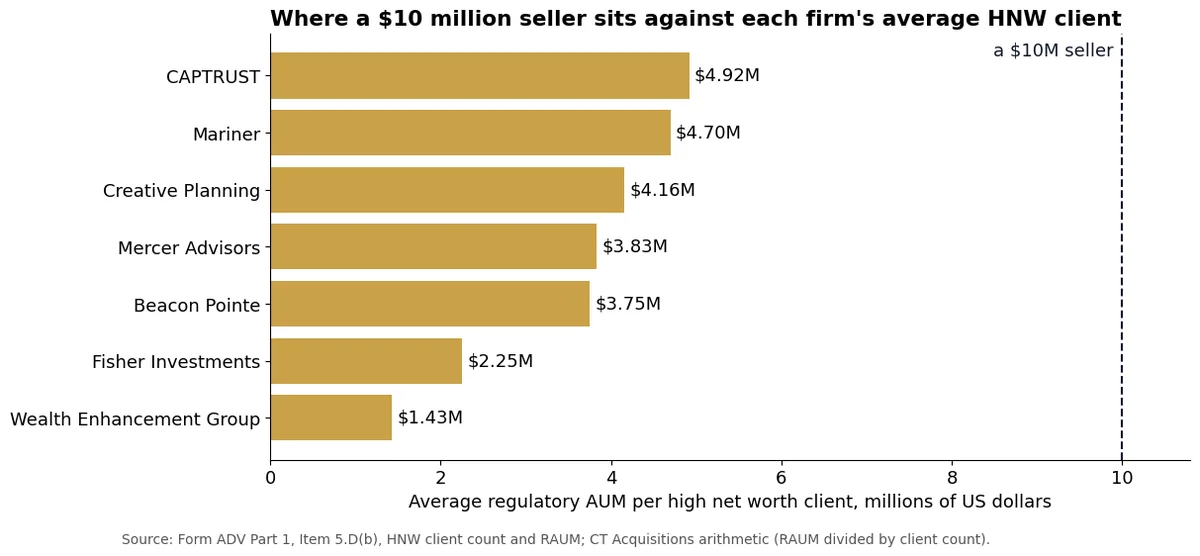
The last column is a rough proxy, not a service score: advisory staff in Item 5.B(1) includes researchers and institutional teams, and CAPTRUST’s 885 also serve retirement plans. Use it to frame a question rather than to rank: ask each firm how many households your named lead advisor covers today, and get the answer in the advisory agreement.
What should a business owner do with the proceeds in the first 90 days?
Park the cash, price the tax bill, then hire. The sale-year return can add the 3.8% net investment income tax above $250,000 of modified AGI for joint filers (IRS), and gifts above the $19,000 annual exclusion count against a $15,000,000 basic exclusion in 2026 (IRS). Interview two or three firms with their Form ADV in hand before moving any money.
A suggested sequence, not a rule; the week counts are illustrative:
- Week 1: hold proceeds in Treasury bills or an FDIC-insured sweep while you interview; no firm needs your money to quote a fee.
- Weeks 1 to 2: have your CPA estimate federal tax, the 3.8% NIIT on IRS thresholds ($250,000 joint, $200,000 single) and state tax, and set that amount aside before investing.
- Weeks 2 to 4: pull each candidate’s Part 2A and Part 1 from adviserinfo.sec.gov, then compute the fee on your balance from Item 5, as in the worked table above.
- Weeks 4 to 6: read Schedules A and B for owners and acquisition months, and Item 11 for disciplinary disclosures.
- Weeks 6 to 8: ask each firm who prepares the sale-year return, who drafts trusts under the 2026 $15,000,000 exclusion, and how many households your lead advisor serves.
- Weeks 8 to 12: sign one advisory agreement with the fee written as a schedule, not a blended estimate, and move assets in tranches.
The emotional side of the first months is covered in our guide to depression after selling a business, and the tax-deferral option for capital gains is covered in our guide to an opportunity zone fund after selling a business. For a planning playbook rather than a firm comparison, read our wealth management after a business sale guide.
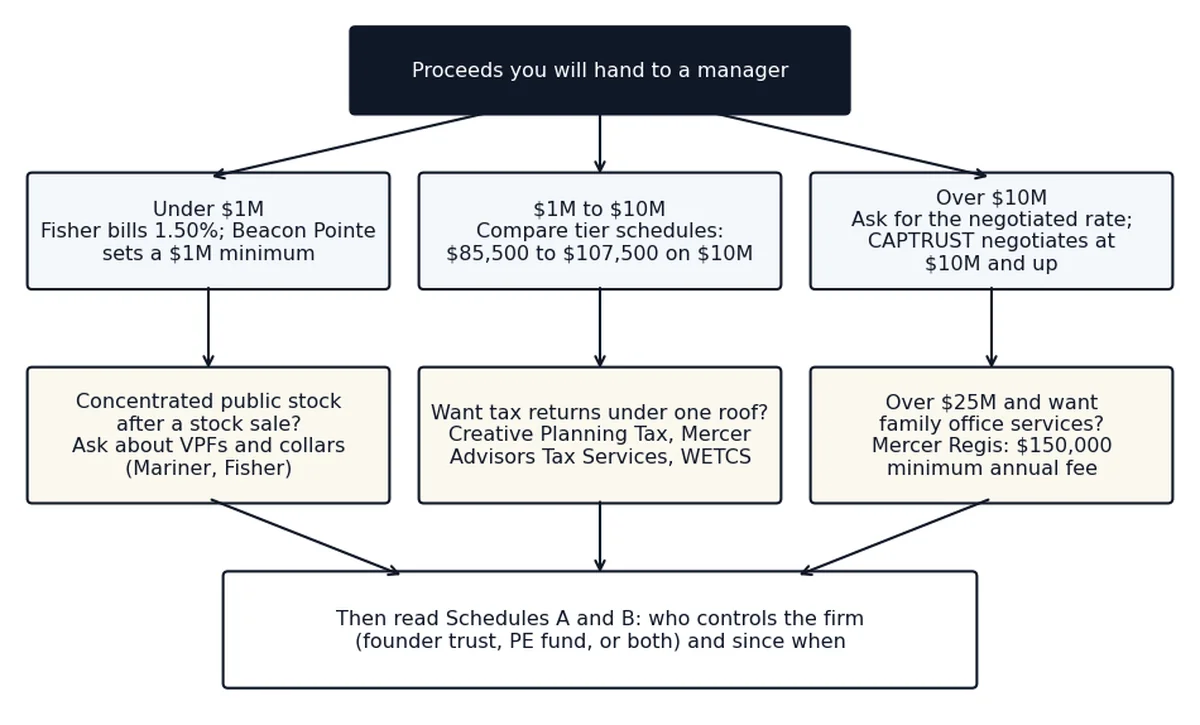
Which wealth manager fits your situation?
Start from the balance you will hand over, then from the one service you cannot do without. The decision table below applies each firm’s own 2026 Form ADV thresholds; it does not rank advice quality, which no filing measures. Where two firms meet a need, compare the fee on your exact balance from the worked table and the ownership chain from Schedule B.
| If your situation is | Then | Threshold source |
|---|---|---|
| If you will invest under $1 million | Expect 1.50% at Fisher and at Wealth Enhancement Group’s sample rate; Beacon Pointe’s account minimum is $1 million; Creative Planning takes new clients from $200,000 | Part 2A, Items 5 and 7 |
| If you will invest $1 million to $10 million | Compare tier schedules: $85,500 to $107,500 on $10 million at published rates; CAPTRUST’s schedule covers balances under $10 million at funding | Part 2A, Item 5 |
| If you will invest over $10 million | Ask for a negotiated schedule in writing; CAPTRUST negotiates from $10 million, Mercer bills 0.50% and Mariner 0.60% above $10 million | Part 2A, Item 5 |
| If you hold concentrated public stock after a stock sale | Ask Mariner and Fisher for a variable prepaid forward or collar proposal; ask Creative Planning about exchange funds | Part 2A, Items 4 and 8 |
| If you want the sale-year return prepared under one roof | Short-list Creative Planning, Mercer Advisors and Wealth Enhancement Group, which disclose affiliated tax entities | Part 2A, Item 10 |
| If you want trust documents drafted without a separate legal bill | Ask Mercer about the Advanced Services Law Group foundational plan offered to most clients over $1.5 million | Mercer Part 2A, Item 5 |
| If you have over $25 million and want family office services | Ask about Mercer’s Regis tier ($150,000 minimum fee) and Creative Planning’s 0.40% to 0.25% upper tiers | Part 2A, Item 5 |
| If a change of control would make you leave | Choose with Schedule B dates in view: Leonard Green since Apr 2021, KKR since Nov 2021, Altas since Aug 2023, Advent since Jan 2025 | Form ADV Schedules A and B |
Before you sign the LOI
Still selling? Your deal structure decides what a wealth manager can do later.
Cash at close, rollover equity, an earnout and a seller note each land differently in a portfolio and on the sale-year return. We work for owners on the sell side. Our fee is success only: nothing upfront, and you pay nothing unless the business sells.
Curious what your business is worth?
A 15-minute confidential call gives you a real valuation range and tells you which buyers would compete for your business. No cost, no obligation, no pressure to sell.
How we compiled this
We pulled the latest Form ADV Part 1 and the current Part 2A brochure for each of the seven firms from the SEC’s Investment Adviser Public Disclosure site in November 2026, 14 primary documents in all, plus two IRS pages for tax thresholds. Fees in the worked table are our arithmetic on each firm’s published standard schedule. We excluded advisor rankings, award lists, client reviews and forum posts, and we did not survey clients or test any firm’s service. CT Acquisitions is a sell-side M&A advisor, not a wealth manager, and is not affiliated with any firm on this page.
Frequently asked questions
Which is better after a business sale, Mercer Advisors or Fisher Investments?
Mercer Advisors is cheaper at every balance we priced and bundles more planning: its Custom Wealth schedule charges $85,500 a year on $10 million against $107,500 at Fisher Investments, per each firm’s 2026 Form ADV Part 2A. Fisher fits an owner who wants one equity or blended mandate and tools such as variable prepaid forwards; Mercer fits one who wants tax returns and estate documents through affiliates.
What is the typical fee for a wealth management advisor?
Among the seven firms here, the rate on the first dollars runs from 1.10% (Mercer Custom Wealth) to 1.50% (Wealth Enhancement Group’s sample rate under $1 million) and falls to 0.25% to 1.00% on large balances, per each firm’s 2026 Form ADV Part 2A. On $10 million, the published schedules work out to 0.855% to 1.075% a year before any negotiated discount.
What is the real difference between Creative Planning and Mercer Advisors for a family with about $20 million?
On $20 million, Mercer Advisors’ Custom Wealth schedule comes to $135,500 a year and Creative Planning’s to $156,500, a $21,000 gap, per their 2026 Form ADV Part 2A filings. Both run affiliated tax practices. Ownership differs: a trust of CEO Peter Mallouk holds 50% to 75% of a Creative Planning holding company, while Altas Partners funds hold 25% to 50% of Mercer’s parent chain.
When should you change financial advisors after selling a business?
Move when the numbers or the ownership change: your fee is above the firm’s own published schedule for your balance, Schedule A or B shows a new controlling owner after you signed, or the advisor cannot model the 3.8% net investment income tax on your sale year. Ask for the fee calculation in writing first, since all seven brochures here say fees are negotiable.
Who advises business owners on post-exit wealth management?
Usually three people: a registered investment adviser for the portfolio, a CPA for the sale-year return, and an estate attorney for trusts and gifts under the 2026 basic exclusion of $15,000,000 per person (IRS). Some firms here bundle two of the three through affiliates, such as Mercer Advisors Tax Services. CT Acquisitions is a sell-side M&A advisor, not a wealth manager, and is not affiliated with any firm listed.
What are the best wealth management firms for $10M+ individuals?
No filing ranks quality, so start with fit: at $10 million you would be about twice the average high net worth client at CAPTRUST ($4.92 million) and Mariner ($4.70 million), and about seven times the average at Wealth Enhancement Group ($1.43 million), based on Form ADV Item 5.D. Then compare the fee on your balance, the in-house tax bench and who owns the firm.
Sources
- Fisher Asset Management, LLC: Form ADV Part 1 (filed Oct 7, 2026) and Part 2A Private Client (Feb 11, 2026). Accessed November 13, 2026.
- Creative Planning, LLC: Form ADV Part 1 (filed Jul 10, 2026) and Part 2A (Mar 31, 2026). Accessed November 13, 2026.
- Mercer Global Advisors Inc.: Form ADV Part 1 (filed Sep 17, 2026) and Part 2A (Mar 30, 2026). Accessed November 13, 2026.
- Mariner, LLC: Form ADV Part 1 (filed Oct 2, 2026) and Part 2A (Jul 17, 2026). Accessed November 13, 2026.
- CapFinancial Partners, LLC (CAPTRUST): Form ADV Part 1 (filed Oct 29, 2026) and Wealth Client Brochure (Mar 27, 2026). Accessed November 13, 2026.
- Wealth Enhancement Advisory Services, LLC: Form ADV Part 1 (filed Nov 9, 2026) and Part 2A (Mar 2026). Accessed November 13, 2026.
- Beacon Pointe Advisors, LLC: Form ADV Part 1 (filed Aug 31, 2026) and Part 2A (Mar 31, 2026). Accessed November 13, 2026.
- IRS, Net Investment Income Tax (page updated Jul 1, 2026) and What’s new: estate and gift tax (updated Nov 3, 2026). Accessed November 13, 2026.
The five pillars of how CT Acquisitions works
We represent owners: confidential sale, recapitalization and exit planning.
Success fee only, nothing upfront.
Search funders, family offices, lower-middle-market PE, strategics.
Introductions to the right buyers only. No public listing.
You see exactly how we are paid before any work starts.

About the Author
Christoph Totter is the founder of CT Acquisitions, an M&A advisory firm that helps owners make the most of their exit, headquartered in Sheridan, Wyoming. We work with a network of 500+ buyers, including family offices, lower middle-market PE and strategic consolidators. We work for owners on the sell side. Our fee is success only: nothing upfront, and you pay nothing unless the business sells. Connect on LinkedIn · Get in touch