Sell Your HVAC Business in Illinois, 76+ Active PE Buyers, $0 Seller Fees
Quick Answer
Illinois HVAC businesses attract 76+ active PE buyers, with 16 having explicit Illinois mandates, because Chicago’s large population (9M in metro area), aging housing stock, and year-round heating-cooling demand create strong consolidation targets. Sellers pay zero fees in a buyer-paid model, though valuations typically range 4x to 6x SDE depending on customer concentration, licensing complexity across Illinois municipalities, and working capital intensity. Key diligence items include municipal-level HVAC licenses (Illinois has no statewide license), plumber license overlap under IDPH rules, and suburban Chicago commercial customer concentration, all of which affect buyer pricing and deal certainty.
Thinking about selling your HVAC business in Illinois?
A 15-minute confidential call gives you a real valuation range and the Illinois buyers most likely to compete for your business. No cost, no obligation.
Christoph Totter · Managing Partner, CT Acquisitions
20+ home services M&A transactions across HVAC, plumbing, pest control, roofing · Updated May 7, 2026
Selling an HVAC business in Illinois in 2026 is one of the most active Midwest exit windows available right now. The Chicago metropolitan area is the third-largest MSA in the United States with approximately 9 million residents (U.S. Census Bureau, 2025), Illinois carries one of the most demanding combined heating-and-cooling load profiles in the country, the housing stock is aging (median Chicago single-family home built before 1960), and PE consolidators have been active in the state for the better part of three years. Reedy Industries (rebranded PremiStar), backed by Partners Group and headquartered in Schaumburg, has emerged as one of the most acquisitive commercial HVAC platforms in the Midwest. Sila Services (Goldman Sachs Alternatives) and Wrench Group (Leonard Green) have made multiple residential tuck-ins in Chicago’s northern and northwestern suburbs.
But Illinois has unique state-specific dynamics that owners outside the state often miss. There is no statewide HVAC contractor license, HVAC is regulated municipality-by-municipality across Illinois. Chicago has its own licensing regime, Cook County has another, and Aurora, Joliet, Naperville, Rockford, and dozens of other municipalities each maintain their own bonded-contractor registries. Buyers diligence which licenses your entity holds today and which require a new qualifying individual to transfer. The Illinois Department of Public Health (IDPH) handles plumbing licensing statewide, so any HVAC business performing meaningful plumbing-adjacent work (gas piping, hydronic systems, condensate drains tied into sanitary plumbing) needs to consider plumber license overlap. Customer concentration in suburban Chicago commercial work, brutal winter working-capital cycles, and high property tax exposure on real-estate-owning entities all matter for valuation.
The framework draws on direct work with 76+ active U.S. lower middle market buyers, including 16 with explicit Illinois HVAC mandates. Reedy Industries / PremiStar (Partners Group), Sila Services (Goldman Sachs Alternatives), Wrench Group (Leonard Green), Apex Service Partners (Alpine Investors), Service Logic (Bain Capital + Mubadala), Wind Point Partners, Granite Comfort, and Champions Group (Blackstone) have all closed Illinois HVAC deals in the past 24 months. Public consolidator Comfort Systems USA (NYSE: FIX) maintains Illinois commercial mechanical exposure. Watsco (NYSE: WSO) operates Illinois distribution. We’re a buy-side partner. The buyers pay us when a deal closes, not you. If you want a 90-second valuation range before reading further, our free business valuation calculator produces a starting-point estimate based on your EBITDA, recurring revenue mix, and residential-vs-commercial split.
One reality check before you start. Illinois HVAC owners who exit at the top of the multiple range almost always started preparing 18-24 months ahead, clean monthly closes, tracked maintenance-agreement attach rate, identified replacement qualifying individuals for every active municipal license, and resolved any open consumer complaints with the Illinois Attorney General’s Consumer Protection Division. Owners who go to market reactively, with a single qualifying individual who is also the seller and 6 months of clean books, routinely receive offers 1-1.5x EBITDA below the realistic Illinois range. Read the prep section carefully, that’s where most of the value gets created or lost.
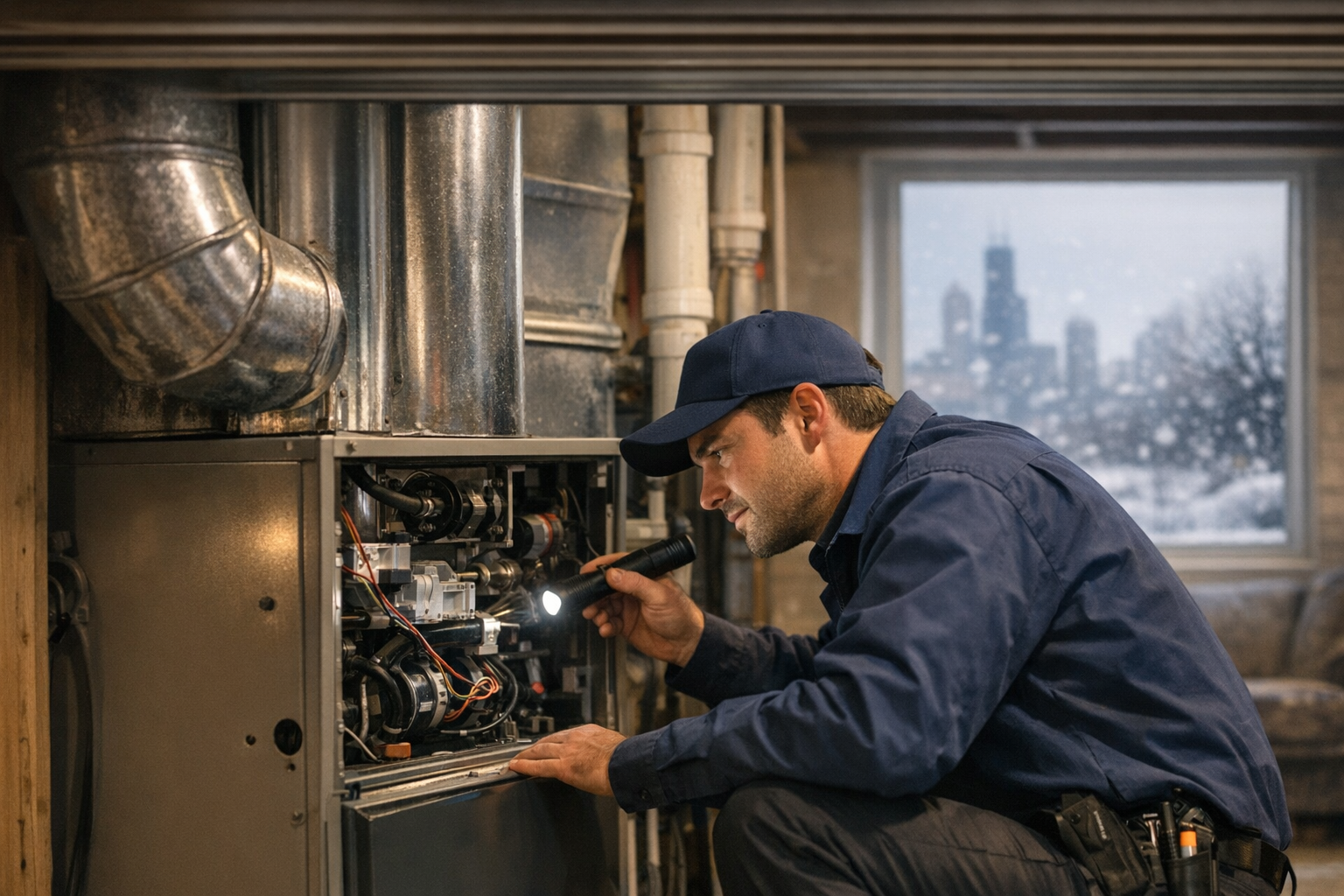
“Illinois is a top-five Midwest state for HVAC PE consolidator activity in 2026, the Chicago MSA’s 9M residents, dual heating-and-cooling load, and aging housing stock create the kind of replacement-cycle revenue that PE platforms underwrite at premium multiples. Owners who clean up their municipal licensing, lock in a strong residential MSA base, and prep their financials with a CPA-prepared package routinely close at 5.5-7x EBITDA. We’re a buy-side partner, the buyers pay us, no contract required.”
TL;DR, the 90-second brief
- Illinois HVAC businesses sell for 4-7x EBITDA in 2026. Chicago-metro residential operators with $1M-$3M EBITDA, 25%+ recurring maintenance revenue, and clean municipal licensing trade at 5.5-7x. Sub-$1M EBITDA shops without dispatch software or transferable municipal licenses trade at 3.5-5x.
- The Chicago MSA is one of the most active HVAC roll-up markets in the Midwest. Greater Chicago is home to 9M+ residents (U.S. Census Bureau, 2025), running both heavy winter heating load (sub-zero January temperatures crush furnace life cycles) and meaningful summer cooling demand. Reedy Industries / PremiStar (Partners Group), Sila Services (Goldman Sachs Alternatives), Wrench Group (Leonard Green), Wind Point Partners, and Granite Comfort have collectively closed 10+ disclosed Illinois HVAC acquisitions in 2024-2026.
- Illinois has no statewide HVAC contractor license, municipal licensing is the gating item. HVAC contracting in Illinois is regulated at the city and county level. Chicago, Aurora, Joliet, Naperville, Rockford, and Cook County each issue their own contractor licenses with separate examinations, bonds, and fees. Plumbing-related work intersects with the Illinois Department of Public Health (IDPH) statewide plumber license. Buyers diligence which municipal licenses your business holds and which transfer with the entity (most do) versus which require a new qualifying individual.
- Illinois’ flat 4.95% state income tax is middle-of-the-pack but predictable. Illinois taxes long-term capital gains as ordinary income at the flat 4.95% state rate (Illinois Department of Revenue). Combined with federal LTCG, the effective top combined rate is approximately 28.75-28.85%. Higher than Tennessee, Texas, or Florida (no state income tax) but materially lower than California or New York. On a $5M HVAC sale, that’s $100-200K of after-tax preservation versus a high-tax state seller.
- Of our 76+ active U.S. lower middle market buyers, 16 are actively bidding on HVAC businesses in Illinois right now. We’re a buy-side partner working with PE platforms (Apex Service Partners, Wrench Group, Sila Services, Service Logic, Reedy Industries / PremiStar, Champions Group), public consolidators (Comfort Systems USA, Watsco affiliates), and family offices with active Chicago-metro buy-boxes. The buyers pay us, not you. No retainer. No contract required.
Key Takeaways
- Illinois HVAC businesses with $1M-$5M EBITDA sell for 4-7x in 2026, with Chicago-metro residential operators commanding the top of the band.
- Illinois has no statewide HVAC license, municipal licensing in Chicago, Cook County, and dozens of suburbs is the #1 Illinois-specific deal-mechanics issue.
- Illinois’ flat 4.95% state income tax preserves $100-200K more after-tax proceeds on a typical $5M sale versus high-tax-state sellers.
- Maintenance-agreement (MSA) recurring revenue above 25% of total revenue lifts your Illinois multiple by 0.5-1.0x EBITDA, PE buyers underwrite Chicago-area MSAs as some of the most predictable cash flow in HVAC.
- Use our free business valuation calculator for a 90-second starting-point Illinois HVAC valuation range based on your EBITDA and revenue mix.
- Active 2026 Illinois HVAC buyers include Reedy Industries / PremiStar, Sila Services, Wrench Group, Apex Service Partners, Service Logic, Wind Point Partners, Granite Comfort, Champions Group, Comfort Systems USA (FIX), and 12+ family offices with explicit Chicago-metro mandates.
The Illinois HVAC market in 2026
Illinois HVAC is structurally a top-five Midwest market, anchored by the Chicago MSA, and PE consolidators have been writing checks here aggressively since 2022. The Chicago metropolitan statistical area is home to approximately 9 million residents across Cook, DuPage, Lake, Will, Kane, McHenry, and surrounding counties (U.S. Census Bureau, 2025). Greater Chicago has the third-largest installed HVAC base in the country behind only New York and Los Angeles. Illinois’ combined heating-and-cooling load, sub-zero January temperatures and 90°F+ summer humidity, means residential customers run their HVAC equipment harder than in most milder-climate states, accelerating replacement cycles.
Chicago has the oldest housing stock of any major U.S. metro. Approximately 60% of Chicago single-family homes were built before 1960, with significant portions of Cook County and the inner-ring suburbs (Oak Park, Berwyn, Cicero, Evanston, Skokie) carrying pre-WWII construction. That housing stock requires retrofit furnace replacements, ductwork modifications, and AC additions on tight Chicago lot lines. Residential HVAC replacement and retrofit are the dominant revenue stream for the typical Chicago-area operator. The aging housing base creates structural demand that buyers underwrite favorably.
The residential-versus-commercial split in Illinois favors residential consolidators in the Chicago suburbs and commercial mechanical specialists downtown. Suburban Chicago HVAC revenue mix is approximately 65-75% residential, 25-35% light commercial. Downtown Chicago and the West Loop / River North commercial mechanical scene is dominated by larger union shops with significant project work, hospital and high-rise mechanical, and prevailing-wage exposure. PE consolidators almost universally prefer the suburban residential-and-light-commercial profile (25%+ MSA penetration, owner-operator-stepping-out structure) over the union commercial mechanical profile (lumpy project work, prevailing-wage compliance overhead, project-management bench depth required).
Recent Illinois HVAC M&A activity tells the story. Reedy Industries / PremiStar, headquartered in Schaumburg and backed by Partners Group, has built a 1,500+ employee commercial mechanical platform across 10 states with multiple Chicago-area tuck-ins (Mercury Mechanical of Northlake, Johansen & Anderson of Joliet). Sila Services (Goldman Sachs Alternatives) has acquired residential operators in the northern suburbs (Park Ridge Unique Indoor Comfort of Northbrook). Granite Comfort has acquired Green Air Care of Buffalo Grove. Wind Point Partners (Chicago-based PE) launched Zone Climate Services through the acquisition of Zone Mechanical, focused on commercial refrigeration and HVAC. The activity is transparent in regional trade press and PrivSource transaction data.
What this means for your timing. Illinois is a seller’s market for HVAC businesses with $1M-$5M EBITDA, 25%+ recurring revenue, and clean municipal-licensing standing across whichever municipalities you operate in. Buyers are competitive on price for assets that fit the residential-replacement playbook in the Chicago MSA, and the typical suburban Chicago deal closes at 5.5-7x EBITDA when prep is complete. The sub-$1M EBITDA tier is more measured but still actively bid by family offices and individual SBA buyers, with multiples in the 3.5-5x range. Downstate Illinois (Springfield, Peoria, Rockford, Bloomington-Normal) trades at slightly lower multiples than Chicago-metro because of thinner buyer-pool depth.
What HVAC businesses are worth in Illinois (multiples and ranges)
Illinois HVAC valuations follow national HVAC multiple bands but with Chicago-metro premiums and downstate discounts that move the actual number 0.5-1.0x EBITDA in either direction. The starting point is the national HVAC range of 4-7x EBITDA for $1M-$10M EBITDA businesses, but the Illinois-specific adjustments matter. A residential Naperville operator with $2M EBITDA and 30% MSA penetration trades closer to 6.5x than to 5x. A downstate Peoria commercial operator with single-customer concentration above 30% trades closer to 4x than 5.5x. The framework below is what buyers actually price in Illinois.
Sub-$500K SDE: 2.5-4x SDE. Owner-operator residential shops, often single-truck or two-truck, with the seller as the lead technician and primary qualifying individual on multiple municipal licenses. Buyer pool: individual SBA buyers, occasionally a local consolidator. Chicago-metro versions of this tier still trade better than downstate Illinois because of buyer-pool depth. Multiples push toward 4x when the seller has a clean transition plan for municipal licensing and a documented customer list with credit-card-on-file MSAs; multiples compress to 2.5x when the seller is the only qualifying individual and is performing all the technical work.
$500K-$1.5M EBITDA: 3.5-5.5x EBITDA. Established residential and light commercial operators, 6-15 trucks, dispatch software in place, named operations manager, 15-25% MSA penetration. Buyer pool: family offices, smaller PE platforms, search funders, regional consolidators. This tier is where Illinois’ 4.95% flat state tax starts to matter materially, on a $4M sale, the Illinois seller keeps roughly $80-150K more after-tax than a California seller of the same business, though $100-150K less than a Florida or Texas seller.
$1.5M-$5M EBITDA: 5-7x EBITDA. The PE platform sweet spot. 15-50 trucks, full dispatch and CRM integration, GM or COO in place, 25-35% MSA penetration, residential-heavy revenue mix. Buyer pool: Reedy Industries / PremiStar, Sila Services, Wrench Group, Apex Service Partners, Service Logic, Champions Group, Wind Point Partners, regional family offices. Suburban Chicago operators in this tier with clean books and clean municipal licensing routinely receive 6-7x EBITDA LOIs in 2026.
$5M+ EBITDA: 6.5-9x EBITDA. Platform-quality businesses. 50+ trucks, multi-location, professional management team independent of seller, 30%+ MSA, residential-and-light-commercial mix with route density. Buyer pool: large PE platforms competing aggressively, public consolidators (Comfort Systems USA for commercial-heavy operators, Watsco distribution-side strategics), family offices with mandate scale. Chicago-metro businesses at this scale are limited in supply, we count fewer than 30 in the entire MSA, and competitive bid dynamics regularly push final multiples 0.5-1.0x above the national range.
What moves the multiple within the band. Recurring MSA revenue percentage (each 5 percentage points above 20% adds roughly 0.25-0.5x). Residential mix percentage (PE platforms pay premium for 70%+ residential). Customer concentration (any single customer above 15% costs 0.25-0.5x). Owner dependency (true GM/COO in place adds 0.5-1.0x). Route density in a single MSA (concentrated Chicago-metro routes worth more than scattered statewide). Refrigerant inventory and tech training on R-32/A2L systems (current vs lagging adds 0.25x in 2026). Union-versus-non-union labor structure (PE buyers generally prefer non-union for residential, accept union for commercial mechanical specialty platforms).
Active PE buyers and consolidators acquiring HVAC businesses in Illinois
The Illinois HVAC buyer pool in 2026 is dense, sophisticated, and actively writing checks. Below is the named landscape we work with directly. Each of these buyers has either disclosed Illinois acquisitions in the past 24 months, maintains an active Illinois platform, or has explicit Illinois buy-box criteria currently open. This is not theoretical, it’s the actual table of who pays what for HVAC businesses in this state.
Reedy Industries / PremiStar (Partners Group). Headquartered in Schaumburg, Illinois, an Illinois-anchored platform with a uniquely deep advantage in Chicago-metro tuck-ins. PremiStar has acquired Mercury Mechanical (Northlake), Johansen & Anderson (Joliet), and multiple other Chicagoland HVAC contractors. Buy-box: $1M-$15M EBITDA, commercial mechanical preferred, residential considered, recurring service contracts heavily valued. Pays at the top of market for the right Chicago-area asset because route density compounds with their existing footprint. Typical close timeline post-LOI: 75-105 days.
Sila Services (Goldman Sachs Alternatives). Multi-region home services platform with active Northeast and Midwest expansion. Has acquired Park Ridge Unique Indoor Comfort (Northbrook) and other Chicago-area residential HVAC operators. Buy-box: $1.5M-$15M EBITDA, residential and light commercial, route density valued highly. Pays competitively and provides rollover equity options that appeal to sellers wanting continued upside. Sila was acquired by Goldman Sachs Alternatives in 2024, giving the platform additional balance-sheet capacity for larger Illinois platform deals.
Wrench Group (Leonard Green & Partners). National portfolio of high-quality residential HVAC brands, including Williams Comfort Air which has emerged as the Wrench Midwest platform. Wrench has been acquiring Midwest tuck-ins. Buy-box: $1M-$8M EBITDA, residential preferred, strong technician retention metrics, MSA penetration as a proxy for quality. Wrench typically pays mid-to-high end of the multiple range and retains brand identity post-close, which appeals to founders who don’t want their brand collapsed.
Apex Service Partners (Alpine Investors). One of the most aggressive HVAC consolidators in the U.S. Apex has built a national platform of 50+ HVAC, plumbing, and electrical brands. Active in Illinois through tuck-in strategy. Buy-box: $1M-$10M EBITDA, residential-heavy, 20%+ MSA, multi-truck operations. Pays at the top of market for the right asset. Typical close timeline post-LOI: 75-105 days.
Service Logic (Bain Capital + Mubadala) and Champions Group (Blackstone). Service Logic is a commercial-mechanical-focused consolidator. Likely to pursue Illinois commercial HVAC operators with hospital, data center, or institutional account exposure (Chicago’s strong healthcare and higher-education base creates target pool). Champions Group is Blackstone-backed and acquires home services platforms with strong residential MSA bases. Both pay at the high end for genuine fits.
Wind Point Partners and Granite Comfort. Wind Point Partners is a Chicago-based PE firm that launched Zone Climate Services through the acquisition of Zone Mechanical, with Illinois geographic emphasis. Granite Comfort has acquired Green Air Care (Buffalo Grove) as part of Chicagoland expansion. Both are active Illinois-focused buyers, pay 5-7x EBITDA range for residential and light commercial Illinois targets, and offer continuity-of-brand structures that appeal to sellers.
Comfort Systems USA (NYSE: FIX). Public mechanical contractor consolidator. Trades on enterprise-value-to-EBITDA multiples of 15-20x at the public level (10-K data, FY2024-2025), which gives them currency to pay 7-10x EBITDA for high-quality commercial mechanical platforms. Active in Illinois commercial. Best fit for operators with $5M+ EBITDA, commercial-dominant revenue, hospital or data center exposure, and strong project-management bench.
Family offices and search funders with Illinois mandates. We track 12+ family offices and 8+ search funders with explicit Illinois HVAC buy-boxes in the $500K-$3M EBITDA range. Family offices typically offer slower close timelines but better cultural fit and longer hold periods (15-25 years vs PE’s 5-7). Search funders typically need SBA financing, cap purchase prices around $5M total enterprise value, and offer the seller meaningful rollover equity in a single-asset entity. Chicago-metro family-office demand is meaningfully deeper than downstate Illinois.
Selling an HVAC business in Illinois? Talk to a buy-side partner who knows the buyers.
We’re a buy-side partner working with 76+ active buyers… the buyers pay us, not you, no contract required. Of those 76+, 16 are actively bidding on HVAC businesses in Illinois right now, including Reedy Industries / PremiStar (Schaumburg-based, Partners Group-backed), Sila Services, Wrench Group, Apex Service Partners, Service Logic, Wind Point Partners, Granite Comfort, Champions Group, Comfort Systems USA-aligned strategics, family offices, and search funders with explicit Chicago-metro mandates. A 15-minute call gets you three things: a real read on what your Illinois HVAC business is worth in today’s market, a sense of which buyer types fit your business, and the option to meet one of them. If none of it is useful, you’ve lost 15 minutes.
Book a 15-Min Call| Business size | SBA buyer | Search funder | Family office | LMM PE | Strategic |
|---|---|---|---|---|---|
| Under $250K SDE | Yes | No | No | No | Rare |
| $250K-$750K SDE | Yes | Some | No | No | Add-on |
| $750K-$1.5M SDE | Some | Yes | Some | Add-on | Yes |
| $1.5M-$3M EBITDA | No | Yes | Yes | Yes | Yes |
| $3M-$10M EBITDA | No | Some | Yes | Yes | Yes |
| $10M+ EBITDA | No | No | Yes | Yes | Yes |
Illinois-specific HVAC licensing and municipal regulatory transfer
Illinois does not have a statewide HVAC contractor license, HVAC contracting is regulated municipality-by-municipality, and that fragmentation is the single biggest Illinois-specific deal-mechanics issue. Chicago, Aurora, Naperville, Joliet, Rockford, Cook County, DuPage County, Lake County, and dozens of other municipalities each maintain their own contractor licensing schemes. Each typically requires a qualifying individual with a passing trade exam, a bond (often $10K-$50K), and a license fee. The contracting entity registers separately. When the entity is sold, the question becomes: does the existing license transfer with the entity, or does the buyer need to produce a new qualifying individual? The answer varies by municipality, and most buyers don’t learn this until diligence.
City of Chicago licensing. Chicago issues general contractor and specialty licenses through the Department of Buildings. HVAC work in Chicago typically requires a Refrigeration Contractor license (for refrigeration and AC work) and may require additional Mechanical Contractor or General Contractor licensing depending on scope. The qualifying party (called the “qualifier”) must pass a city exam and meet experience requirements. License does not automatically transfer in an asset sale, the buyer must produce a qualifier and re-register. License transfer in a stock sale is generally smoother but still requires notification.
Cook County and suburban municipalities. Cook County issues separate contractor licensing for unincorporated Cook County. Suburban municipalities (Aurora, Joliet, Naperville, Schaumburg, Oak Park, Evanston, etc.) each issue their own. An HVAC business operating across 15-20 suburbs typically holds 15-20 separate municipal licenses. Buyers diligence the full registry. Multi-license operators with clear documentation of every active license, every qualifying individual, every bond, and every renewal date close 30-60 days faster than operators with disorganized records.
Illinois Department of Public Health (IDPH) plumbing license overlap. Plumbing in Illinois is licensed at the state level by IDPH. HVAC work that touches gas piping, hydronic systems, condensate drains tied into sanitary plumbing, or water heaters can require a state-licensed plumber on staff or a plumbing contractor partnership. Buyers diligence whether your scope of work has crossed plumbing-license boundaries and whether IDPH compliance is current. Plumbing exposure unaddressed in diligence creates re-pricing risk.
The license-transfer timeline mechanics. Day 0: LOI signed. Day 7-14: buyer audits municipal license inventory across all jurisdictions and identifies qualifying-individual succession (existing employee, new hire, or transition arrangement with seller). Day 14-45: candidate sits for any required municipal exams (Chicago Department of Buildings exam, suburban municipal exams). Day 45-90: each municipality processes license modification, new bonds filed where required. Day 60-120: all licenses officially transferred. Most Illinois HVAC deals build a 60-120 day transition services agreement to bridge the multi-jurisdiction transfer process.
Common license-transfer pitfalls in Illinois. Seller is the only qualifying individual on 15 municipal licenses AND plans to fully exit at close (no transition agreement), deals stall across multiple jurisdictions simultaneously. Seller has unrenewed licenses in active jurisdictions (lapsed Cook County registration, expired Aurora bond) that surface in diligence. Buyer’s designated replacement has insufficient documented experience for Chicago Refrigeration Contractor license. Plumbing-overlap scope (gas piping work) performed without a state IDPH plumbing license, surfaces in diligence and creates re-pricing or compliance-remediation cost. The fix in every case is early identification, 12+ months pre-sale, with a clear municipal-by-municipal transition plan.
EPA Section 608 certifications transfer with technicians. Federal EPA Section 608 refrigerant handling certifications stay with the individual technician, not the company. Buyers diligence the percentage of your tech bench with current Type II / Type III / Universal certs. A bench with 90%+ universal certs adds value; a bench with 40%+ uncertified or expired certs creates remediation cost and reduces multiple. Document your tech bench’s certs in the data room.
Illinois tax implications for HVAC business sale
Illinois’ flat 4.95% state income tax is middle-of-the-pack nationally, and that has measurable but moderate impact on HVAC seller after-tax outcomes. The Illinois state income tax is a flat 4.95% on long-term capital gains (Illinois Department of Revenue). Combined with federal long-term capital gains (15-23.8% depending on bracket), an Illinois HVAC seller’s effective top federal-and-state rate on goodwill gain is approximately 28.75-28.85%. Compare to California (federal + 13.3% state = 37.1% combined), New York (federal + 10.9% = 34.7%), or no-income-tax states like Texas, Florida, and Tennessee (federal-only ~24%).
The dollar impact on a typical Illinois HVAC sale. On a $5M Illinois HVAC sale with $4M of the purchase price allocated to goodwill (the typical asset-deal structure), the Illinois seller pays approximately $1.15M in combined federal-and-state long-term capital gains tax. A California seller of the same business pays approximately $1.48M (Illinois saves $330K). A Texas seller pays approximately $0.95M (Texas saves $200K vs Illinois). Illinois is a moderate-tax state, not the cheapest, not the most expensive.
Asset allocation in an Illinois HVAC deal. Most Illinois HVAC deals structure as asset sales for buyer-side liability and depreciation reasons. The IRS Form 8594 allocation typically splits: $50-300K to vehicle fleet and equipment (Class IV/V, ordinary income recapture), $20-100K to inventory (Class III, ordinary income), $20-50K to non-compete (Class VI, ordinary income to seller), and the remainder to goodwill and customer relationships (Class VI/VII, capital gains). Working with a tax attorney to push allocation toward goodwill (where you pay 28.85% combined) versus equipment (where you pay your ordinary rate of up to 41.95% in Illinois) typically saves 5-12% of total tax.
Illinois Replacement Tax and entity-level considerations. Illinois imposes a Personal Property Replacement Tax (commonly 1.5% on partnerships and S-corps, 2.5% on C-corps) in addition to individual income tax. This sits on top of the 4.95% individual rate when income flows through. For HVAC sellers structured as S-corps (the most common structure), the effective Illinois state-level tax on flow-through income is 4.95% + 1.5% = 6.45% combined Illinois rate. C-corp sellers face entity-level Illinois corporate tax (9.5% combined including Replacement Tax) plus shareholder-level distribution tax, the classic double-taxation problem. Asset-sale structuring matters.
Illinois property tax considerations. Illinois has the second-highest property tax burden in the United States (Tax Foundation, 2025). HVAC business real estate (truck yard, office, warehouse) held in a separate LLC faces meaningful annual property tax cost, effective rates of 2.0-2.5% in many Cook County and collar-county jurisdictions, sometimes higher. Sellers retaining real estate at sale should model property tax cost in their hold-vs-sell decision. Many Illinois HVAC sellers choose to sell the real estate alongside the business or 1031-exchange into a lower-tax-jurisdiction property to escape ongoing burden.
Illinois residency considerations for sellers planning relocation. Some Illinois HVAC sellers consider relocating to Florida, Tennessee, or Texas (no state income tax) pre-sale to avoid the 4.95% Illinois state rate. Illinois Department of Revenue scrutinizes residency claims aggressively when sale proceeds appear in the year of relocation. A genuine non-Illinois residency requires more than 183 days physical presence outside Illinois, primary home, driver’s license, voter registration, and absence of meaningful Illinois ties. Cosmetic relocations get unwound on audit and produce penalties. If you’re considering relocation for tax purposes, work with a tax attorney 24+ months pre-sale, not 6 months.
The 5 buyer archetypes for Illinois HVAC sales
The Illinois HVAC buyer pool sorts into five distinct archetypes, each with its own pricing approach, deal structure, and timeline. Knowing which archetype fits your business is the highest-leverage positioning decision before going to market. Mismatched positioning wastes 4-6 months and signals to buyers that you don’t understand the market.
Archetype 1: PE platform consolidators. Reedy Industries / PremiStar, Sila Services, Wrench Group, Apex Service Partners, Service Logic, Champions Group, Wind Point Partners. Buy-box: $1.5M-$15M EBITDA, residential-heavy or commercial-mechanical-specialty, MSA penetration above 20%, multi-truck operations with operations bench depth. Pay 5-7x EBITDA in 2026 for clean Illinois assets, occasionally 7-9x for premier platforms. Close timeline 75-120 days. Typically request 10-30% rollover equity for sellers staying through transition. The dominant buyer for $1.5M+ EBITDA Illinois deals.
Archetype 2: Search funders. Individual or two-person searcher teams using SBA-backed financing to acquire and operate. Buy-box: $500K-$2.5M EBITDA, single-MSA focus (Chicago preferred), willing to lead operations post-close. Pay 3.5-5x EBITDA. Close timeline 90-150 days due to SBA processing. Often need 20-30% seller financing. Strong cultural fit for owners who want their business preserved and run by an operator (not absorbed into a national platform).
Archetype 3: Family offices. Single-family or multi-family offices with home services mandates, including several Chicago-area family offices with explicit suburban Illinois mandates. Buy-box: $1M-$10M EBITDA, residential or commercial, longer hold-period flexibility (15-25 years vs PE 5-7). Pay 4.5-6.5x EBITDA. Close timeline 60-120 days. Often the best cultural fit for sellers with strong employee loyalty who want continuity. Less aggressive on price than PE but more flexible on structure (rollover, earn-outs, real estate retention).
Archetype 4: Strategic acquirers. Comfort Systems USA, Watsco affiliates, large regional HVAC operators acquiring for geographic density or commercial customer cross-sell. Buy-box: varies by strategic, often $3M+ EBITDA with specific Chicago-market or customer fit. Pay 5-9x EBITDA depending on strategic value, occasionally 10x+ for premier commercial platforms with hospital/data-center exposure (Chicago’s healthcare and corporate-headquarters base creates strong target pool). Close timeline 90-180 days. Synergies (route density, distribution, cross-sell) drive their willingness to pay above the financial-buyer range.
Archetype 5: Individual SBA buyers. Owner-operators or first-time buyers using SBA 7(a) financing. Buy-box: under $1.5M total enterprise value, single-truck or small-multi-truck operations. Pay 2.5-4x SDE. Close timeline 90-180 days due to SBA underwriting. Need 20-30% seller financing typically. Best fit for very small Illinois HVAC shops where the buyer pool above doesn’t fit. Chicago-metro has reasonable individual-buyer demand depth; downstate Illinois (Springfield, Peoria, Decatur) thinner.
What drives premium multiples in Illinois HVAC
Illinois HVAC operators land at the top of the 4-7x EBITDA multiple band when they show buyers a specific set of operational characteristics. The list below is what every PE platform diligences in their first management meeting. Operators hitting 5+ of these characteristics routinely receive 6-7x EBITDA LOIs; operators hitting 2-3 trade closer to the bottom of the range.
Driver 1: Maintenance Service Agreement (MSA) penetration above 25%. Chicago-metro residential MSA programs typically run $200-400 per home per year for two-visit annual maintenance (spring AC tune-up, fall furnace tune-up). An operator with 2,500 active MSAs at $300 average is generating $750K of recurring revenue with industry-standard 65-75% gross margins. That recurring base is the most valuable revenue any HVAC business has, PE buyers underwrite it at lower discount rates than service or replacement revenue. Each 5 percentage points of MSA penetration above 20% adds approximately 0.25-0.5x EBITDA to your multiple.
Driver 2: Residential revenue mix above 70%. PE consolidators almost universally prefer residential HVAC over commercial for the simple reason that residential revenue diversifies across thousands of households (no concentration risk) versus commercial which can have 30%+ in a single account. Suburban Chicago is structurally residential-heavy. Operators with 70%+ residential in a Chicago-metro footprint trade at the top of the band.
Driver 3: Route density in a single MSA. An operator with 80% of revenue inside a 30-mile radius of a central Chicago-metro dispatch hub trades better than an operator with the same revenue spread across Chicago, Rockford, and Peoria. Density drives technician productivity, fuel efficiency, and customer-acquisition cost per route, all of which buyers underwrite. Concentrated routes worth 0.25-0.5x EBITDA more than scattered.
Driver 4: Owner independence. An operator with a true GM or COO running day-to-day operations independent of the seller adds 0.5-1.0x EBITDA to the multiple. Buyers diligence this hard, they ask for 30-day owner-absence proof, they interview the GM separately, they probe whether customer relationships sit with the seller or with the company. The Illinois owners who go to market with a 12+ month track record of GM-led operations close at the top of the band.
Driver 5: Technician retention and certification. HVAC labor is the binding constraint in this industry. An operator with 80%+ technician retention over 24 months, NATE-certified leads, and 90%+ EPA Section 608 universal certifications signals operational discipline that buyers reward. Chicago-area technician labor is competitive (union shops, multiple competing PE platforms hiring), demonstrating retention is especially valuable here. An operator with 40% annual tech turnover, uncertified bench, and high overtime ratios signals operational fragility that buyers price aggressively.
Driver 6: Clean municipal-licensing standing. Every active municipal license documented with renewal date, qualifying individual, bond, and any open complaints. Chicago Refrigeration Contractor license current. Cook County registration current. Suburban municipalities current. No lapsed registrations. Plumbing-overlap exposure addressed via state IDPH plumber on staff or partnership. Illinois operators who can hand a buyer a clean municipal-license registry in week one of diligence accelerate the deal materially, 60-90 days faster close on average.
Driver 7: R-32 / A2L refrigerant readiness. The 2025 EPA AIM Act rule capped HFC production and is driving the residential HVAC industry toward A2L refrigerants (R-32, R-454B). Illinois operators with technician training on A2L systems, R-32-ready inventory, and OEM relationships across multiple A2L-compatible brands signal forward operational positioning. Operators still inventory-heavy on R-410A and untrained on A2L take a 0.25x discount in 2026, the gap will widen in 2027.
Common deal-killers in Illinois HVAC sales
Most Illinois HVAC deals that fall apart fall apart for one of seven specific reasons. Knowing the failure modes in advance lets you fix them 12-18 months pre-sale instead of discovering them mid-diligence. The list below is what we see kill Illinois HVAC deals in 2025-2026.
Deal-killer 1: Multi-jurisdiction municipal licensing chaos. Seller operates across 15-20 Illinois municipalities with no central registry of licenses, qualifying individuals, bonds, or renewal dates. Buyer diligences and discovers expired registrations in 4 jurisdictions, mismatched qualifying individuals across 6 others, and unaddressed plumbing-overlap exposure on gas piping work. Deal stalls or re-prices. The fix: build a central license registry 12+ months pre-sale with every municipality, every license, every bond, every renewal date, every qualifying individual.
Deal-killer 2: Customer concentration above 25%. Single-customer concentration is more common in Illinois commercial HVAC than residential. A national-builder GC relationship that’s 40% of revenue, a hospital system that’s 30%, or a property management company with multi-site Chicago exposure all create concentration risk that buyers price aggressively or refuse outright. The fix: diversify before going to market by deliberately growing alternative accounts, or accept the concentration discount and structure earn-out tied to retention.
Deal-killer 3: Working capital surprise. Illinois HVAC has heavy seasonal working-capital swings, receivables peak in winter heating season and summer AC season, payables peak in spring inventory builds. Buyers expect normal operating working capital delivered at close. Sellers who don’t model working capital target during the LOI often discover at close that they’re leaving $200-500K of additional value behind. The fix: negotiate working capital target as part of the LOI, not at close, with a 24-month average as the benchmark.
Deal-killer 4: Aggressive add-backs that don’t survive bank scrutiny. An Illinois operator claiming $200K of personal vehicle, family salary, and discretionary travel add-backs on a $1.5M EBITDA business is asking the bank to underwrite a 13% adjustment. SBA lenders typically allow 5-10% with documentation. PE-buyer financing is more flexible but still scrutinizes. Aggressive add-backs that get cut during diligence re-price the deal at the same multiple but on a smaller base, net effect: $300K-$1M lower purchase price.
Deal-killer 5: Open Illinois Attorney General consumer complaints. Illinois Attorney General’s Consumer Protection Division receives HVAC consumer complaints. Open complaints, recent monetary settlements, or unresolved consumer protection cases either re-price the deal or kill it entirely. The fix: pull your own AG and Better Business Bureau record 12+ months pre-sale, resolve every open item, and document the resolutions for buyer diligence.
Deal-killer 6: Refrigerant inventory mismatch. An operator carrying $200K of R-410A inventory in 2026, with no R-32 or R-454B on the truck, is signaling that the post-close buyer has to absorb refrigerant transition cost. Buyers either discount for it or push it into post-close working capital adjustments. The fix: rotate inventory toward A2L over 12-24 months pre-sale, and ensure technician training on A2L safety procedures (combustibility, leak detection) is current.
Deal-killer 7: Union-versus-non-union labor mismatch. Chicago HVAC labor markets include union shops (Pipefitters Local 597, Sheet Metal Workers Local 73) with collective bargaining agreements, prevailing-wage exposure on public work, and pension multiemployer-plan withdrawal liability. Buyers diligence whether your shop is union or non-union, whether your post-close structure preserves the labor model, and what pension withdrawal liability looks like if a union shop is sold to a non-union platform. Withdrawal liability can be $500K-$5M+ in surprise post-close cost. The fix: actuarial assessment of withdrawal liability 12+ months pre-sale if your shop is union.
The Illinois HVAC sale process and timeline
An Illinois HVAC sale typically runs 9-12 months from prep-complete to close, with the timeline driven primarily by buyer financing, multi-jurisdiction municipal license transfer, and quality-of-earnings (QoE) scope. The breakdown below is what we see in actual Illinois HVAC deals at the $1M-$10M EBITDA tier in 2025-2026. Smaller deals move slightly faster (no QoE, simpler structure); larger deals slightly slower (more diligence layers, more complex tax structuring, more municipal licensing complexity).
Months -24 to -12: pre-sale preparation. Clean monthly closes with CPA-prepared financials. Track MSA penetration, customer concentration, technician retention. Build central municipal-license registry covering every Illinois jurisdiction. Identify replacement qualifying individuals for every active license. Resolve any open AG or BBB complaints. Renegotiate any concentrated customer contracts to reduce exposure. Build SOPs for owner-replaceable functions. This window is where 80% of value is created or destroyed.
Months -12 to -6: positioning and buyer identification. Build CIM emphasizing Illinois-specific advantages (Chicago MSA scale, dual heating-and-cooling load, aging housing stock, MSA recurring base). Identify target buyer pool (PE platforms, family offices, strategics) by archetype fit. If you’re working with a buy-side partner, this is when buyer outreach begins quietly. If you’re working with a sell-side broker, this is when CIM is finalized and broker engagement signed.
Months -6 to -3: buyer outreach and management meetings. Targeted outreach to 8-15 buyers with explicit Illinois HVAC mandates. Initial calls, NDAs, CIM distribution. Management meetings with 4-8 serious bidders. Indications of interest (IOIs) collected. Narrowing to 2-4 LOI-stage buyers.
Months -3 to 0: LOI, QoE, diligence. Best-and-final LOIs collected. Signed exclusive LOI with chosen buyer (typically 60-90 day exclusivity). Quality-of-earnings engagement (3-6 weeks). Operational diligence (technician interviews, customer calls with consent, municipal license registry pull, refrigerant inventory audit, union liability review if applicable). Purchase agreement drafted. Working capital target negotiated. License transfers initiated across all Illinois municipalities.
Close: day 0 to day 30. Funds wire, license transfers effective (or transition services agreement begins for jurisdictions still in process), customer notification letters mailed. Major municipal licenses officially modified within 30-60 days. Vendor and OEM relationships transferred. Insurance policies switch over. Employee retention bonuses paid if structured.
Post-close transition: 90-180 days. Seller typically remains as nominal qualifying individual on residual municipal licenses through transfer completion. Customer transition support, key employee retention, financial reporting handoff. Earn-out measurement period begins (if applicable). Most Illinois HVAC sellers exit operationally within 90-180 days post-close, with final earn-out true-ups extending 12-24 months in some structures.
Sell Your HVAC Business in Other States: Sibling Guides
Sibling state guides for selling a hvac business. Each guide below covers state-specific licensing, multiple ranges, tax considerations, and named PE buyers active in that geography. If you operate in multiple states, the multi-state premium typically adds 0.5-1.5x to EBITDA multiple at exit (buyers value contiguous coverage).
State-by-state guides: Sell Your HVAC Business in Texas · Sell Your HVAC Business in Florida · Sell Your HVAC Business in California · Sell Your HVAC Business in New York · Sell Your HVAC Business in Pennsylvania · Sell Your HVAC Business in Ohio · Sell Your HVAC Business in Georgia · Sell Your HVAC Business in North Carolina
For valuation context that applies regardless of state: See our hvac business valuation guide for nationwide multiple ranges and PE buyer pool. Run our free 90-second valuation calculator for a starting-point estimate. Or browse the full sell-your-business hub for all verticals and states.
How CT Acquisitions works for Illinois HVAC sellers
CT Acquisitions is a buy-side partner, not a sell-side broker. We work directly with 76+ active U.S. lower middle market buyers, including 16 with explicit Illinois HVAC mandates currently open. The buyers pay us when a deal closes, you pay nothing. No retainer. No exclusivity. No 12-month contract. No tail fee. You can walk after the discovery call with zero hooks.
How that’s structurally different from a sell-side broker. A sell-side broker charges you 8-12% of deal value (often $300K-$1M+ on a $5M Illinois HVAC sale), runs a 9-12 month auction process to find buyers, and locks you into 12-month exclusivity with tail-fee provisions extending 24+ months post-engagement. We don’t run an auction, we already know which of our 76+ buyers fits your Illinois HVAC business and we make the introductions directly. Faster process. Same-or-better economics for the seller. No fee.
Why buyers pay us. Our 76+ buyers (PE platforms, family offices, strategics, public consolidators) maintain active mandates and need consistent deal flow. Finding businesses that fit their buy-box is expensive for them, the alternative is paying internal BD teams or generalist M&A advisors. We deliver pre-qualified, well-prepared sellers in their target verticals (HVAC is one of our top three verticals by deal volume) at a fraction of their internal cost. It’s a structural advantage for both sides that disappears if the seller pays anything.
What a typical engagement looks like. Step 1: 15-minute discovery call. We learn your business, your goals, your timeline. You learn the realistic Illinois HVAC market and the buyer types that fit. Step 2: if there’s mutual fit, we provide a preliminary valuation range based on your numbers and prepare your business for buyer introductions. Step 3: targeted introductions to 3-6 of our 76+ buyers whose mandates align with your business. Step 4: management meetings, LOIs, exclusive due diligence with chosen buyer. Step 5: close. Total elapsed time on a well-prepared Illinois HVAC business: 90-150 days from first introduction to close, dramatically faster than the 9-12 month sell-side broker auction.
What we don’t do. We don’t prep your books, run your QoE, or negotiate the purchase agreement, you keep your CPA and your M&A attorney for that work. We don’t lock you up with exclusivity. We don’t take fees from you. We’re not a broker, not a sell-side advisor, not an investment bank. We’re a buy-side partner whose job is to know which of our buyers fits your business and to make a clean introduction.
Curious what your Illinois HVAC business would sell for?
A 15-minute confidential call gives you a real valuation range and tells you which buyers would compete for your business. No cost, no obligation, no pressure to sell.
Sell Your HVAC Business in Illinois: 2026 Outlook and Key Takeaways
Selling an HVAC business in Illinois in 2026 is a structurally favorable Midwest exit. The Chicago MSA’s 9 million residents create one of the deepest installed-base markets in the country. The dual heating-and-cooling load drives accelerated replacement cycles. The aging Chicago-area housing stock generates structural retrofit demand. The active buyer pool is 16-deep among our 76+ relationships, with PE platforms (including Illinois-anchored Reedy Industries / PremiStar and Wind Point Partners), family offices, public consolidators, and search funders all writing checks for Illinois HVAC assets. Owners who prep their books, build a central municipal-license registry, lock down MSA penetration, address plumbing-overlap exposure, and resolve any open AG or BBB complaints routinely close at 5.5-7x EBITDA, the top of the national HVAC range. Owners who skip prep and go to market reactively close 1-1.5x lower or don’t close at all. Use the free business valuation calculator for a 90-second starting-point range. If you want to talk to someone who already knows the Illinois HVAC buyers personally instead of running a 9-12 month sell-side auction to find them, we’re a buy-side partner, the buyers pay us, not you, no contract required.

About the Author
Christoph Totter is the founder of CT Acquisitions, a buy-side partner headquartered in Sheridan, Wyoming. We work directly with 100+ buyers, search funders, family offices, lower middle-market PE, and strategic consolidators, including direct mandates with the largest consolidators that other intermediaries cannot access. The buyers pay us when a deal closes, not the seller. No retainer, no exclusivity, no contract until close. Connect on LinkedIn · Get in touch
Sell Your HVAC Business in Illinois: Frequently Asked Questions
How much is my Illinois HVAC business worth?
Illinois HVAC businesses typically sell for 4-7x EBITDA in 2026. Chicago-metro residential operators with $1M-$5M EBITDA, 25%+ MSA penetration, and clean municipal licensing trade at 5.5-7x. Sub-$1M EBITDA shops trade at 3.5-5x. Use our free business valuation calculator for a starting-point range.
Is there a statewide HVAC license in Illinois?
No. Illinois does not issue a statewide HVAC contractor license. HVAC contracting is regulated municipality-by-municipality, Chicago, Cook County, Aurora, Naperville, Joliet, Rockford, and dozens of other Illinois municipalities each issue their own contractor licenses with separate exams, bonds, and fees. Plumbing licensing, by contrast, is statewide through the Illinois Department of Public Health (IDPH).
How do I transfer Chicago and Illinois municipal HVAC licenses to a buyer?
Each Illinois municipality has its own transfer process. The City of Chicago Department of Buildings requires the buyer to designate a qualifying individual who passes the city exam and meets experience requirements; the license does not automatically transfer in an asset sale. Suburban municipalities (Aurora, Naperville, Joliet, etc.) follow similar municipality-by-municipality processes. Multi-jurisdiction Illinois HVAC sales typically build a 60-120 day transition services agreement to bridge license transfers across all active municipalities.
Which PE firms are buying HVAC businesses in Illinois right now?
Reedy Industries / PremiStar (Partners Group, Schaumburg-headquartered), Sila Services (Goldman Sachs Alternatives), Wrench Group (Leonard Green), Apex Service Partners (Alpine Investors), Service Logic (Bain Capital + Mubadala), Wind Point Partners (Chicago-based), Granite Comfort, and Champions Group (Blackstone) are all actively acquiring Illinois HVAC operators. Public consolidator Comfort Systems USA (NYSE: FIX) maintains Illinois positions. We work with 16 of these and other Illinois-mandate buyers directly.
How long does it take to sell an HVAC business in Illinois?
Typically 9-12 months from prep-complete to close. Pre-sale preparation should ideally start 18-24 months earlier. The Illinois-specific bottleneck is multi-jurisdiction municipal license transfer (60-120 days post-LOI across multiple municipalities). Smaller deals (sub-$1M EBITDA) close faster (6-9 months); larger deals ($5M+ EBITDA) closer to 12-15 months.
What are the Illinois tax implications of selling my HVAC business?
Illinois’ flat 4.95% state income tax applies to long-term capital gains as ordinary income (no preferential capital gains rate at the state level). Combined with federal long-term capital gains (15-23.8%), the effective top combined rate is approximately 28.85%. On a $5M Illinois HVAC sale, this preserves $330K more after-tax proceeds than a California sale of the same business but is $200K more expensive than a Texas or Florida sale. Asset allocation between equipment (ordinary income) and goodwill (capital gains) is the highest-leverage tax decision.
Does the Illinois Department of Public Health (IDPH) plumbing license affect my HVAC sale?
Yes, if your HVAC business performs work that crosses plumbing-license boundaries (gas piping, hydronic systems, condensate drains tied into sanitary plumbing, water heaters), buyers diligence whether you have a state IDPH-licensed plumber on staff or a plumbing contractor partnership. Plumbing-overlap exposure unaddressed in diligence creates re-pricing risk. The fix: clarify scope and IDPH compliance 12+ months pre-sale.
What multiple should I expect for a Chicago-metro HVAC business?
Chicago-metro residential HVAC operators with $1M-$3M EBITDA, 25%+ MSA penetration, and clean municipal-licensing standing trade at 5.5-7x EBITDA in 2026. Chicago is one of the strongest HVAC selling markets in the Midwest due to MSA scale, dual heating-and-cooling demand, aging housing stock, and dense PE consolidator interest including Illinois-anchored Reedy Industries / PremiStar and Wind Point Partners.
How does customer concentration affect my Illinois HVAC valuation?
Single-customer concentration above 15% costs 0.25-0.5x EBITDA in multiple. Above 25%, buyers either re-price aggressively or pass. Illinois commercial operators with single national-builder GC, hospital system, or property-management-company concentration above 30% face the largest discounts. The fix: diversify 12-24 months pre-sale, or structure earn-out tied to retention.
What is MSA penetration and why does it matter in Illinois?
Maintenance Service Agreement (MSA) penetration is the percentage of your customer base on recurring annual maintenance contracts (typically $200-400/year/home in Chicago metro for two-visit service: spring AC tune-up, fall furnace tune-up). Each 5 percentage points above 20% adds approximately 0.25-0.5x EBITDA. PE buyers underwrite MSA revenue at lower discount rates than service or replacement revenue because it’s the most predictable cash flow in HVAC.
What about A2L refrigerant transition, does it affect my Illinois sale?
Yes, in 2026 it does. The 2025 EPA AIM Act phase-down has accelerated industry transition to A2L refrigerants (R-32, R-454B). Illinois buyers diligence your inventory mix and technician training. R-410A-heavy inventory and untrained tech bench take a 0.25x EBITDA discount. The fix: rotate inventory and fund tech training over 12-24 months pre-sale.
What about union labor exposure in Chicago HVAC?
Chicago HVAC labor markets include union shops (Pipefitters Local 597, Sheet Metal Workers Local 73) with collective bargaining agreements, prevailing-wage exposure on public work, and multiemployer-plan pension withdrawal liability. Buyers diligence union-versus-non-union structure carefully. Withdrawal liability for a union shop sold to a non-union platform can be $500K-$5M+ in surprise post-close cost. If your shop is union, get an actuarial assessment of withdrawal liability 12+ months pre-sale.
How is CT Acquisitions different from a sell-side broker or M&A advisor?
We’re a buy-side partner, not a sell-side broker. Sell-side brokers represent you and charge you 8-12% of the deal (often $300K-$1M+) plus monthly retainers, run a 9-12 month auction process, and require 12-month exclusivity. We work directly with 76+ buyers, PE platforms, family offices, strategics, and individual buyers, who pay us when a deal closes. You pay nothing. No retainer, no exclusivity, no contract until a buyer is at the closing table. You can walk after the discovery call with zero hooks. We move faster (90-150 days from intro to close on a prepared Illinois HVAC business) because we already know who the right buyer is rather than running an auction to find one.
Sources & References
All claims and figures in this analysis are sourced from the publicly available references below.
- Illinois Department of Public Health (IDPH) – Plumbing Program, Plumbing in Illinois is licensed at the state level by IDPH; HVAC work that touches plumbing-adjacent scope can require a state-licensed plumber.
- Illinois Department of Revenue – Income Tax Rates, Illinois imposes a flat 4.95% state income tax on long-term capital gains as ordinary income.
- City of Chicago Department of Buildings – Contractor Licensing, The City of Chicago issues separate Refrigeration Contractor and Mechanical Contractor licenses with city-specific exam and qualification requirements.
- U.S. Census Bureau – 2025 Metropolitan Area Population Estimates, The Chicago metropolitan statistical area is home to approximately 9 million residents, making it the third-largest U.S. MSA.
- Comfort Systems USA Annual Report (NYSE: FIX), Comfort Systems USA maintains Illinois commercial mechanical operations as part of its national footprint.
- Reedy Industries / PremiStar, Reedy Industries / PremiStar (Partners Group-backed) is headquartered in Schaumburg, Illinois with active Chicago-area HVAC tuck-in activity including Mercury Mechanical and Johansen & Anderson.
- Illinois Attorney General – Consumer Protection Division, The Illinois Attorney General’s Consumer Protection Division receives and tracks HVAC consumer complaints; open complaints surface in M&A diligence.
- EPA AIM Act and HFC Phase-Down, The EPA AIM Act phase-down rule accelerated industry transition to A2L refrigerants (R-32, R-454B) in residential HVAC starting in 2025.
- Air Conditioning Contractors of America (ACCA), ACCA publishes industry standards (Manual J/S/D) and tracks state-level contractor regulation across the U.S.
- Illinois Department of Financial and Professional Regulation
- Illinois Department of Revenue
- Illinois Census QuickFacts
Related Guide: How to Sell an HVAC Business, Complete national playbook for HVAC owners preparing to exit.
Related Guide: How to Sell an HVAC Business in Texas, Texas-specific TDLR licensing, no-tax-state premium, and active buyer pool.
Related Guide: What’s My HVAC Business Worth in 2026?, EBITDA multiples, premium drivers, and free valuation calculator.
Related Guide: Private Equity in HVAC: 2026 Consolidator Landscape, Active PE platforms, deal volume, and what they pay.
Related Guide: How to Attract Private Equity to Buy Your Business, Operational signals PE buyers underwrite and how to position.
Want a Specific Read on Your Business?
15 minutes, confidential, no contract, no cost. You leave with a read on your local buyer market and a likely valuation range.