Sell Your Landscaping Business in Washington, 76+ Active PE Buyers, $0 Seller Fees
Quick Answer
Washington landscaping businesses command premium valuations of 4x to 6x SDE, driven by high-margin commercial contracts with major tech campuses (Microsoft, Amazon, Meta, Google, Apple, Boeing) in the Seattle-Bellevue MSA. However, Washington-specific licensing transitions (L&I Contractor Registration, WSDA Pesticide Applicator), the 7% capital gains tax, and regulatory complexity around water conservation and H-2B labor can extend deal timelines 30-60 days and require specialized tax planning. Over 76 active lower-market buyers, including BrightView, Yellowstone Landscape, and Heartland, actively acquire Washington landscape companies, with 11 holding explicit state mandates, making off-market processes typical for founder-owned sellers paying zero fees.
Thinking about selling your landscaping business in Washington?
A 15-minute confidential call gives you a real valuation range and the Washington buyers most likely to compete for your business. No cost, no obligation.
Christoph Totter · Managing Partner, CT Acquisitions
20+ home services M&A transactions across HVAC, plumbing, pest control, roofing · Updated May 7, 2026
Selling a landscaping business in Washington in 2026 is one of the highest-quality West Coast landscape exits available in the United States. Seattle-Bellevue is one of the highest-quality commercial landscape contract markets in the country. The Seattle-Tacoma-Bellevue MSA (approximately 4.06M residents) hosts Microsoft (Redmond), Amazon (Seattle and Bellevue), Meta (Bellevue), Google (Kirkland and Seattle), Apple (Seattle and Redmond), Boeing (Renton, Everett, Tukwila), Costco (Issaquah), Starbucks (Seattle), F5 Networks (Seattle), Tableau (Seattle), and dozens of other major corporate campuses. These tech and corporate campuses generate premium landscape maintenance demand. Spokane MSA, Portland-Vancouver-Hillsboro (the WA portion of Vancouver), and Tri-Cities (Kennewick-Richland) carry secondary markets.
But Washington-specific dynamics also create deal complexity that owners outside the state often miss. L&I Contractor Registration transitions can stall a deal 30-60 days. WSDA Pesticide Applicator transitions can stall a deal 30-60 days. Washington’s 7% Capital Gains Tax (effective 2022, with $270K standard deduction) has reshaped landscape M&A tax planning since enactment. Washington Paid Family and Medical Leave (PFML) and Long-Term Services and Supports (WA Cares) create payroll tax overhead. H-2B seasonal labor reliance creates compliance risk. Western Washington water-conservation requirements (Cascadia Water Alliance, Seattle Public Utilities) create regulatory complexity for irrigation.
The framework draws on direct work with 76+ active U.S. lower middle market buyers, including 11 with explicit Washington landscape mandates. BrightView (NYSE: BV) maintains Seattle and Spokane branches with active tuck-in strategy. Yellowstone Landscape (CenterOak Partners-backed) has executed Washington acquisitions in 2023-2025. Heartland (TPG-backed) carries Washington footprint through its Western platform. LandCare (Aurora Resurgence), Sperber Landscape Companies, and Park West all have active or developing Washington interest. Mariani Premier Group (MSouth Equity Partners) targets premium Washington residential design-build operators (Mercer Island, Medina, Hunts Point, Clyde Hill premium residential corridor). We’re a buy-side partner. The buyers pay us when a deal closes, not you. If you want a 90-second valuation range, our free business valuation calculator produces a starting-point estimate.
One reality check before you start. The Washington landscape owners who exit at the top of the multiple range almost always started preparing 18-24 months ahead, clean monthly closes, audited L&I Contractor Registration standing, audited WSDA pesticide standing, identified replacement licensed individuals, audited H-2B documentation, audited PFML and WA Cares payroll tax compliance, and resolved any open WSDA or L&I enforcement matters. Owners who go to market reactively, with weak documentation and 6 months of clean books, routinely receive offers 1-1.5x EBITDA below the realistic range.
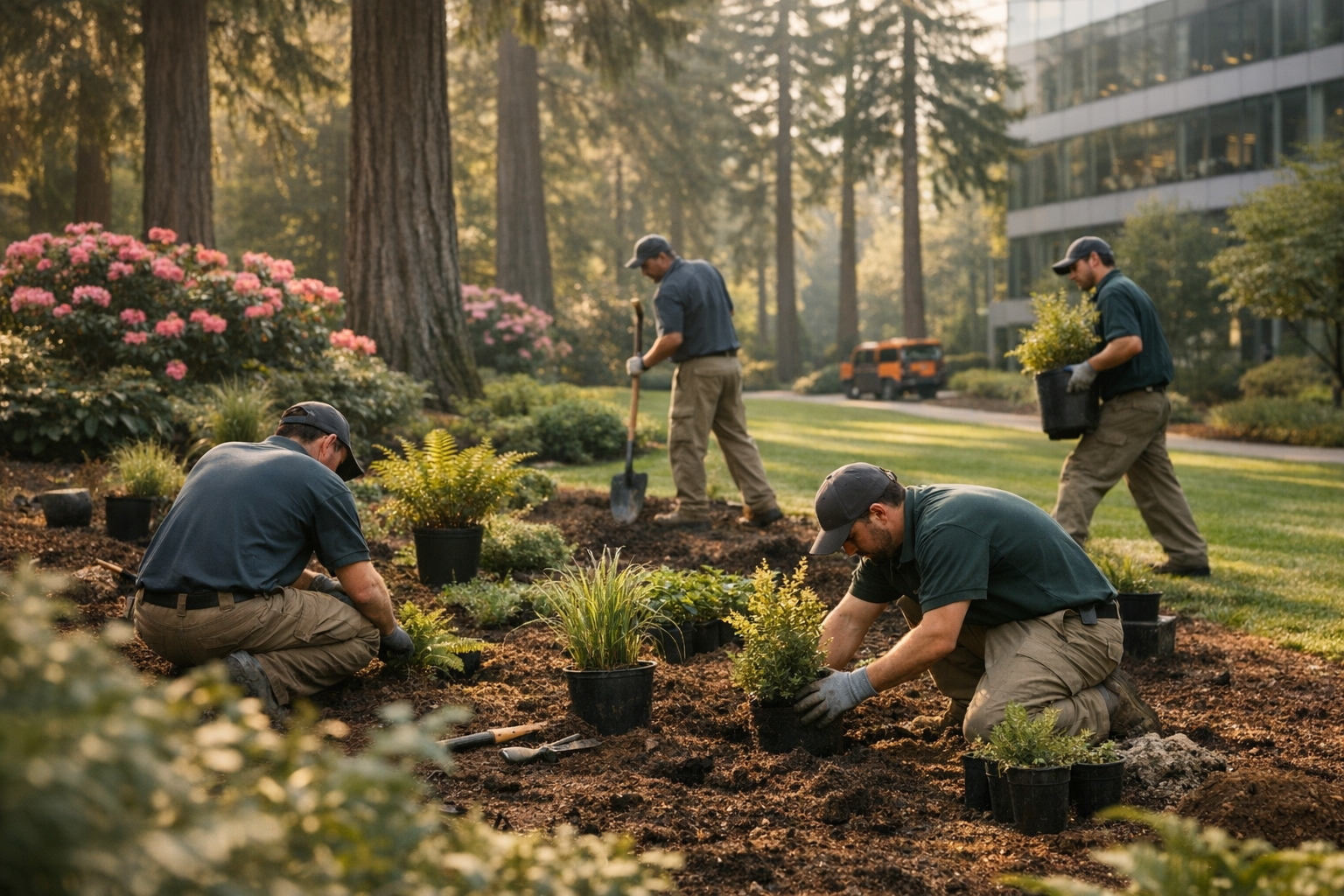
“Washington is one of the highest-quality West Coast landscape M&A markets, Seattle-Bellevue tech corporate-campus density (Microsoft, Amazon, Meta, Google, Apple, Boeing) supports premium commercial maintenance demand, and the 12-month Pacific Northwest growing season produces year-round recurring revenue. The 7% capital gains tax (on amounts above $270K) is a meaningful cost but materially lower than California’s 13.3%. We’re a buy-side partner, the buyers pay us, no contract required.”
TL;DR, the 90-second brief
- Washington landscaping businesses sell for 4-6x EBITDA in 2026. Seattle-Bellevue tech corridor commercial-maintenance operators with $1M-$5M EBITDA, 60%+ recurring contract revenue, and clean Washington State Department of Agriculture (WSDA) pesticide licensing trade at 5-6x. Sub-$1M EBITDA shops trade at 3-4.5x SDE.
- Seattle-Bellevue is one of the highest-quality West Coast commercial landscape markets in the U.S. Microsoft (Redmond), Amazon (Seattle, Bellevue), Meta (Bellevue), Google (Kirkland, Seattle), Apple (Seattle, Redmond), Boeing (Renton, Everett), and Costco (Issaquah) corporate campuses anchor premium commercial maintenance demand. The 12-month Pacific Northwest growing season and mild climate produce year-round recurring revenue.
- Washington requires Washington State Department of Labor & Industries (L&I) Contractor Registration plus WSDA Pesticide Applicator licensing. L&I issues General Contractor (GC) or Specialty Contractor (SC) registrations with bonding and liability insurance requirements. WSDA administers Commercial Applicator licensing with category certifications (Categories 3 Ornamental Pest Control, 4 Right of Way, 6 Industrial, Institutional, Structural and Health Related Pest Control are most common). Washington State Department of Licensing administers Public Works contractor pre-qualification.
- Washington has no state individual income tax but imposes a 7% Capital Gains Tax on long-term capital gains above $270K (effective 2022, with $270K standard deduction). Combined with federal long-term capital gains, WA sellers pay roughly 30.8% effective tax on goodwill above the deduction threshold versus 24% for true no-tax states (Florida, Texas, Nevada, Tennessee). On a $4M sale, WA’s tax cost is roughly $200-250K higher than true no-tax states but $200K lower than California. Washington recently expanded the capital gains tax which affects landscape M&A planning.
- Of our 76+ active U.S. lower middle market buyers, 11 are actively bidding on landscaping businesses in Washington right now. We’re a buy-side partner working with PE platforms (BrightView NYSE: BV, Yellowstone Landscape/CenterOak, Heartland/TPG, LandCare/Aurora, Sperber Landscape, Park West, Mariani Premier/MSouth), Pacific Northwest regional consolidators, and family offices with active WA buy-boxes. The buyers pay us, not you. No retainer. No contract required.
Key Takeaways
- Washington landscape businesses with $1M-$5M EBITDA sell for 4-6x in 2026, with Seattle-Bellevue tech corridor commercial-maintenance and Eastside premium residential operators commanding the top of the band.
- Washington has no state income tax but imposes a 7% Capital Gains Tax on long-term capital gains above $270K (effective 2022), on a $4M sale, costs $200-250K more than true no-tax states (Florida, Texas, Nevada, Tennessee) but $200K less than California.
- Washington requires L&I Contractor Registration (General or Specialty) plus WSDA Pesticide Applicator licensing.
- Recurring tech corporate-campus, Class A office, and master-planned community contract revenue above 60% lift your WA multiple by 0.5-1.0x EBITDA, Microsoft, Amazon, Meta, Google, Apple, and Boeing campus contracts are particularly valuable.
- Washington PFML and WA Cares Long-Term Services and Supports payroll taxes create compliance overhead that buyers diligence.
- Use our free business valuation calculator for a 90-second starting-point Washington landscape valuation range.
- Active 2026 Washington landscape buyers include BrightView (NYSE: BV), Yellowstone Landscape, Heartland, LandCare, Sperber Landscape, Park West, Mariani Premier Group, and 7+ family offices with explicit WA mandates.
The Washington landscaping market in 2026
Washington’s landscaping market is one of the highest-quality West Coast markets, structurally supported by Seattle-Bellevue tech corporate-campus density and 12-month Pacific Northwest growing season. Washington has approximately 7.96M residents (2024 Census estimates). The Seattle-Tacoma-Bellevue MSA carries approximately 4.06M residents. Spokane MSA approximately 580K. Smaller MSAs include Olympia, Bellingham, Yakima, Tri-Cities. Washington’s population growth has remained strong (1-1.5% annually) driven by tech corporate-relocation activity.
Climate creates a 12-month landscape season. Western Washington (Seattle, Bellevue, Tacoma, Olympia, Bellingham) supports a true 12-month landscape maintenance season due to mild Pacific Northwest climate (no hard freeze in most years, average annual rainfall 36-40 inches in Seattle). Eastern Washington (Spokane, Tri-Cities, Yakima) supports a 9-10 month season with light winter snow rotation. The 12-month Western Washington cycle produces year-round recurring revenue.
Commercial-versus-residential split favors commercial-maintenance consolidators. Washington landscape revenue mix is approximately 60-70% commercial maintenance (tech corporate-campus, Class A office, multifamily, healthcare, education, hospitality, municipal), 20-30% residential maintenance, 10-15% installation/design-build. Seattle-Bellevue tech corporate-campus contracts (Microsoft, Amazon, Meta, Google, Apple, Boeing) are the premium commercial segment unique to Washington.
Recent Washington landscape M&A activity tells the story. BrightView (NYSE: BV) maintains Seattle and Spokane branches with active tuck-in strategy. Yellowstone Landscape (CenterOak Partners) has executed Washington acquisitions in 2023-2025. Heartland (TPG-backed) carries Washington footprint. LandCare (Aurora Resurgence), Sperber Landscape Companies, and Park West all have active Washington presence. Mariani Premier Group (MSouth Equity Partners) has acquired premium Eastside residential design-build operators.
What this means for your timing. Washington is a healthy seller’s market for landscape businesses with $1M-$5M EBITDA, 50%+ recurring contract revenue, and meaningful Seattle-Bellevue tech corridor concentration. Buyers compete on price for assets that fit the tech corporate-campus playbook, and the typical Eastside deal closes at 5-6x EBITDA when prep is complete.
What landscaping businesses are worth in Washington (multiples and ranges)
Washington landscape valuations follow national landscape multiple bands with state-specific premiums for Seattle-Bellevue tech corporate-campus operators and Eastside premium residential design-build. The starting point is the national landscape range of 3-6x EBITDA. WA-specific premiums apply for tech corridor concentration.
Sub-$500K SDE: 3-4.5x SDE. Owner-operator residential or small commercial shops, often 3-6 trucks, with the seller as the WSDA Certified Applicator and L&I Contractor Registration holder. Buyer pool: individual SBA buyers, occasionally a local consolidator.
$500K-$1.5M EBITDA: 3.5-5x EBITDA. Established commercial-maintenance and HOA-route operators, 8-20 trucks, dispatch software in place, named operations manager, 50-60% recurring contract revenue.
$1.5M-$5M EBITDA: 4.5-6x EBITDA. The PE platform sweet spot. 20-50 trucks, full dispatch and CRM integration, GM or COO in place, 60-70% recurring commercial contract revenue, multi-year tech corporate-campus, Class A office, and multifamily contracts. Buyer pool: BrightView, Yellowstone Landscape, Heartland, LandCare, Sperber, Park West, Mariani Premier Group, regional family offices. Eastside operators in this tier with clean books routinely receive 5.5-6x EBITDA LOIs.
$5M+ EBITDA: 6-7.5x EBITDA. Platform-quality businesses. 50+ trucks, multi-location, professional management team independent of seller, 65%+ recurring contracts, blue-chip tech corporate-campus customer list. Buyer pool: large PE platforms competing aggressively.
What moves the multiple within the band. Recurring commercial maintenance contract percentage. Tech corporate-campus concentration. Eastside (Bellevue, Redmond, Kirkland, Issaquah, Sammamish) route density. Customer concentration. Owner dependency. Multi-year contract terms with auto-renewal. L&I Contractor Registration clean. WSDA Certified Applicator transferable. PFML and WA Cares compliance clean.
Active PE buyers and consolidators acquiring landscaping businesses in Washington
The Washington landscape buyer pool in 2026 is meaningful, particularly for Seattle-Bellevue tech corridor and Eastside premium residential operators. Below is the named landscape we work with directly.
BrightView Holdings (NYSE: BV). Maintains Seattle and Spokane branches with active tuck-in strategy. Buy-box: $1M-$15M EBITDA, commercial-maintenance dominant, multi-year contracts.
Yellowstone Landscape (CenterOak Partners). Active in Washington acquisitions. Buy-box: $1M-$10M EBITDA, commercial-maintenance focus.
Heartland (TPG-backed). Multi-region commercial landscape platform with active Western expansion. Buy-box: $1.5M-$15M EBITDA.
LandCare (Aurora Resurgence). National commercial-landscape consolidator with active Western presence. Buy-box: $1M-$10M EBITDA.
Sperber Landscape Companies. California-headquartered family-of-brands platform with Western U.S. expansion including Washington. Buy-box: $1.5M-$15M EBITDA, commercial maintenance dominant.
Park West. Premium commercial landscape platform with Western U.S. presence. Buy-box: $1M-$10M EBITDA, premium commercial focus.
Mariani Premier Group (MSouth Equity Partners). Premier residential design-build platform. Active in Mercer Island, Medina, Hunts Point, Clyde Hill, Sammamish, Issaquah Plateau premium residential markets. Buy-box: $1M-$8M EBITDA, residential design-build with high-net-worth client base.
Family offices and search funders with Washington mandates. We track 7+ family offices and 5+ search funders with explicit Washington landscape buy-boxes in the $400K-$2.5M EBITDA range.
Selling a landscaping business in Washington? Talk to a buy-side partner who knows the buyers.
We’re a buy-side partner working with 76+ active buyers… the buyers pay us, not you, no contract required. Of those 76+, 11 are actively bidding on landscaping businesses in Washington right now, including BrightView (NYSE: BV), Yellowstone Landscape, Heartland, LandCare, Sperber Landscape, Park West, Mariani Premier Group, family offices, and search funders with explicit Seattle-Bellevue mandates. A 15-minute call gets you three things: a real read on what your Washington landscape business is worth in today’s market, a sense of which buyer types fit your business, and the option to meet one of them.
Book a 15-Min Call| Business size | SBA buyer | Search funder | Family office | LMM PE | Strategic |
|---|---|---|---|---|---|
| Under $250K SDE | Yes | No | No | No | Rare |
| $250K-$750K SDE | Yes | Some | No | No | Add-on |
| $750K-$1.5M SDE | Some | Yes | Some | Add-on | Yes |
| $1.5M-$3M EBITDA | No | Yes | Yes | Yes | Yes |
| $3M-$10M EBITDA | No | Some | Yes | Yes | Yes |
| $10M+ EBITDA | No | No | Yes | Yes | Yes |
Washington-specific landscape licensing and regulatory transfer
Washington requires multiple licensing layers: Washington State Department of Labor & Industries (L&I) Contractor Registration, WSDA Pesticide Applicator licensing, and various local jurisdiction licensing. Washington’s licensing structure is rigorous and well-enforced.
L&I Contractor Registration. Washington State Department of Labor & Industries requires Contractor Registration for any contractor performing work in Washington. Registration includes General Contractor (GC) and Specialty Contractor (SC) categories. Registration requires a $12,000 surety bond ($6,000 for SC), $250,000 general liability insurance, and continuous registration maintenance. Buyers diligence L&I registration carefully because failure to register exposes the entity to consumer-protection claims and fines.
Why this matters for the sale. L&I Contractor Registration is at the entity level and includes specific named individuals. License-transfer mechanics require the buyer to register or transfer the registration. Most Washington deals build a 60-180 day transition services agreement to bridge the licensing-transition gap.
WSDA Pesticide Applicator licensing. Washington State Department of Agriculture administers commercial pesticide applicator licensing. Operators applying pesticides for hire must hold Commercial Applicator licenses with category certifications. Category 3 (Ornamental Pest Control), Category 4 (Right of Way), and Category 6 (Industrial, Institutional, Structural and Health Related Pest Control) are most common for landscape. The Core Exam covers pesticide safety, regulations, and integrated pest management.
Washington Paid Family and Medical Leave (PFML). Washington PFML, effective 2020, requires employers and employees to contribute to a state insurance fund providing paid family and medical leave benefits. Employer premium rate is 0.6%-0.7% of wages (2024 rate, varies by year and employer size). Landscape operators must register and contribute. Buyers diligence PFML compliance.
Washington Cares Long-Term Services and Supports. WA Cares Fund, effective July 2023, requires employee contributions of 0.58% of wages to fund long-term care benefits. Employers withhold and remit. Landscape operators must comply with payroll tax administration.
Local jurisdiction licensing. Seattle, Bellevue, Redmond, Kirkland, Tacoma, Spokane, Vancouver, and other Washington municipalities each have local business license requirements. King County and other counties have additional registrations. Buyers diligence multi-jurisdiction licensing carefully.
Washington water-conservation regulations. Western Washington water utilities (Seattle Public Utilities, Cascadia Water Alliance, Tacoma Water) impose smart-controller mandates and water-conservation requirements. Operators with smart-controller-equipped commercial portfolios are positioned favorably.
Washington tax implications for landscaping business sale
Washington has no state individual income tax but imposes a 7% Capital Gains Tax (effective 2022) on long-term capital gains above $270K (with $270K standard deduction). Washington’s Capital Gains Tax was enacted in 2021, effective tax year 2022, and applies to long-term capital gains above the $270K standard deduction (indexed annually). The 7% rate applies to amounts above $270K. The tax was upheld by the Washington Supreme Court in 2023. This is a meaningful tax planning consideration for landscape M&A given typical sale gain levels above the deduction threshold.
The dollar impact on a typical Washington landscape sale. On a $4M Washington landscape sale with $3.2M of the purchase price allocated to goodwill, the Washington seller pays approximately $968K in combined federal-and-state long-term capital gains tax (federal long-term capital gains plus 7% on amounts above $270K Washington exemption). A Texas, Florida, Nevada, or Tennessee seller of the same business pays approximately $762K (no state tax). A California seller pays approximately $1.19M. Washington’s tax position is roughly $206K higher than true no-tax states but $222K lower than California.
Asset allocation in a Washington landscape deal. Most Washington landscape deals structure as asset sales for buyer-side liability and depreciation reasons. Working with a tax attorney to push allocation toward goodwill versus equipment typically saves 5-12% of total tax. The Washington Capital Gains Tax applies to long-term capital gains, so equipment ordinary-income recapture is taxed federally but not at the state level.
Washington Business and Occupation Tax (B&O). Washington imposes a B&O tax on gross receipts (rates vary by classification, typically 0.484% for landscape services). Landscape M&A diligence reviews B&O Tax compliance. Pre-sale, ensure all Washington tax filings are current.
Washington sales and use tax. Washington imposes 6.5% state sales tax plus local sales taxes that can total 9.5-10.5% in Seattle, Bellevue, Tacoma. Landscape installation may be subject to sales and use tax depending on whether the work is treated as a service or sale of tangible personal property. Buyers diligence sales tax compliance carefully.
Washington pre-sale relocation considerations. Some Washington landscape sellers consider pre-sale relocation to Idaho, Nevada, Florida, Texas, or Tennessee to capture lower state tax. Washington Department of Revenue scrutinizes residency claims when sale proceeds appear in the year of relocation. Note that Washington does have an exit tax provision under the Capital Gains Tax for relocation, requiring careful structuring.
The 5 buyer archetypes for Washington landscape sales
The Washington landscape buyer pool sorts into five distinct archetypes. Knowing which archetype fits your business is the highest-leverage positioning decision before going to market.
Archetype 1: National landscape platforms. BrightView, Yellowstone Landscape, LandCare, Heartland, Sperber Landscape, Park West. Buy-box: $1.5M-$15M EBITDA, commercial-maintenance dominant, tech corporate-campus concentration preferred.
Archetype 2: Premier residential design-build acquirers. Mariani Premier Group, select boutique Pacific Northwest-focused acquirers. Buy-box: $1M-$8M EBITDA, residential design-build with high-net-worth client base in Mercer Island, Medina, Hunts Point, Clyde Hill premium markets.
Archetype 3: Family offices. Single-family or multi-family offices with home services or commercial services mandates. Buy-box: $1M-$10M EBITDA.
Archetype 4: Search funders. Individual or two-person searcher teams using SBA-backed financing. Buy-box: $400K-$2.5M EBITDA, single-MSA focus (Seattle-Bellevue preferred).
Archetype 5: Individual SBA buyers. Owner-operators or first-time buyers using SBA 7(a) financing. Buy-box: under $1.5M total enterprise value.
What drives premium multiples in Washington landscaping
Washington landscape operators land at the top of the 4-6x EBITDA multiple band when they show buyers a specific set of operational characteristics. The list below is what every PE platform diligences.
Driver 1: Tech corporate-campus contract concentration. Microsoft (Redmond), Amazon (Seattle and Bellevue), Meta (Bellevue), Google (Kirkland and Seattle), Apple, Boeing campus contracts are the premium commercial revenue in Washington. Operators with concentrated tech-campus portfolios trade at premium multiples.
Driver 2: Recurring commercial maintenance contract revenue above 60%. Combined tech corporate-campus, Class A office, multifamily, and HOA contracts. Each 5 percentage points above 50% adds 0.25-0.5x EBITDA.
Driver 3: Eastside route density. An operator with 80% of revenue inside Bellevue-Redmond-Kirkland-Issaquah-Sammamish corridor trades better than scattered statewide.
Driver 4: Owner independence. An operator with a true GM or COO running day-to-day operations independent of the seller adds 0.5-1.0x EBITDA.
Driver 5: H-2B labor compliance and crew retention. Most Washington landscape operators run H-2B seasonal workers. Clean documentation and crew retention above 70% over 24 months signal operational discipline.
Driver 6: Clean L&I, WSDA, PFML, and WA Cares standing. L&I Contractor Registration current. WSDA Certified Applicator licenses current. PFML and WA Cares payroll tax filings current. No open enforcement matters.
Driver 7: Multi-year contract terms with auto-renewal. Multi-year contracts with CPI escalators worth more than annual.
Common deal-killers in Washington landscape sales
Most Washington landscape deals that fall apart fall apart for one of seven specific reasons. Knowing the failure modes in advance lets you fix them 12-18 months pre-sale.
Deal-killer 1: L&I Contractor Registration transition with no plan. Lapsed or non-transferable L&I registration creates compliance exposure.
Deal-killer 2: WSDA Certified Applicator transition with no plan. Seller is the only licensed Applicator. Pesticide application capability stalls.
Deal-killer 3: Customer concentration above 25%. Single-customer concentration in single tech corporate-campus or single property-management firm above 30% creates concentration risk.
Deal-killer 4: PFML or WA Cares payroll tax compliance gaps. Unfiled PFML or WA Cares contributions create successor liability exposure.
Deal-killer 5: H-2B compliance gaps. Sloppy H-2B records, unfiled prevailing wage documentation, or active Department of Labor investigations face deal collapse.
Deal-killer 6: Aggressive add-backs. Washington operators claiming $200K of personal vehicle, family salary, and discretionary travel add-backs face SBA and PE-buyer scrutiny.
Deal-killer 7: B&O Tax non-compliance. Unfiled WA B&O Tax returns or amounts owed create successor liability concerns.
The Washington landscape sale process and timeline
A Washington landscape sale typically runs 9-12 months from prep-complete to close. The breakdown below is what we see in actual Washington landscape deals at the $1M-$10M EBITDA tier in 2025-2026.
Months -24 to -12: pre-sale preparation. Clean monthly closes with CPA-prepared financials. Track recurring contract revenue, customer concentration, crew retention, H-2B documentation, PFML and WA Cares filings. Identify replacement L&I-registered individuals and WSDA Certified Applicator. Resolve any open WSDA or L&I enforcement matters. Audit Washington Capital Gains Tax planning opportunities.
Months -12 to -6: positioning and buyer identification. Build CIM emphasizing Washington-specific advantages (Seattle-Bellevue tech corridor, 12-month Pacific Northwest growing season, Eastside premium residential).
Months -6 to -3: buyer outreach and management meetings. Targeted outreach to 8-12 buyers with explicit Washington landscape mandates.
Months -3 to 0: LOI, QoE, diligence. Best-and-final LOIs collected. Quality-of-earnings engagement. Operational diligence including L&I and WSDA history pull, PFML and WA Cares compliance audit, B&O Tax review, H-2B file audit.
Close: day 0 to day 30. Funds wire, customer notification letters mailed, vendor and OEM relationships transferred.
Post-close transition: 90-180 days. Customer transition support, key employee retention, financial reporting handoff.
How CT Acquisitions works for Washington landscape sellers
CT Acquisitions is a buy-side partner, not a sell-side broker. We work directly with 76+ active U.S. lower middle market buyers, including 11 with explicit Washington landscape mandates currently open. The buyers pay us when a deal closes, you pay nothing. No retainer. No exclusivity. No 12-month contract. No tail fee.
How that’s structurally different from a sell-side broker. A sell-side broker charges you 8-12% of deal value (often $300K-$1M+ on a Washington landscape sale), runs a 9-12 month auction process, and locks you into 12-month exclusivity.
Why buyers pay us. Our 76+ buyers maintain active mandates and need consistent deal flow. We deliver pre-qualified, well-prepared sellers in their target verticals at a fraction of their internal BD cost.
What a typical engagement looks like. Step 1: 15-minute discovery call. Step 2: preliminary valuation range and prep for buyer introductions. Step 3: targeted introductions to 4-5 of our 76+ Washington-mandate buyers. Step 4: management meetings, LOIs, exclusive due diligence. Step 5: close. Total elapsed time: 90-150 days from first introduction to close.
What we don’t do. We don’t prep your books, run your QoE, or negotiate the purchase agreement, you keep your CPA and your M&A attorney for that work. We don’t lock you up with exclusivity. We don’t take fees from you.
Seattle-Bellevue tech corporate-campus contracts and Washington landscape M&A
Seattle-Bellevue tech corporate-campus contracts are among the most premium commercial maintenance revenue streams in U.S. landscape services. The Eastside (Bellevue, Redmond, Kirkland, Issaquah, Sammamish) and Seattle proper host more major tech corporate campuses than any other location outside Silicon Valley. Microsoft (Redmond, multiple buildings totaling over 12M square feet), Amazon (Seattle including Spheres, multiple Bellevue buildings totaling over 14M square feet), Meta (Bellevue Spring District, multiple buildings), Google (Kirkland and Seattle), Apple (Seattle and Redmond), Boeing (Renton, Everett, Tukwila), Costco (Issaquah), Starbucks (Seattle), F5 Networks (Seattle), and dozens of other major corporate campuses generate premium landscape maintenance demand.
Why Seattle-Bellevue tech-campus contracts are valuable. These contracts run multi-year terms with high specifications (Pacific Northwest native plantings, sustainable landscape design, stormwater management, premium ornamental plantings, integrated public art and amenity area maintenance). Customer credit quality is excellent. Operators with 20%+ revenue from major tech corporate-campus contracts trade at premium multiples.
What buyers diligence in Seattle-Bellevue tech operators. Customer concentration (single Big Tech relationship above 25% creates risk). Multi-year contract terms (3-5 years preferred). Customer retention rate. Scope specifications (high-spec ornamental plantings, sustainable-design features). Sustainability and ESG signaling alignment with tech corporate values.
Eastside premium residential design-build. Mercer Island, Medina, Hunts Point, Clyde Hill, Sammamish Plateau, Issaquah Highlands support some of the highest-net-worth residential markets in the country. Multi-million-dollar single-property landscape installation budgets are routine. Mariani Premier Group is the dominant national acquirer in this niche, with multiples 4.5-6x EBITDA for established premium brands.
Microsoft and Amazon vendor concentration risk. Microsoft and Amazon each maintain significant landscape vendor portfolios, with consolidated property-management approaches. Operators with concentration above 25% in either single tech giant face concentration risk. The fix: diversify across multiple tech-corporate-campus customers and intermediary property-management firms.
Sell Your Landscaping Business in Other States: Sibling Guides
Sibling state guides for selling a landscaping business. Each guide below covers state-specific licensing, multiple ranges, tax considerations, and named PE buyers active in that geography. If you operate in multiple states, the multi-state premium typically adds 0.5-1.5x to EBITDA multiple at exit (buyers value contiguous coverage).
State-by-state guides: Sell Your Landscaping Business in Texas · Sell Your Landscaping Business in Florida · Sell Your Landscaping Business in California · Sell Your Landscaping Business in New York · Sell Your Landscaping Business in Pennsylvania · Sell Your Landscaping Business in Illinois · Sell Your Landscaping Business in Ohio · Sell Your Landscaping Business in Georgia
For valuation context that applies regardless of state: See our landscaping business valuation guide for nationwide multiple ranges and PE buyer pool. Run our free 90-second valuation calculator for a starting-point estimate. Or browse the full sell-your-business hub for all verticals and states.
Seattle vs Bellevue Eastside vs Spokane vs Tacoma: regional Washington submarket dynamics
Washington landscape M&A activity is concentrated in the Seattle-Bellevue corridor, with secondary activity in Tacoma, Spokane, and the Vancouver/Portland-adjacent corridor. Seattle and the Eastside (Bellevue, Redmond, Kirkland, Issaquah, Sammamish) represent roughly 65-70% of statewide landscape M&A volume. Tacoma-Pierce County 12-15%. Spokane MSA 8-10%. Vancouver/Portland-adjacent 5-8%.
Seattle and Eastside: deepest Washington buyer pool. King County (Seattle, Bellevue, Redmond, Kirkland, Issaquah, Sammamish, Mercer Island, Bothell, Kenmore) dominates Washington landscape M&A. Tech corporate-campus concentration (Microsoft Redmond campus, Amazon Bellevue and Seattle campuses, Meta Bellevue, Google Kirkland, Apple Seattle) anchors premium commercial demand. Multiples 5.5-6x EBITDA for tech-corridor concentrated operators.
Tacoma and Pierce County: Joint Base Lewis-McChord, healthcare. Tacoma, Lakewood, University Place, Puyallup. Joint Base Lewis-McChord military, Tacoma General Hospital, MultiCare healthcare, Boeing Auburn-Renton operations, Port of Tacoma logistics. Multiples 4.5-5.5x EBITDA.
Spokane and Eastern Washington: thinner but real. Spokane MSA (approximately 580K residents) supports growing healthcare (Providence Sacred Heart, MultiCare Deaconess), Eastern Washington University, and Inland Empire commercial maintenance. Multiples 3.5-5x EBITDA. Buyer pool thinner than Western Washington but real for the right operator profile.
Washington statewide-platform premium. Operators running multi-MSA Washington platforms (Seattle + Tacoma or Seattle + Spokane) trade at premium versus single-MSA operators. PE platforms targeting Washington as a multi-MSA buy-out platform pay aggressively for multi-MSA exposure.
Curious what your Washington landscaping business would sell for?
A 15-minute confidential call gives you a real valuation range and tells you which buyers would compete for your business. No cost, no obligation, no pressure to sell.
Sell Your Landscaping Business in Washington: 2026 Outlook and Key Takeaways
Selling a landscaping business in Washington in 2026 is a high-quality West Coast exit. Seattle-Bellevue tech corporate-campus density (Microsoft, Amazon, Meta, Google, Apple, Boeing), 12-month Pacific Northwest growing season, and Eastside premium residential markets create the operating profile PE buyers reward. The 7% Capital Gains Tax (on amounts above $270K) is meaningful but materially lower than California’s 13.3%. The active buyer pool is 11-deep among our 76+ relationships, with BrightView (NYSE: BV), Yellowstone Landscape, Heartland, LandCare, Sperber Landscape, Park West, Mariani Premier Group, and 7+ family offices all writing checks for Washington landscape assets. Owners who prep their books, identify a replacement L&I-registered individual and WSDA Certified Applicator, push recurring contract revenue above 60%, and clean up PFML, WA Cares, and B&O Tax compliance routinely close at 5-6x EBITDA. We’re a buy-side partner, the buyers pay us, not you, no contract required.

About the Author
Christoph Totter is the founder of CT Acquisitions, a buy-side partner headquartered in Sheridan, Wyoming. We work directly with 100+ buyers, search funders, family offices, lower middle-market PE, and strategic consolidators, including direct mandates with the largest consolidators that other intermediaries cannot access. The buyers pay us when a deal closes, not the seller. No retainer, no exclusivity, no contract until close. Connect on LinkedIn · Get in touch
Sell Your Landscaping Business in Washington: Frequently Asked Questions
How much is my Washington landscaping business worth?
Washington landscape businesses typically sell for 4-6x EBITDA in 2026. Seattle-Bellevue tech corridor commercial-maintenance operators with $1M-$5M EBITDA, 60%+ recurring contract revenue, and clean L&I/WSDA standing trade at 5-6x. Sub-$1M EBITDA shops trade at 3-4.5x SDE.
Do I need a state license to sell my Washington landscape business?
Washington requires Department of Labor & Industries (L&I) Contractor Registration (General or Specialty) for landscape contracting work. WSDA requires Commercial Pesticide Applicator licensing (Categories 3 Ornamental, 4 Right of Way, 6 Industrial most common). Local jurisdictions impose additional business licenses.
Which PE firms are buying landscaping businesses in Washington right now?
BrightView Holdings (NYSE: BV), Yellowstone Landscape (CenterOak), Heartland (TPG), LandCare (Aurora Resurgence), Sperber Landscape Companies, Park West, and Mariani Premier Group (MSouth Equity) are all actively acquiring Washington landscape operators. We work with 11 of these and other Washington-mandate buyers directly.
How long does it take to sell a landscaping business in Washington?
Typically 9-12 months from prep-complete to close. Pre-sale preparation should ideally start 18-24 months earlier.
What are the Washington tax implications of selling my landscape business?
Washington has no state individual income tax but imposes a 7% Capital Gains Tax (effective 2022) on long-term capital gains above $270K (with $270K standard deduction). Combined with federal long-term capital gains, the effective top combined rate on goodwill above the deduction is approximately 30.8%. On a $4M Washington landscape sale, this costs $200-250K more than true no-tax states (Texas, Florida, Nevada, Tennessee) but $200K less than California.
How does Washington’s Capital Gains Tax affect my landscape sale?
Washington’s 7% Capital Gains Tax (effective 2022, upheld by WA Supreme Court 2023) applies to long-term capital gains above $270K standard deduction. The tax was a meaningful change to Washington’s tax landscape and affects landscape M&A planning given typical sale gain levels above the deduction. Work with a Washington-experienced tax attorney.
What multiple should I expect for a Seattle-Bellevue landscape business?
Seattle-Bellevue commercial-maintenance landscape operators with $1.5M-$5M EBITDA, tech corporate-campus concentration (Microsoft, Amazon, Meta, Google, Apple, Boeing), 60%+ recurring contract revenue, and clean L&I/WSDA standing trade at 5.5-6x EBITDA in 2026.
How does WSDA pesticide licensing affect my Washington landscape sale?
WSDA Commercial Applicator licenses are individual (per Certified Applicator), not corporate. If you’re the only licensed Applicator, the buyer must produce a replacement before pesticide application can continue. Most Washington deals build a 60-180 day transition services agreement to bridge.
What is L&I Contractor Registration?
Washington State Department of Labor & Industries requires Contractor Registration for any contractor performing work in Washington. Registration includes General Contractor (GC) and Specialty Contractor (SC) categories with surety bond and liability insurance requirements.
What about Washington PFML and WA Cares payroll taxes?
Washington PFML (effective 2020) requires employer and employee contributions to a state insurance fund providing paid family and medical leave. WA Cares Fund (effective July 2023) requires employee contributions for long-term care benefits. Buyers diligence both for compliance. Pre-sale, ensure all PFML and WA Cares filings are current.
How does H-2B labor compliance affect my Washington landscape valuation?
Most Washington landscape operators run H-2B seasonal workers. Clean H-2B files (visa documentation, prevailing wage records, recruitment documentation) preserve full multiple. Open Department of Labor investigations or weak documentation cost 0.5-1.0x EBITDA.
Can I retain real estate when I sell my Washington landscape business?
Yes, many Washington landscape sellers retain truck yard, equipment storage, or nursery real estate and lease to the buyer at fair market rent. Discuss tax structuring with a Washington-experienced tax attorney given the Capital Gains Tax structure.
How is CT Acquisitions different from a sell-side broker or M&A advisor?
We’re a buy-side partner, not a sell-side broker. Sell-side brokers charge you 8-12% of deal value (often $300K-$1M+ on a Washington landscape sale) plus monthly retainers, run a 9-12 month auction process, and require 12-month exclusivity. We work directly with 76+ buyers, PE platforms, family offices, strategics, and individual buyers, who pay us when a deal closes. You pay nothing. No retainer, no exclusivity, no contract until a buyer is at the closing table. We move faster (90-150 days from intro to close on a prepared Washington landscape business) because we already know who the right buyer is rather than running an auction to find one.
Sources & References
All claims and figures in this analysis are sourced from the publicly available references below.
- Washington State Department of Labor & Industries – Contractor Registration, Washington L&I requires Contractor Registration (General or Specialty) for any contractor performing work in Washington, with surety bond and liability insurance requirements.
- Washington State Department of Agriculture – Pesticide Programs, WSDA administers Commercial Pesticide Applicator licensing with category certifications including Category 3 (Ornamental Pest Control), Category 4 (Right of Way), and Category 6 (Industrial, Institutional, Structural and Health Related Pest Control) for landscape operators.
- Washington State Department of Revenue – Capital Gains Tax, Washington imposes a 7% Capital Gains Tax (effective 2022) on long-term capital gains above $270K standard deduction, upheld by the Washington Supreme Court in 2023.
- Washington State Paid Family and Medical Leave, Washington PFML requires employer and employee contributions to a state insurance fund providing paid family and medical leave benefits.
- BrightView Holdings Investor Relations (NYSE: BV), BrightView Holdings maintains Seattle and Spokane branches with active Washington tuck-in acquisition strategy.
- Yellowstone Landscape, Yellowstone Landscape (CenterOak Partners-backed) has executed Washington acquisitions in 2023-2025.
- Mariani Premier Group, Mariani Premier Group (MSouth Equity Partners-backed) consolidates premier residential design-build operators in Eastside Washington premium residential markets including Mercer Island, Medina, Hunts Point, and Clyde Hill.
- Sperber Landscape Companies, Sperber Landscape Companies is a California-headquartered family-of-brands platform expanding into Washington as part of multi-state Western strategy.
- U.S. Department of Labor – H-2B Temporary Non-Agricultural Workers, H-2B program governs temporary foreign worker hiring for non-agricultural positions including landscape services.
- Washington Department of Labor & Industries, contractors
- Washington Department of Revenue
- Washington Census QuickFacts
Related Guide: How to Sell a Landscaping Business, Complete national playbook for landscape owners preparing to exit.
Related Guide: Sell Your Landscaping Business in California, Bay Area, OC, LA premium West-Coast multiples, C-27 license.
Related Guide: What’s My Landscaping Business Worth in 2026?, EBITDA multiples, premium drivers, and free valuation calculator.
Related Guide: Private Equity in Landscaping: 2026 Consolidator Landscape, Active PE platforms, deal volume, and what they pay.
Related Guide: How to Attract Private Equity to Buy Your Business, Operational signals PE buyers underwrite and how to position.
Want a Specific Read on Your Business?
15 minutes, confidential, no contract, no cost. You leave with a read on your local buyer market and a likely valuation range.