Commercial Plumbing Business Worth (2026): EBITDA Multiples by Size and Work Mix
Quick Answer
Commercial plumbing business worth in 2026: 3.5x to 9x adjusted EBITDA by size, on CT Acquisitions estimates. Contracted service and maintenance work prices at the top of each band; general contractor project work prices at the bottom.
By Christoph Totter, Founder of CT Acquisitions · Last reviewed: October 2026
Thinking about selling your business?
A 15-minute confidential call gives you a real valuation range and the buyers most likely to compete for your business. No cost, no obligation.

Key takeaways
- CT Acquisitions estimates for 2026: 3.5x to 4.5x adjusted EBITDA under $1M, 4.5x to 5.5x at $1M to $3M, 5.5x to 6.5x at $3M to $7M, 6.5x to 8x at $7M to $15M, and 7x to 9x above $15M.
- Public deals land inside those bands: Limbach Holdings paid $23 million for Consolidated Mechanical, which it expected to earn $4 million of EBITDA a year (5.75x at close), and $66.1 million for Pioneer Power against $10 million of expected FY 2026 Adjusted EBITDA (6.6x), per its August 2025 Form 8-K.
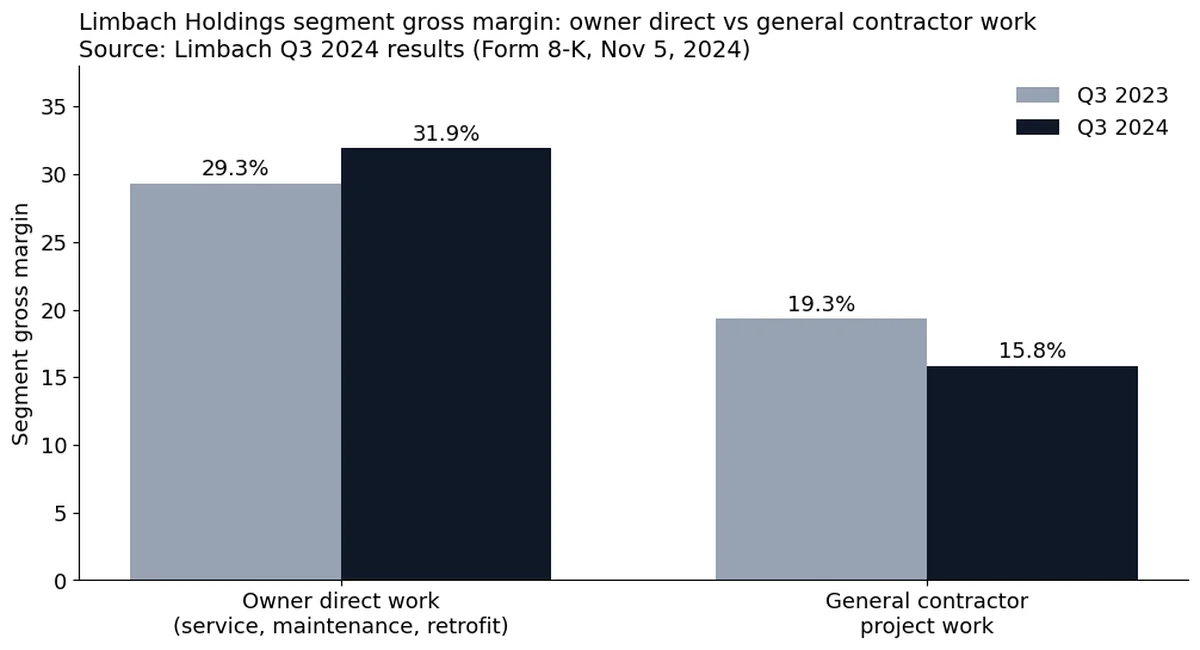
- Service work out-earns project work: Limbach’s owner direct segment ran a 31.9% gross margin in Q3 2024 against 15.8% on general contractor work, per its Q3 2024 results.
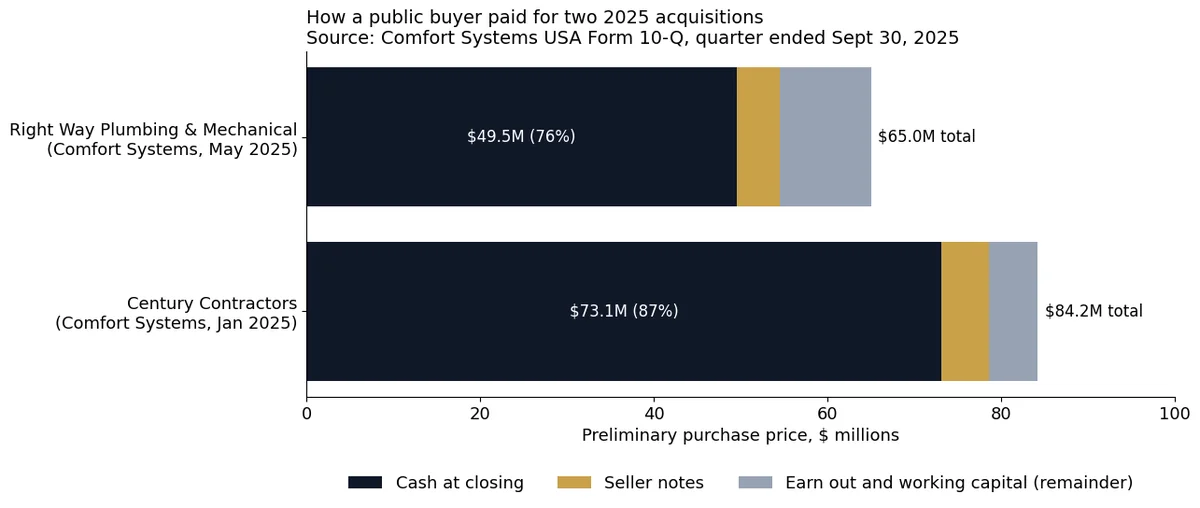
- Price is not cash: Comfort Systems USA paid $65.0 million for Right Way Plumbing & Mechanical in May 2025, of which $49.5 million (76%) was cash at closing, per its Form 10-Q for Q3 2025.
- Market context: GF Data put sub-$25 million deals at 6.3x and 6.9x average TEV/EBITDA in H1 2025, against 7.2x across all deal sizes, as reported by Middle Market Growth (September 2025).
What is a commercial plumbing business worth in 2026?
A commercial plumbing business is worth a multiple of adjusted EBITDA that rises with size: 3.5x to 4.5x under $1 million of EBITDA, up to 7x to 9x above $15 million, on CT Acquisitions estimates for 2026. Inside each band, the share of contracted service and maintenance revenue decides whether a business lands at the top or the bottom.
Adjusted EBITDA is reported profit before interest, taxes, depreciation and amortization, plus documented add-backs such as above-market owner pay and one-time legal costs. Owner-run shops under roughly $500,000 of earnings usually price on seller’s discretionary earnings (SDE), which adds the owner’s own pay back; CT’s reference band for residential service owner-operators is 2.5x to 4.5x SDE.
| Adjusted EBITDA | CT estimate | Service-led position | Project-led position | Buyers most likely to bid |
|---|---|---|---|---|
| Under $1M | 3.5x to 4.5x | 4.0x to 4.5x | 3.5x or below | SBA 7(a) financed individuals, search funds, local strategics |
| $1M to $3M | 4.5x to 5.5x | 5.0x to 5.5x | 4.5x or below | Private equity add-ons, regional mechanical contractors |
| $3M to $7M | 5.5x to 6.5x | 6.0x to 6.5x | 5.5x or below | Public mechanical contractors, private equity platforms |
| $7M to $15M | 6.5x to 8x | 7x to 8x | 6.5x or below | Private equity platforms, public mechanical contractors |
| $15M and up | 7x to 9x | 8x to 9x | 7x | Public strategics, large private equity |
Source: CT Acquisitions estimates, October 2026, cross-checked against the disclosed public deals in the comparison table below and against GF Data’s H1 2025 averages. Ranges are enterprise value on a debt-free, cash-free basis, before earn-outs, seller notes and the working capital adjustment.
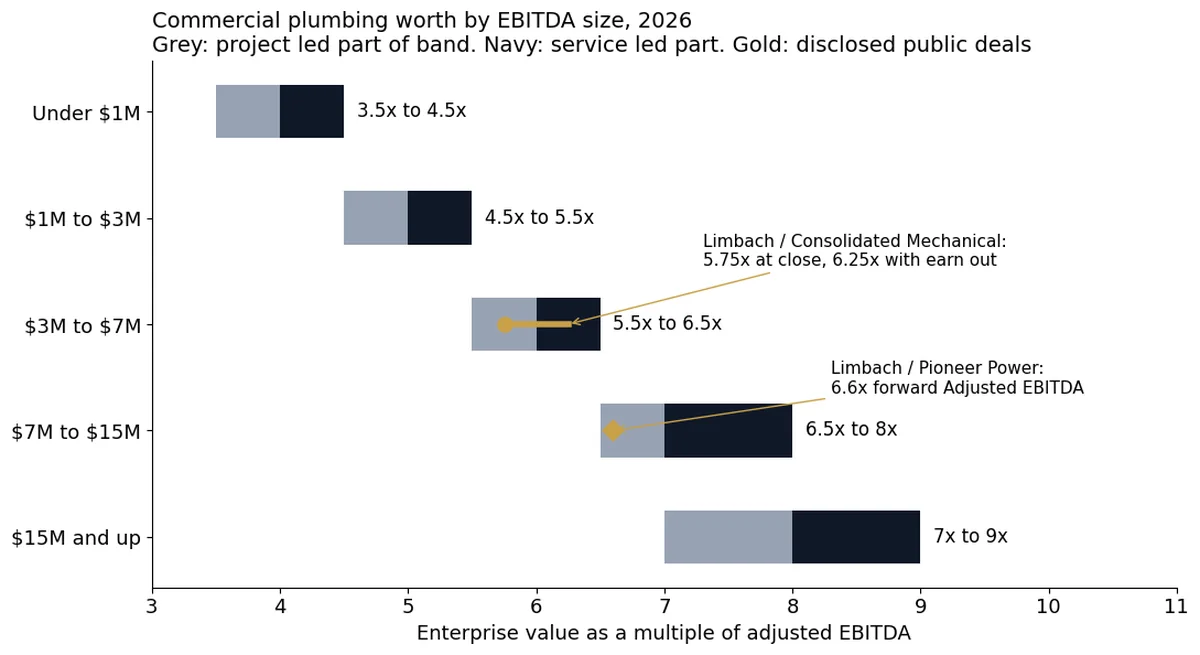
The bands rise with size because the buyer pool and its financing change. Below $1 million of EBITDA, many buyers fund the purchase with an SBA 7(a) loan, and the U.S. Small Business Administration caps a 7(a) loan at $5 million, which limits what an individual buyer can pay. Above $3 million of EBITDA, public mechanical contractors and private equity platforms bid with cheaper capital, and the public filings below show what they paid.
Is a commercial plumbing business worth more than a residential one?
Only when the commercial revenue is contracted service. Commercial service and maintenance work sold to building owners prices at the top of each EBITDA band, while general contractor project work prices at the bottom, often below a residential service plumber with the same earnings. The commercial label does not earn the premium; the contract type and the margin do.
The clearest public evidence comes from Limbach Holdings (NASDAQ: LMB), a mechanical and plumbing contractor that reports two segments. In Q3 2024, its owner direct relationships (ODR) segment, work sold straight to building owners, earned a 31.9% gross margin on $93.0 million of revenue, while its general contractor relationships (GCR) segment earned 15.8%, per the Limbach Q3 2024 results. That 16.1 point gap is roughly 2.0 times the margin for the same trade.
| Limbach segment | Q3 2023 gross margin | Q3 2024 gross margin | Source |
|---|---|---|---|
| Owner direct relationships (ODR): service, maintenance, retrofit for building owners | 29.3% | 31.9% | Limbach Q3 2024 results, Form 8-K Exhibit 99.1 |
| General contractor relationships (GCR): project work bid through general contractors | 19.3% | 15.8% | Limbach Q3 2024 results, Form 8-K Exhibit 99.1 |
| Attribute | Commercial service and maintenance | Commercial project and new construction | Residential service | Source |
|---|---|---|---|---|
| Who signs the contract | Building owner, property manager, facility team | General contractor | Homeowner | Limbach segment definitions |
| Gross margin evidence | 31.9% (Limbach ODR, Q3 2024) | 15.8% (Limbach GCR, Q3 2024) | No public pure-play discloses it | Limbach Form 8-K |
| Recurring element | Maintenance agreements, scheduled backflow testing | Backlog, which ends when the job ends | Membership plans | CT Acquisitions |
| Valuation basis | Adjusted EBITDA | Adjusted EBITDA | SDE for owner-operators | CT Acquisitions |
| Position in the CT estimate | Top of the EBITDA band | Bottom of the band or below | 2.5x to 4.5x SDE for owner-operators | CT Acquisitions estimates, 2026 |
Residential consolidators and commercial buyers are different pools. The Wrench Group, for example, was described as a home maintenance and repair provider when Leonard Green & Partners agreed to buy it from Investcorp in April 2019. A commercial plumber with mostly owner direct service work fits buyers such as Comfort Systems USA (NYSE: FIX) or Limbach, which report plumbing inside their mechanical businesses. For residential and blended shops, the wider picture is in our answer on how much a plumbing business is worth.
What have public buyers paid for commercial plumbing and mechanical contractors?
Public filings show 2024 to 2025 prices of about 5.75x to 6.6x expected EBITDA for commercial mechanical and plumbing contractors earning $4 million to $10 million, and roughly 0.55x to 1.08x expected revenue. Those figures come from Limbach Holdings and Comfort Systems USA disclosures, two public buyers in this niche that publish deal terms.
| Buyer | Target and work type | Closed | Price disclosed | Expected revenue | Expected EBITDA | Implied multiple (CT arithmetic) | Source |
|---|---|---|---|---|---|---|---|
| Limbach Holdings | Consolidated Mechanical, Owensboro, Kentucky (founded 1984): mechanical, plumbing construction, maintenance and outage services for industrial owners | Dec 2, 2024 | $23M at close, plus up to $2M earn-out | About $23M a year | $4M a year | 5.75x EBITDA at close; 6.25x with full earn-out; 1.0x revenue | Limbach release |
| Limbach Holdings | Pioneer Power, Twin Cities (founded 1947): industrial and institutional mechanical, mostly owner direct, time and materials and small maintenance and retrofit projects | Jul 1, 2025 | $66.1M at close | $120M (FY 2026) | $10M Adjusted EBITDA (FY 2026) | 6.6x forward EBITDA; 0.55x revenue | Limbach Form 8-K |
| Comfort Systems USA | Right Way Plumbing & Mechanical, Florida: plumbing installation and maintenance in the Southeast | May 1, 2025 | $65.0M preliminary | $60M to $70M a year (CEO remarks) | Not disclosed | 0.93x to 1.08x expected revenue | Form 10-Q; Q2 2025 call |
| Comfort Systems USA | Century Contractors, Matthews, North Carolina: mechanical installation, pipe fabrication, steel erection | Jan 1, 2025 | $84.2M preliminary | Not disclosed | Not disclosed | Not computable | Form 10-Q |
Three cautions apply before you borrow these numbers. Limbach’s multiples use expected FY 2026 EBITDA, so a trailing multiple on the same price would read higher if earnings were growing. These buyers pay with public-company capital and bought businesses earning $4 million or more, so a founder-owned shop with $2 million of EBITDA should expect the $1M to $3M band, not 6.6x. And each price bundles earn-outs and notes, broken out in the closing section below.
Comfort Systems USA said on its July 2025 earnings call that it expects Right Way to earn $60 million to $70 million a year, and the Q3 2025 Form 10-Q shows Right Way added $129.8 million of backlog. A price of $65.0 million on that revenue is 0.93x to 1.08x, a useful check when an owner hears a revenue rule of thumb.
How do you calculate what your commercial plumbing business is worth?
Start from adjusted EBITDA, place it in its size band, set the position inside the band from your contracted service share, apply concentration and license adjustments, then subtract debt and settle the working capital peg. The worked example below runs those steps for two businesses with the same $2.0 million of EBITDA and a different work mix.
- Build adjusted EBITDA from 36 months of financials. Start with reported EBITDA and add only documented items such as above-market owner pay and one-time legal costs. A quality of earnings (QoE) review strikes add-backs without invoices; our guide to EBITDA add-backs that survive diligence lists which hold.
- Pick the size band. Under $1M, $1M to $3M, $3M to $7M, $7M to $15M, or $15M and up of adjusted EBITDA.
- Measure the work mix. Divide contracted service and maintenance revenue by total revenue. At 40% or more you sit in the service-led half of the band; above 60% general contractor project revenue you sit at the bottom.
- Apply concentration discounts. Top customer at 25% to 35% of revenue: subtract 0.25x to 0.5x. At 35% to 50%: subtract 0.5x to 1x and expect an earn-out. Above 50%: subtract 1x to 1.5x.
- Check license continuity. If the only master plumber license that qualifies the company belongs to the owner, expect a 30 to 90 day closing delay or a holdback until a second license holder is on the entity’s contractor license.
- Convert to equity value. Subtract funded debt from enterprise value, then add or subtract the gap between delivered working capital and the peg.
| Illustrative step | Business A: service led | Business B: project led |
|---|---|---|
| Adjusted EBITDA | $2.0M | $2.0M |
| Work mix | 50% contracted maintenance and backflow testing | 70% general contractor projects |
| Top customer | 12% of revenue | 30% of revenue (one general contractor) |
| Size band | $1M to $3M: 4.5x to 5.5x | $1M to $3M: 4.5x to 5.5x |
| Position in band | Top: 5.5x | Bottom: 4.5x |
| Concentration discount | None | 0.5x |
| Multiple applied | 5.5x | 4.0x |
| Enterprise value | $11.0M | $8.0M |
| Less funded debt | $1.0M | $1.0M |
| Less working capital shortfall against the peg | $150,000 | $150,000 |
| Equity value to the seller | $9.85M | $6.85M |
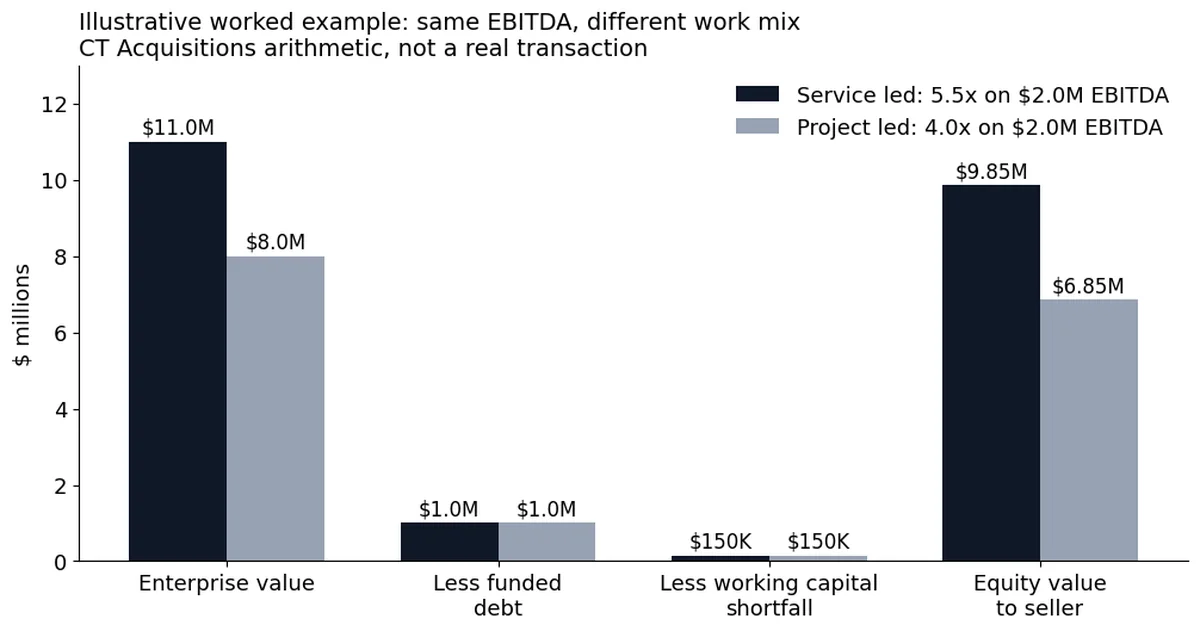
This is an illustrative example built on CT Acquisitions estimates, not a real transaction. The $3.0 million gap equals 1.5x EBITDA, and nothing about the plumbing work changed between the two businesses: only who signs the contracts and how concentrated they are. Run your own numbers in the plumbing business valuation calculator.
Curious what your business is worth?
A 15-minute confidential call gives you a real valuation range and tells you which buyers would compete for your business. No cost, no obligation, no pressure to sell.
Which revenue counts as recurring in commercial plumbing?
Buyers count revenue as recurring when a written agreement with a defined scope, price and renewal term stands behind it: preventive maintenance agreements, scheduled backflow testing and contracted grease interceptor service. Repeat calls from the same customer without a contract, tenant improvement work and new construction do not count, however often they come back.
| Revenue line | Counts as recurring? | What makes it hold up in diligence | Rule or document behind it |
|---|---|---|---|
| Annual backflow assembly testing | Yes, where the local code requires an annual test | Customer list with assembly IDs and last test dates | Fairfax County, Virginia: test at installation, after repair, on relocation and annually, by a certified tester |
| Preventive maintenance agreements | Yes | Signed term, scope, price and auto-renewal clause | The contract itself |
| Grease interceptor service contracts | Yes, when scheduled under contract | Service schedule and invoices by site | The contract itself |
| Emergency response retainers | Partly: the retainer fee, not the call volume | Signed retainer with fee schedule | The contract itself |
| Repeat one-off service calls | No | Not applicable | None |
| Tenant improvement and new construction | No: backlog, not recurring | Backlog schedule by job | General contractor subcontracts |
Many plumbing valuation guides, including the previous version of this page, call backflow testing state mandated and recurring. The primary text is narrower. The model code section, 312.10.2 of the International Plumbing Code, is adopted state by state: Michigan’s adopted version requires testing at installation, after repairs and at relocation, with no annual interval, under Mich. Admin. Code R. 408.30725h, while Fairfax County, Virginia requires an annual test. List which jurisdictions in your service area require the annual test before you call that revenue recurring.
Converting repeat customers into written agreements is the highest-return move in the 12 to 18 months before a sale, because it moves revenue from the bottom row of this table to the top. Our guide on how service agreements increase business value covers contract terms buyers accept.
What moves a commercial plumber up or down its band?
Five items move the multiple most under CT’s working rules: contracted service share, top customer concentration, master plumber license depth, technician tenure and public-work wage records. Each premium adds roughly 0.25x to 0.5x EBITDA; each discount takes 0.25x to 1x, and a single customer above 50% of revenue can take 1x to 1.5x.
| Item | Premium threshold | Discount trigger | CT working effect |
|---|---|---|---|
| Contracted service share | 40% or more of revenue | Under 15% of revenue | Top of band versus bottom of band |
| Top customer | Below 20% of revenue | 25% to 35%; 35% to 50%; above 50% | Minus 0.25x to 0.5x; minus 0.5x to 1x plus earn-out; minus 1x to 1.5x |
| Master plumber license | 2 or more licensed masters on the entity license | Owner holds the only qualifying license | Closing delay of 30 to 90 days or a holdback |
| Technician tenure | Average of 5 years or more | High turnover, no apprentices | Plus 0.25x to 0.5x when tenure is documented |
| Public work wage records | Certified payroll on every federally funded job | Missing prevailing wage records | Escrow or special indemnity request |
Commercial plumbers that work on public buildings face a check residential shops rarely see. The Davis-Bacon and Related Acts require locally prevailing wages and fringe benefits on federally funded or assisted construction contracts above $2,000, per the U.S. Department of Labor. Buyers ask for certified payroll on every such job because, in a stock sale, an underpayment claim stays with the company they are buying.
Concentration is the most common discount in commercial plumbing because property managers, hospital systems and general contractors buy in volume. A business with 35% of revenue from one account should plan 12 to 18 months of diversification or negotiate a customer retention earn-out in the letter of intent; our analysis of customer concentration and valuation shows how buyers structure it.
Who buys commercial plumbing businesses in 2026?
Four buyer groups bid on commercial plumbing: public mechanical contractors such as Comfort Systems USA and Limbach Holdings, private equity backed commercial service platforms such as Service Logic, regional mechanical contractors buying capacity, and SBA-financed individuals at the small end. Residential home services consolidators bid mainly on residential-heavy or blended books.
| Buyer group | Named example | Evidence | Typical target |
|---|---|---|---|
| Public mechanical contractor | Comfort Systems USA (NYSE: FIX) | Bought Right Way Plumbing & Mechanical for $65.0M in May 2025 (Form 10-Q) | Plumbing installation and maintenance with backlog |
| Public mechanical contractor | Limbach Holdings (NASDAQ: LMB) | Bought Consolidated Mechanical ($23M) and Pioneer Power ($66.1M) | Owner direct service and maintenance, $4M to $10M EBITDA |
| Private equity backed commercial service platform | Service Logic (Bain Capital with Mubadala since December 2025) | 140+ locations and 5,000+ technicians in commercial HVAC service, per Mubadala | Service-led commercial mechanical add-ons |
| Residential home services consolidator | The Wrench Group (Leonard Green & Partners since 2019) | Described as a home maintenance and repair provider at the 2019 sale | Residential-heavy or blended books |
| SBA-financed individual or search fund | Not applicable | SBA 7(a) loans up to $5M may fund changes of ownership | Owner-run shops under $1M EBITDA |
The buyer group sets the deal shape as much as the price. A public mechanical contractor pays mostly cash with a seller note and an earn-out, while a private equity platform often asks the owner to roll part of the proceeds into equity. Our guide to private equity in plumbing lists the active platforms and their add-on criteria.
Selling a commercial plumbing business? Talk to an advisor who knows the buyers first.
We work both sides of the table, with 500+ active buyers in our network. Commercial plumbing acquirers range from public mechanical contractors to private equity backed service platforms and regional strategics. No fee to you on buy-side introductions; sell-side mandates are paid on success at closing. A 15-minute discovery call gets you three things: an estimate of what your commercial plumbing business is worth in 2026, a sense of which buyer types fit your goals, and the option to meet one of them. Try our free valuation calculator first if you prefer. For founders in this space, our guide on plumbing contractor business worth maps the buyer behavior and typical multiples.
How much of the price do you receive at closing?
Less than the headline. In Comfort Systems USA’s 2025 deals, cash at closing was 76% of the price for Right Way Plumbing & Mechanical and 87% for Century Contractors; seller notes, earn-outs and a working capital adjustment made up the rest. Taxes then depend on whether the deal is an asset sale or a stock sale.
| Deal | Total preliminary price | Cash at closing | Seller notes | Remainder: earn-out and working capital | Source |
|---|---|---|---|---|---|
| Right Way Plumbing & Mechanical (May 1, 2025) | $65.0M | $49.5M (76%) | $5.0M (8%) | $10.5M (16%) | Comfort Systems USA Form 10-Q |
| Century Contractors (Jan 1, 2025) | $84.2M | $73.1M (87%) | $5.5M (7%) | $5.6M (6%) | Comfort Systems USA Form 10-Q |
In an asset sale, buyer and seller both file IRS Form 8594 to allocate the price across asset classes under Section 1060. Gain on trucks and equipment up to prior depreciation is taxed as ordinary income under the Section 1245 rules in IRS Publication 544, while goodwill held more than a year is taxed as long-term capital gain at 0%, 15% or 20%, per IRS Topic 409. Moving price from equipment to goodwill lowers the seller’s tax, which is why the allocation belongs in the letter of intent; ask your CPA to model both allocations before you sign.
Commercial plumbers carry receivables because property managers and general contractors pay on terms, so the working capital peg matters more than in residential service. The purchase agreement sets the peg, usually as a trailing 12-month average; deliver less and the price drops dollar for dollar. Our guide to the working capital peg in a business sale covers how to negotiate it for seasonal books.
Which exit path fits your commercial plumbing business?
Match the path to your EBITDA, work mix and license position. The decision table below turns the thresholds on this page into a next step for each common situation, from an owner-run shop under $1 million of EBITDA to a service-led contractor large enough to draw public mechanical buyers.
| If your situation is | Do this next | Why |
|---|---|---|
| Under $1M EBITDA and the owner holds the only master license | Add a licensed master plumber to the entity license at least 12 months before a sale | Removes a 30 to 90 day closing delay |
| Under $1M EBITDA with clean monthly books | Market to SBA-financed buyers, search funds and local strategics | SBA 7(a) loans reach $5M |
| $1M to $3M EBITDA and under 15% contracted service | Convert top accounts to written maintenance agreements for 12 to 18 months first | Moves you from 4.5x toward 5.5x |
| Any size, top customer above 35% of revenue | Diversify first, or negotiate a customer retention earn-out in the letter of intent | Avoids a 0.5x to 1x discount at diligence |
| $3M or more EBITDA with 40% or more owner direct service | Put public mechanical contractors and commercial service platforms on the buyer list | These buyers paid 5.75x to 6.6x expected EBITDA in 2024 to 2025 filings |
| More than 60% general contractor projects | Price against the bottom of the band, or split service and project P&Ls before marketing | Project margins ran 15.8% against 31.9% for owner direct work at Limbach |
Our guide on how to sell a plumbing business covers the process from the confidential information memorandum to closing. State-by-state licensing and buyer notes sit in the plumbing sale hub.
How we compiled this
We compiled this page from 16 primary documents accessed in October 2026: Limbach Holdings and Comfort Systems USA SEC filings, press releases and an earnings call; the GF Data H1 2025 summary published by Middle Market Growth; SBA, Department of Labor, Bureau of Labor Statistics and IRS pages; and two adopted plumbing code texts. The size bands are CT Acquisitions estimates, not a survey. We left out forum posts and broker multiples that cite no transactions.
Frequently asked questions
What is a commercial plumbing business worth in 2026?
On CT Acquisitions estimates, a commercial plumbing business is worth 3.5x to 4.5x adjusted EBITDA under $1 million, 4.5x to 5.5x at $1 million to $3 million, 5.5x to 6.5x at $3 million to $7 million, 6.5x to 8x at $7 million to $15 million and 7x to 9x above that. Contracted service work moves a business to the top of its band.
Is commercial plumbing worth more than residential plumbing?
Commercial service work is; commercial project work often is not. Limbach Holdings earned a 31.9% gross margin on owner direct work and 15.8% on general contractor work in Q3 2024. A commercial plumber living on general contractor bids can price below a residential service shop with the same earnings, while one with written maintenance agreements prices at the top of its band.
How much is a plumbing business worth with $1,000,000 in sales?
Revenue alone does not set the price. In an illustrative case, $1,000,000 of sales at a 20% owner earnings margin gives $200,000 of seller’s discretionary earnings; at 2.5x to 4.5x SDE that is $500,000 to $900,000. The same math on $500,000 of sales gives $250,000 to $450,000. Margin, not sales, moves the answer.
Do commercial plumbers make more money?
The Bureau of Labor Statistics reports a May 2024 median pay of $62,970 a year for plumbers, pipefitters and steamfitters, with no commercial versus residential split in that headline figure. At the business level, contracted commercial service earns more: Limbach’s owner direct segment ran a 31.9% gross margin in Q3 2024, about double its 15.8% on general contractor work.
Who buys commercial plumbing businesses?
Public mechanical contractors such as Comfort Systems USA and Limbach Holdings, private equity backed commercial service platforms such as Service Logic, regional mechanical contractors and, under $1 million of EBITDA, SBA-financed individuals. Comfort Systems paid $65.0 million for Right Way Plumbing and Mechanical in May 2025, and Limbach paid $66.1 million for Pioneer Power in July 2025.
Does backflow testing count as recurring revenue?
Only where a written contract and an annual testing rule stand behind it. Fairfax County, Virginia requires an annual test by a certified tester, but Michigan’s adopted code section 312.10.2 requires tests only at installation, after repairs and at relocation. Buyers check the rule in each jurisdiction you serve before they count the revenue as recurring.
How long does it take to sell a commercial plumbing business?
On CT Acquisitions planning ranges, a prepared commercial plumbing business takes 6 to 9 months from market launch to closing: about 2 months of outreach, 2 months of management meetings and offers, then 2 to 5 months of diligence and documents. Fixing a license gap or a customer concentration problem first adds 12 to 24 months of preparation.
Asset sale or stock sale for a commercial plumbing business?
Most buyers prefer an asset sale for the tax step-up and to leave old liabilities behind, and both sides then file IRS Form 8594. Sellers often prefer a stock sale for capital gains treatment on the whole price. A stock sale also keeps the contractor license with the company, which matters when in-progress commercial contracts cannot pause.
Sources
- Limbach Holdings, “Limbach Holdings Acquires Consolidated Mechanical” (December 2, 2024), accessed October 2026.
- Limbach Holdings, Form 8-K Exhibit 99.1 on the Pioneer Power acquisition (August 7, 2025), accessed October 2026.
- Limbach Holdings, Q3 2024 results, Form 8-K Exhibit 99.1 (November 5, 2024), accessed October 2026.
- Comfort Systems USA, Form 10-Q for the quarter ended September 30, 2025, accessed October 2026.
- Comfort Systems USA, Q2 2025 earnings call transcript (July 24, 2025), accessed October 2026.
- Middle Market Growth, “GF Data Report H1 2025” (September 10, 2025), accessed October 2026.
- Mubadala, “Mubadala partners with Bain Capital in acquisition of Service Logic” (December 17, 2025), accessed October 2026.
- Leonard Green & Partners, “Investcorp announces sale of The Wrench Group to Leonard Green” (April 8, 2019), accessed October 2026.
- U.S. Small Business Administration, 7(a) loans, accessed October 2026.
- U.S. Department of Labor, Wage and Hour Division, Davis-Bacon and Related Acts, accessed October 2026.
- Fairfax County, Virginia, Cross Connection Program: installation and testing requirements, accessed October 2026.
- Mich. Admin. Code R. 408.30725h (adopted section 312.10.2, Testing), accessed October 2026.
- U.S. Bureau of Labor Statistics, Occupational Outlook Handbook: Plumbers, Pipefitters, and Steamfitters, accessed October 2026.
- IRS, About Form 8594, Asset Acquisition Statement Under Section 1060, accessed October 2026.
- IRS, Topic No. 409, Capital gains and losses, accessed October 2026.
- IRS, Publication 544, Sales and Other Dispositions of Assets, accessed October 2026.

About the Author
Christoph Totter is the founder of CT Acquisitions, an M&A advisory firm working both sides of the table, headquartered in Sheridan, Wyoming. We work directly with 500+ buyers, search funders, family offices, lower middle-market PE, and strategic consolidators, including direct mandates with the largest consolidators that other intermediaries cannot access. No fee to you on buy-side introductions; sell-side mandates are paid on success at closing. Connect on LinkedIn · Get in touch
Related Guide: How to Sell a Plumbing Business, Full sale process for plumbing contractors across residential and commercial.
Related Guide: What Is a Plumbing Contractor Business Worth?, Plumbing contractor valuation by size tier and what drives multiples.
Related Guide: 2026 LMM Buyer Demand Report, Aggregated buy-box data from 76 active U.S. lower middle market buyers.
Related Guide: Buyer Archetypes: PE, Strategic, Search Fund, Family Office, How each buyer underwrites differently and what they pay for.
Related Guide: How to Sell an HVAC Business, HVAC valuation and sale process for residential and commercial.
Next steps: If you’re selling your commercial plumbing business, we run a confidential sell-side process, paid on success at closing. No public listing; introductions go only to matched buyers in our network of 500+ active capital partners.
Want a Specific Read on Your Business?
15 minutes, confidential, no cost. You leave with a read on your local buyer market and a likely valuation range.