Manufacturing M&A Advisor: How Business Owners Pick the Right Firm for Their Sale

A manufacturing M&A advisor is the firm that runs the sale of your manufacturing company: under $2 million of value a business broker usually fits, $2 million to $50 million an M&A advisor, above that an investment bank.
By Christoph Totter, Founder of CT Acquisitions · Last reviewed: October 2026
Key takeaways
- The IBBA guide to the business brokerage profession (2021) splits the market into Main Street (under $2 million of value), lower middle market ($2 million to $25 million), middle market ($25 million to $50 million) and upper middle market (over $50 million), where investment bankers usually take over.
- Business broker commissions run 8% to 15% of the sale price on Main Street deals, often with an agreed minimum, per the same IBBA guide (2021).
- In the 2024 to 2025 M&A Fee Guide from Axial, Firmex and Divestopedia (April 2025), 44% of surveyed advisors used a Lehman scale, 26% a flat percentage and 20% an accelerator.
- An unregistered M&A broker can only take a success fee on a stock sale under Exchange Act Section 15(b)(13) if the company had EBITDA under $25 million or revenue under $250 million and the buyer will run it.
- A manufacturer above $133.9 million of deal value faces a Hart-Scott-Rodino filing in 2026, per the FTC (January 14, 2026).
| Key number | Value | Source (date) |
|---|---|---|
| Main Street ceiling | $2 million of business value | IBBA guide (2021) |
| Broker commission, Main Street | 8% to 15% of sale price | IBBA guide (2021) |
| Advisors on a Lehman scale | 44% of surveyed firms | Axial, Firmex, Divestopedia (April 2025) |
| M&A broker exemption test | EBITDA under $25 million or revenue under $250 million | 15 U.S.C. 78o(b)(13) |
| HSR size of transaction, 2026 | $133.9 million | FTC (January 2026) |
| Manufacturing advisory firms listed on Axial | 431 | Axial directory (October 26, 2026) |
What does a manufacturing M&A advisor do?
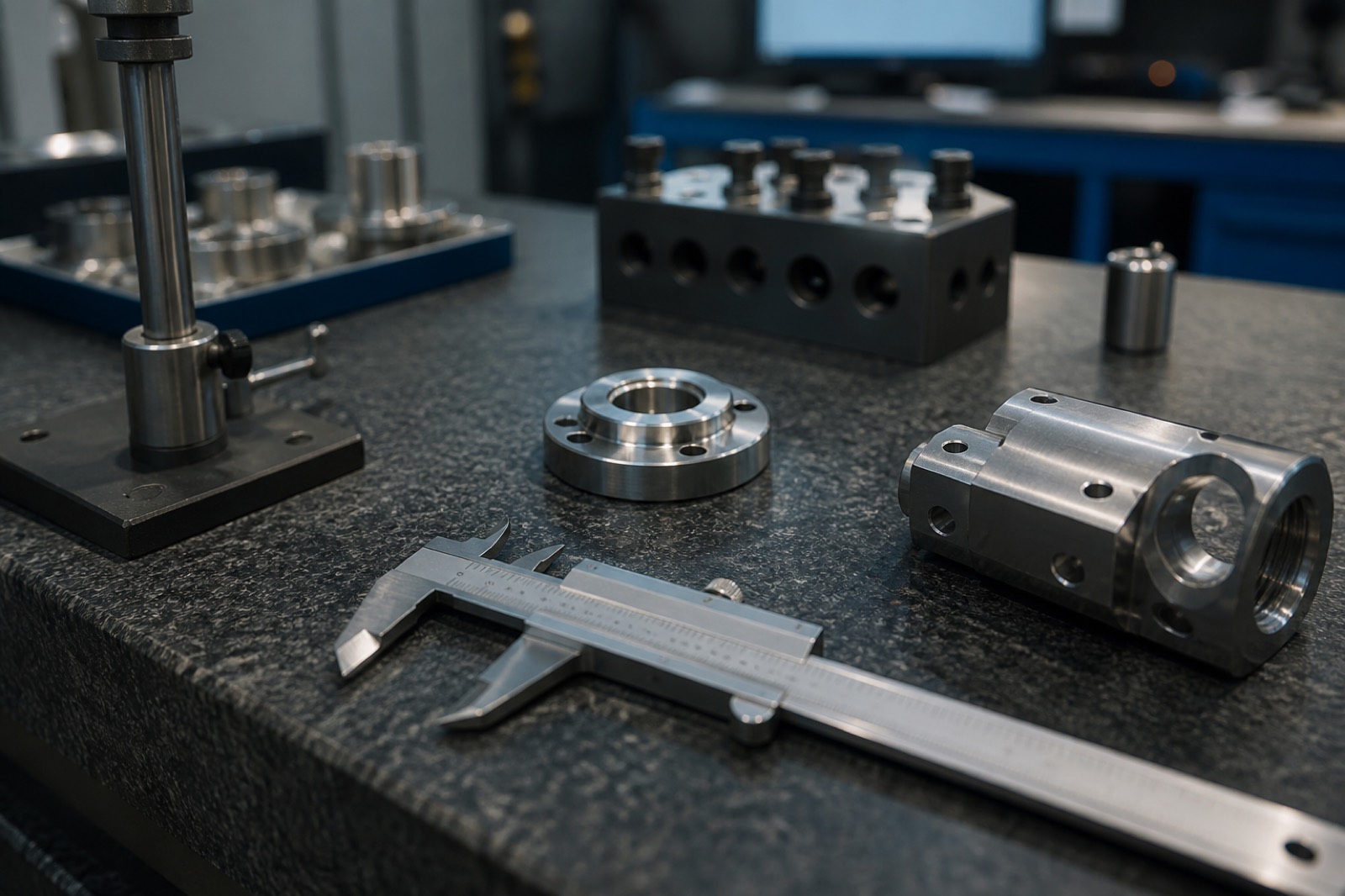
A manufacturing M&A advisor prices the company, prepares the confidential information memorandum (CIM), contacts strategic and private equity buyers, negotiates the letter of intent and manages diligence to closing. The manufacturing part is the balance sheet: inventory in the working capital peg, machinery appraisals, plant real estate, quality certifications and export controls.

Those items move money at closing. A 1% error on a $5,000,000 inventory balance is a $50,000 swing in the working capital true-up. Equipment needs a fair value allocation under ASC 805 for stock deals and IRC Section 1060 for asset deals, so the advisor lines up an American Society of Appraisers (ASA) machinery appraiser before buyers ask.
Buyers also price qualifications a generalist rarely explains. AS9100 for aerospace, ISO 13485 for medical devices and IATF 16949 for automotive take years to earn, and approved-supplier status at named OEMs is part of what a buyer is paying for. A specialist puts the time a competitor would need to qualify into the CIM.
Business broker, M&A advisor or investment bank: what is the difference?
The three advisor types differ by deal size, buyer pool, fee basis and registration. The IBBA guide (2021) places business brokers on Main Street deals under $2 million, M&A advisors in the $2 million to $50 million tiers and investment bankers above $50 million. Fee structure and FINRA registration follow from that split, as the table shows.
| Dimension | Business broker | M&A advisor (boutique) | Investment bank | Source |
|---|---|---|---|---|
| Typical value served | Under $2 million (Main Street) | $2 million to $50 million | Over $50 million | IBBA guide (2021) |
| Typical buyer | Individual operator, often local: under $500,000, 70% of buyers lived within 20 miles | Individuals, strategic or private equity buyers | Similar or larger companies, private equity groups | IBBA guide (2021), Q1 2020 Market Pulse |
| Fee basis | 8% to 15% commission, agreed minimum common | Success fee on a Lehman, flat or accelerator scale | Success fee scale negotiated per mandate | IBBA (2021); Axial fee guide (April 2025) |
| Registration | No broker-specific license in most states; 17 states require a real estate license | Exempt M&A broker under 15(b)(13), or a FINRA member | FINRA broker-dealer; bankers hold the Series 79 | IBBA white paper (2021); 15 U.S.C. 78o; FINRA |
| Named examples | Sunbelt Business Brokers, Transworld Business Advisors | Filter Axial’s manufacturing directory (431 firms) by size and sub-sector | Harris Williams, Baird, Lincoln International, Houlihan Lokey, PMCF | Firm websites and Axial directory, October 2026 |
The examples show the type of firm, not a ranking. Axial’s directory listed 431 manufacturing M&A advisory firms on October 26, 2026, so filter by size and sub-sector first. The full split between the first two types is in our M&A advisor vs business broker comparison.
How much does an M&A advisor charge?
An M&A advisor is paid mainly through a success fee at closing, sometimes with an engagement or work fee. In the Axial, Firmex and Divestopedia 2024 to 2025 survey, 44% of firms used a Lehman scale, 26% a flat percentage and 20% an accelerator. Business brokers charge 8% to 15% on Main Street deals, per the IBBA guide (2021).
The Lehman formula, developed by Lehman Brothers in the early 1970s per the Lehman Formula entry, charges 5% of the first $1 million, 4% of the second, 3% of the third, 2% of the fourth and 1% above $4 million. The Double Lehman doubles each rate to 10%, 8%, 6%, 4% and 2%. An accelerator raises the rate above a target price.
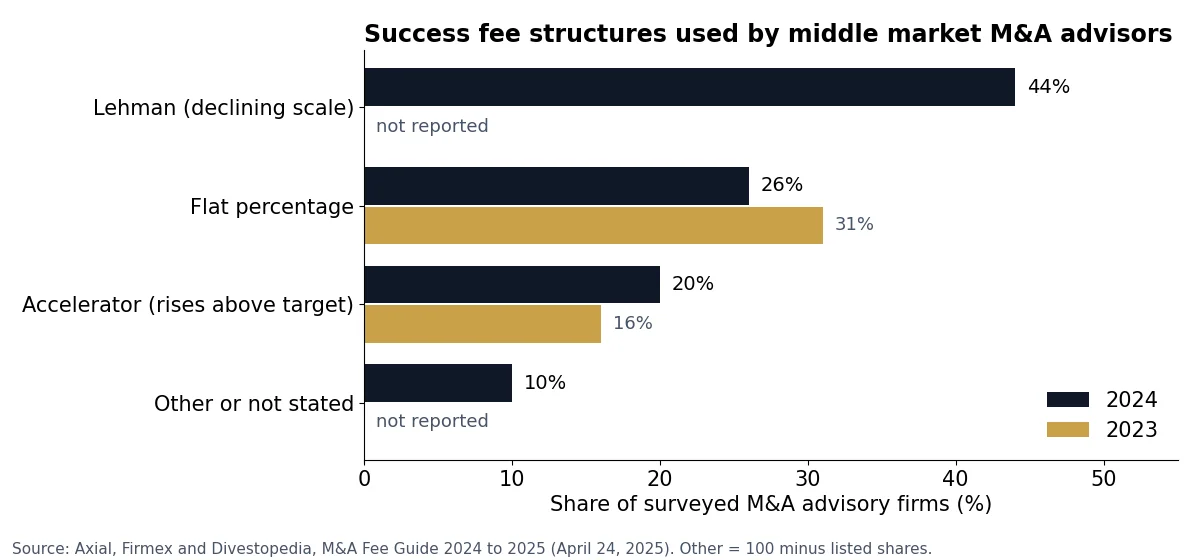
| Success fee structure | Share of firms, 2024 | Share of firms, 2023 | Source |
|---|---|---|---|
| Lehman (declining scale) | 44% | Not reported | Axial fee guide (April 2025) |
| Flat percentage | 26% | 31% | Axial fee guide (April 2025) |
| Accelerator | 20% | 16% | Axial fee guide (April 2025) |
| Other or not stated | 10% (arithmetic) | Not reported | 100 minus listed shares |
The formula changes the check more than the headline rate. The worked example below is illustrative arithmetic on the published formulas, not survey data, for a manufacturer selling at $5 million, $12 million and $30 million of enterprise value. The Firmex US edition of the same guide surveyed 212 US advisors.
| Sale price (illustrative) | Classic Lehman | Double Lehman | Flat 3% |
|---|---|---|---|
| $5,000,000 | $150,000 | $300,000 | $150,000 |
| $12,000,000 | $220,000 (1.8%) | $440,000 (3.7%) | $360,000 |
| $30,000,000 | $400,000 (1.3%) | $800,000 (2.7%) | $900,000 |
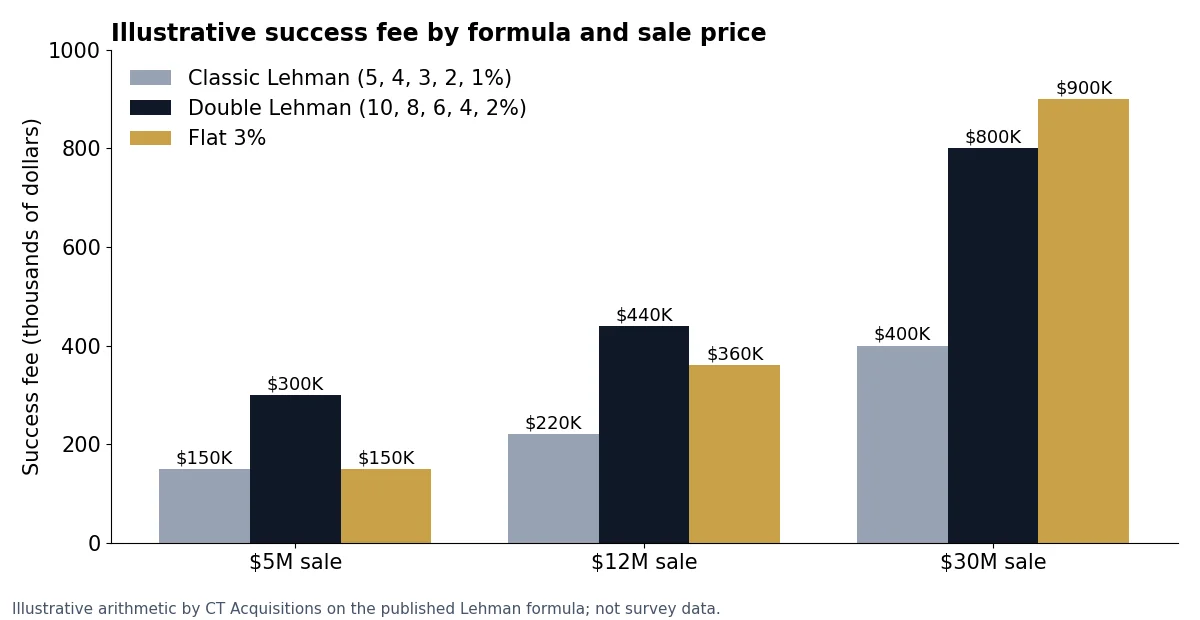
How the $12,000,000 row works: classic Lehman is $50,000 + $40,000 + $30,000 + $20,000 on the first $4 million, plus 1% of the remaining $8 million ($80,000), for $220,000. An accelerator at 3% up to $10 million and 6% above would cost $300,000 + $120,000 = $420,000. A Main Street 10% rate applied to the same sale would be $1,200,000, which is why the IBBA guide says larger deals move to a modified Lehman scale. Our M&A advisor fees guide covers tails, minimums and expense caps.
Which advisor type fits your company size?
Match the advisor to the value of the company, then check four overrides. Under $2 million of value, a business broker fits the IBBA Main Street tier. From $2 million to $50 million, a lower middle market M&A advisor fits. Above $50 million, or near the $133.9 million HSR threshold, an investment bank with antitrust counsel fits better.
| If your situation is | Then hire | Why (rule and source) |
|---|---|---|
| If the company is worth under $2 million | Business broker | IBBA Main Street tier; 8% to 15% commission (IBBA 2021) |
| If it is worth $2 million to $25 million | Lower middle market M&A advisor | IBBA lower middle market; strategic and private equity buyers enter (IBBA 2021) |
| If it is worth $25 million to $50 million | M&A advisor or middle market investment bank | IBBA middle market tier; compare both on named manufacturing closes |
| If it is worth over $50 million | Investment bank (FINRA broker-dealer) | IBBA upper middle market tier; Series 79 bankers (FINRA) |
| If EBITDA is $25 million or more and revenue is $250 million or more | FINRA-registered broker-dealer for any stock sale | Company is outside the 15(b)(13) exemption (15 U.S.C. 78o) |
| If the buyer will be passive, or the advisor will arrange financing | FINRA-registered broker-dealer | Excluded activities under 15(b)(13)(B) |
| If deal value exceeds $133.9 million | Investment bank plus antitrust counsel | HSR filing threshold, effective February 17, 2026 (FTC) |
| If you hold ITAR registration and a foreign buyer is likely | Advisor with ITAR deal experience | 60 days advance notice to DDTC (22 CFR 122.4(b)) |
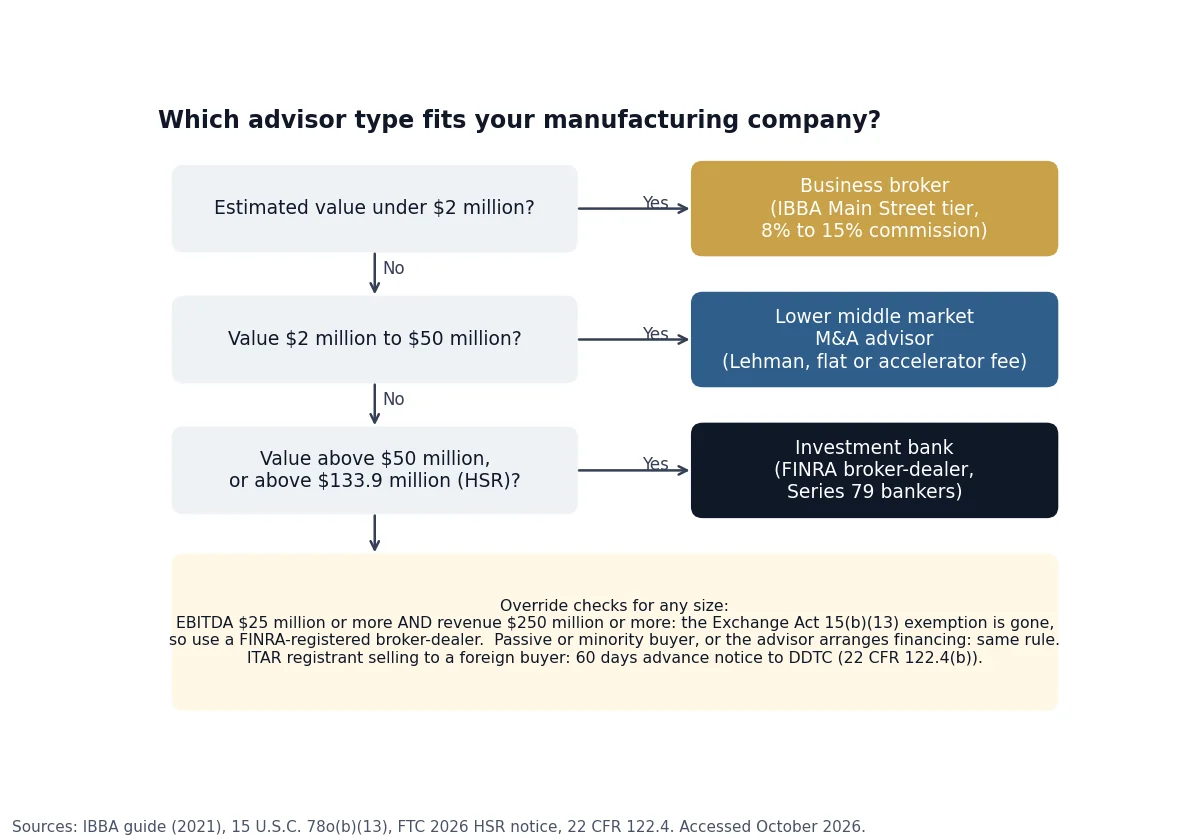
The tiers are value bands, and the IBBA guide notes that some sources use revenue instead. If you do not know your value, start with our manufacturing business valuation multiples and place yourself in a band before the first advisor call.
Does your manufacturing M&A advisor need to be registered?
Sometimes. Several guides state flatly that M&A advisors need no license. The statute is narrower: Exchange Act Section 15(b)(13) exempts an unregistered M&A broker only when the company had EBITDA under $25 million or revenue under $250 million, and the buyer will control and run it.
The same section removes the exemption if the advisor holds the deal funds, arranges or provides financing, sells to passive buyers, works with a shell company, or can bind either party. The dollar tests adjust every 5 years starting 5 years after December 29, 2022, so the first change is due in December 2027, rounded to the nearest $100,000.
Investment bankers who advise on M&A for a broker-dealer hold the FINRA Series 79, the Investment Banking Representative exam, with the SIE as a corequisite. Look up any firm or banker on FINRA BrokerCheck before signing. Business brokers face state rules instead: 17 states require a real estate license, per the IBBA white paper (June 2021).
Which manufacturing issues should the advisor own?
Five issues separate a manufacturing sale from a services sale: inventory in the working capital peg, the equipment appraisal, plant real estate, export controls and antitrust timing. Each carries a rule or a deadline, listed below, and the advisor should put each one into the process timeline before the first buyer call, not after the letter of intent.

| Issue | Rule or deadline | What the advisor does |
|---|---|---|
| Inventory and working capital | Peg set in the LOI; a 1% inventory error on $5,000,000 is $50,000 | Agree the cost method, obsolete stock reserve and count date before signing; see our net working capital adjustment guide |
| Machinery and equipment | ASC 805 fair value (stock deals); IRC Section 1060 allocation (asset deals) | Commission an ASA machinery appraisal showing FMV in continued use, OLV and FLV |
| Plant real estate | Sell with the company, lease back, or sell separately | Model proceeds under each option before buyers see the CIM |
| Export controls | ITAR notice within 5 days of an ownership change; 60 days before a sale to a foreign person (22 CFR 122.4) | Screen foreign buyers early and build the notice into the closing date |
| Antitrust | HSR filing above $133.9 million in 2026, up from $126.4 million in 2025 (FTC) | Add the waiting period to the timeline for large strategic buyers |
Which buyers show up also depends on the sub-sector. Our list of private equity firms buying manufacturing companies names the active sponsors, and the guide to selling a manufacturing business covers the sale process from preparation to closing.
How do you vet a manufacturing M&A advisor?
Interview at least three firms and score each on evidence, not the pitch. Ask for named manufacturing closes at your size in the last 36 months, the person who will run the deal day to day, the fee formula run at your low, base and high price, and a BrokerCheck record or the 15(b)(13) basis if the firm is not registered.
- Ask for 3 named manufacturing sales in your sub-sector in the last 36 months, with buyer type, deal size band and months from engagement to close.
- Ask who runs your deal day to day, and get that name written into the engagement letter.
- Ask for the success fee formula in writing and calculate it at three prices, as in the $12,000,000 example above.
- Ask whether any engagement or work fee is credited against the success fee, and how long the tail period runs after the engagement ends.
- Check the firm on FINRA BrokerCheck, or ask which 15(b)(13) conditions it relies on for a stock sale.
- Ask how the firm handled AS9100, ISO 13485, IATF 16949 or ITAR issues on past deals, if your plant holds any of them.
- Ask for the buyer list split between strategic acquirers and private equity, with 5 names in each column.
Our questions to ask an investment banker before hiring extend this list, and the engagement letter guide shows where tail and exclusivity terms sit.
Where does CT Acquisitions fit?
CT Acquisitions is an M&A advisory firm for founder-owned businesses, working on the sell side, the buy side and exit planning with a network of 500+ buyers and capital partners. No fee to you on buy-side introductions; sell-side mandates are paid on success at closing. To test the decision table above against your own numbers, book a 30-minute exit-readiness call at ctacquisitions.com/contact-us/.
How we compiled this
We compiled this page in October 2026 from 9 primary documents: two IBBA publications (2021), the Axial and Firmex 2024 to 2025 fee guide pages, the text of 15 U.S.C. 78o, FINRA’s Series 79 page, the FTC 2026 HSR notice, 22 CFR 122.4 and Axial’s advisor directory. Fee examples are our own arithmetic on the published formulas. We did not use forum posts or advisor self-rankings as sources.
Frequently asked questions
How much does an M&A advisor charge?
An M&A advisor is paid mostly by a success fee at closing. In the Axial, Firmex and Divestopedia 2024 to 2025 fee guide, 44% of advisors used a Lehman scale, 26% a flat percentage and 20% an accelerator. Business brokers charge 8% to 15% on Main Street sales under $2 million, per the IBBA guide (2021). Run the quoted formula at three prices before signing.
What does an M&A advisor do?
An M&A advisor represents the owner in a sale: it values the company, writes the confidential information memorandum, contacts strategic and private equity buyers, negotiates the letter of intent and runs diligence to closing. For a manufacturer, it also handles the inventory working capital peg, the ASA equipment appraisal under ASC 805 or IRC Section 1060, plant real estate and ITAR notices.
Do I need an investment bank to sell a manufacturing company?
Usually not below $50 million of value, the IBBA upper middle market line. An investment bank becomes the default above that, when HSR applies above $133.9 million in 2026, or when EBITDA is $25 million or more and revenue $250 million or more, because the Exchange Act 15(b)(13) exemption for unregistered M&A brokers no longer covers a stock sale.
Is a business broker or an M&A advisor better for a manufacturer?
A business broker fits a manufacturer worth under $2 million, where buyers are often local individuals and commissions run 8% to 15%, per the IBBA guide (2021). From $2 million upward, strategic and private equity buyers enter, and an M&A advisor with named manufacturing closes and a Lehman, flat or accelerator fee usually fits better.
Who are the Big 4 in M&A, and should a manufacturer hire one?
The Big 4 are Deloitte, PwC, EY and KPMG. Each runs transaction services such as quality of earnings, tax structuring and diligence, plus a corporate finance arm that advises on sales. Lower middle market manufacturers most often hire a Big 4 or regional accounting firm for the sell-side quality of earnings report, and a specialist M&A advisor to run the sale itself.
What is an advanced manufacturing and engineered products M&A advisor?
It is an investment bank or M&A advisor team that covers precision, specification-driven products: machined components, motion and flow control, sensors and parts for aerospace, defense and medical supply chains. These advisors price AS9100, ISO 13485 and IATF 16949 certifications, sole-source positions and build-to-spec designs, and plan ITAR notices of 5 days after, or 60 days before, a foreign sale.
What is the difference between an industrial M&A advisor and a manufacturing M&A advisor?
Industrial is the wider label. An industrial M&A advisor covers manufacturing plus distribution, industrial services, building products and transportation. A manufacturing M&A advisor focuses on companies that make products, so it goes deeper on inventory, equipment appraisals, plant real estate and customer qualifications. Many industrial banks run a manufacturing team inside the group, so ask who would run your deal.
Sources
- IBBA, Your Guide to the Business Brokerage Profession (January 2021), accessed October 2026.
- IBBA, Comparing Business and Real Estate Brokerage (June 2021), accessed October 2026.
- Axial, M&A Fee Guide 2024-2025 (April 24, 2025), accessed October 2026.
- Firmex, M&A Fee Guide 2024-2025, US Edition, accessed October 2026.
- Cornell LII, 15 U.S.C. 78o, Exchange Act Section 15(b)(13), accessed October 2026.
- FINRA, Series 79 Investment Banking Representative exam and BrokerCheck, accessed October 2026.
- FTC, 2026 update of HSR jurisdictional and fee thresholds (January 14, 2026), accessed October 2026.
- Cornell LII, 22 CFR 122.4, ITAR notification of changes, accessed October 2026.
- Axial, Manufacturing M&A advisory firm directory, accessed October 26, 2026.
- Lehman Formula (definition of the 5, 4, 3, 2, 1 scale), accessed October 2026.