
Top 30 Private Credit Firms in 2026: Rankings, Strategies, and AUM

The largest private credit firms in 2026 are Apollo Global Management ($849.3 billion of credit AUM), Blackstone ($480.0 billion) and Ares Management ($440.5 billion), according to each firm’s own 2026 filings.
By Christoph Totter, Founder of CT Acquisitions · Last reviewed: October 2026
Key takeaways
- Apollo Global Management reports $849.3 billion of credit AUM at June 30, 2026, the largest credit figure any manager publishes; a large part backs Athene annuities (Apollo Q2 2026 release).
- Blackstone’s Credit & Insurance segment reached $480.0 billion at September 30, 2026 after $35.8 billion of third quarter inflows (Blackstone Q3 2026 results).
- Ranked by capital raised from 2021 to 2025 instead of AUM, the order changes: the PEI Private Credit 200 puts Ares first with $117,997 million and Apollo seventh.
- BlackRock closed its purchase of HPS on July 1, 2025 (BlackRock) and Brookfield completed its Oaktree acquisition on August 3, 2026 (Brookfield), so neither HPS nor Oaktree is ranked on its own here.
- For founder-owned companies the floor is lower: Twin Brook and Monroe Capital state EBITDA ranges starting at $3 million, and the SBA caps 7(a) loans at $5 million.
Who are the top 30 private credit firms by AUM in 2026?
Ranked by the credit figure each firm publishes about itself, Apollo Global Management, Blackstone and Ares Management are the three largest private credit firms in 2026, followed by Brookfield (which now owns all of Oaktree) and KKR. Each row below shows the exact figure, what it counts, its date and a link to the filing or firm page it came from.
| Rank | Firm | Credit figure as published | What the figure counts | As of | Source |
|---|---|---|---|---|---|
| 1 | Apollo Global Management | $849.3 billion | Credit segment AUM, includes assets backing Athene annuities | June 30, 2026 | Apollo Q2 2026 earnings release |
| 2 | Blackstone (Credit & Insurance) | $480.0 billion | Credit & Insurance segment AUM | September 30, 2026 | Blackstone Q3 2026 results |
| 3 | Ares Management | $440.5 billion | Credit Group AUM | June 30, 2026 | Ares Q2 2026 earnings presentation |
| 4 | Brookfield (incl. Oaktree) | $416 billion | Credit business AUM, includes Oaktree and other partner managers | June 30, 2026 | Brookfield Asset Management Q2 2026 supplemental |
| 5 | KKR | $330.8 billion | Credit and Liquid Strategies AUM | June 30, 2026 | KKR Form 10-Q, Q2 2026 |
| 6 | Goldman Sachs Alternatives | $230 billion | Private credit assets, includes borrowed capital and unfunded commitments | Published September 24, 2026 | Goldman Sachs Asset Management press release |
| 7 | Carlyle (Global Credit) | $211 billion | Global Credit segment AUM | June 30, 2026 | Carlyle Q2 2026 earnings release |
| 8 | PIMCO | $182 billion | Alternative Credit & Private Strategies, includes $79.1 billion of real estate | March 31, 2026 | PIMCO alternatives page |
| 9 | Blue Owl Capital | $158.1 billion | Credit platform AUM ($115.1 billion of it direct lending) | June 30, 2026 | Blue Owl Form 10-Q, Q2 2026 |
| 10 | BlackRock (incl. HPS) | $152.3 billion | Private credit AUM line, includes HPS | September 30, 2026 | BlackRock Q3 2026 earnings release |
| 11 | Sixth Street | $140 billion+ | Firm-wide AUM | June 30, 2026 | Sixth Street website |
| 12 | Oak Hill Advisors (T. Rowe Price) | $108 billion | Firm-wide AUM across credit strategies | September 30, 2025 | OHA press release, December 11, 2025 |
| 13 | TPG (incl. Angelo Gordon, Twin Brook) | $101.2 billion | Credit platform AUM | June 30, 2026 | TPG Q2 2026 earnings release |
| 14 | Benefit Street Partners (Franklin Templeton) | $96.4 billion | Firm-wide AUM, approximate and unaudited | June 30, 2026 | Benefit Street Partners website |
| 15 | Antares Capital | ~$96 billion | Capital under management and administration | June 30, 2026 | Antares Capital website |
| 16 | Golub Capital | $95 billion+ | Capital under management, gross invested capital including borrowings | October 1, 2026 | Golub Capital website |
| 17 | Bain Capital Credit | $73 billion | AUM and co-invest | June 30, 2026 | Bain Capital Credit About page |
| 18 | Barings (Global Private Finance) | $67 billion+ | Global Private Finance platform (firm-wide AUM $500 billion) | May 15, 2026 | Barings press release |
| 19 | Churchill Asset Management (Nuveen) | $66 billion | Committed capital | June 30, 2026 | Churchill website |
| 20 | Fortress Investment Group | $55 billion | Firm-wide managed assets (KBRA: $20 billion corporate credit, $13 billion asset-backed finance) | June 30, 2026 | Fortress website |
| 21 | Crescent Capital Group (Sun Life) | $54 billion | Firm-wide AUM | September 30, 2026 | Crescent website |
| 22 | CVC Credit | EUR 46.7 billion (about $53.2 billion) | Credit fee-paying AUM | June 30, 2026 | CVC 2026 half-year results |
| 23 | Hayfin Capital Management | about EUR 40 billion (about $45.6 billion) | Firm-wide AUM | Q2 2026 | Hayfin website |
| 24 | Kayne Anderson | about $43 billion | Firm-wide AUM (credit plus other strategies) | June 30, 2026 | Kayne Anderson BDC website |
| 25 | Partners Group (private credit) | $40.5 billion | Private credit AuM (firm-wide $186 billion) | June 30, 2026 | Partners Group H1 2026 AuM release |
| 26 | ICG (Debt) | $33.6 billion | Fee-earning AUM of Private Debt plus Credit (firm-wide AUM $126 billion) | March 31, 2026 | ICG FY2026 results |
| 27 | Neuberger Berman (private debt) | $24.3 billion | Private debt AUM | September 30, 2025 | Neuberger Berman newsroom |
| 28 | Monroe Capital | $23.8 billion | Committed and managed capital | July 1, 2026 | Monroe Capital About page |
| 29 | Comvest Partners | $21.8 billion | Firm-wide AUM | June 30, 2026 | Comvest website |
| 30 | Man Varagon (Man Group) | $11.8 billion | AUM at acquisition (latest public figure) | September 7, 2023 | Man Group completion release |
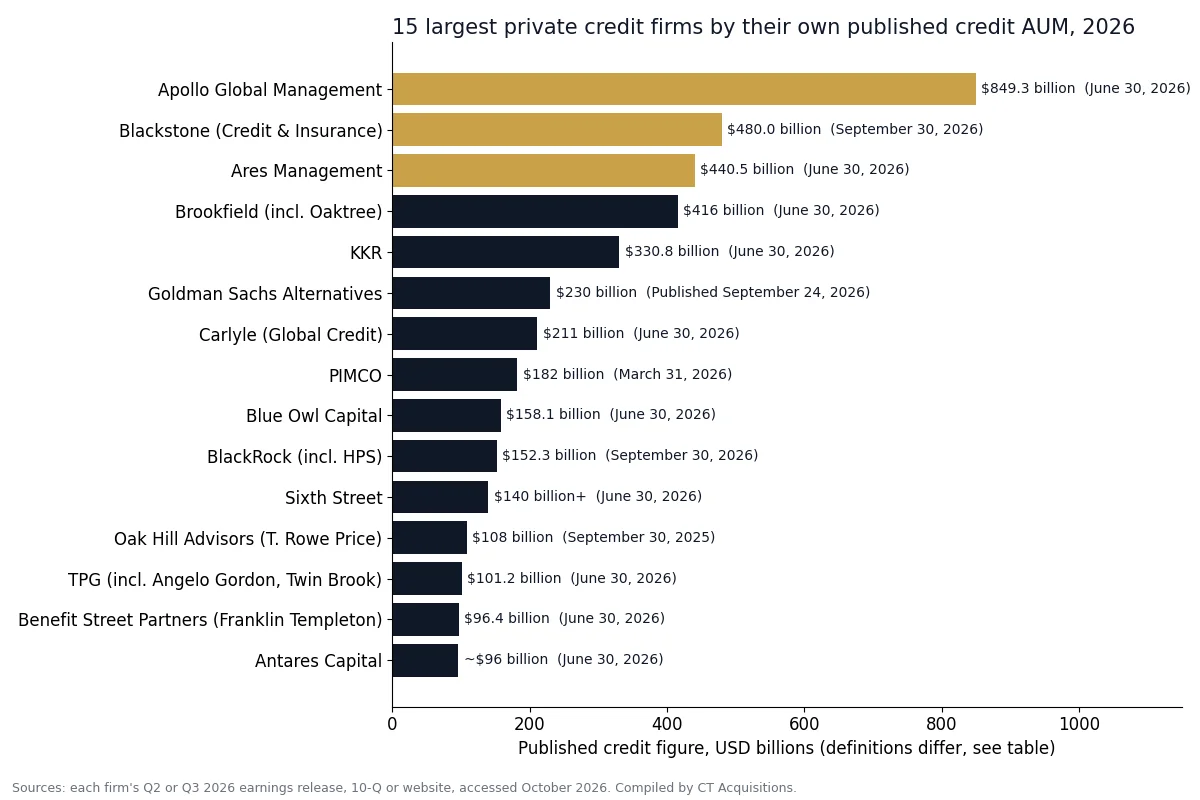
The definitions behind the numbers differ, so the order is directional below the top five. Apollo counts assets backing Athene’s annuities, Golub counts gross invested capital including borrowings, Churchill counts committed capital, and Goldman Sachs Alternatives counts borrowed capital and unfunded commitments in its $230 billion. Fortress, Crescent, Comvest, Kayne Anderson, Sixth Street and Oak Hill Advisors publish firm-wide figures because credit is most or all of what they manage.
Two euro figures are converted at the ECB reference rate of 1.1394 dollars per euro on June 30, 2026 (Official Journal of the EU): CVC’s EUR 46.7 billion becomes about $53.2 billion and Hayfin’s EUR 40 billion about $45.6 billion. Three rows carry older dates because the firms have not published newer numbers: Oak Hill Advisors and Neuberger Berman (September 30, 2025) and Man Varagon (September 7, 2023).
Why do lists of the largest private credit firms disagree?
Lists disagree because they measure different things. AUM rankings count what a firm manages today, including insurance balance sheets, while the PEI Private Credit 200 counts private debt capital raised from January 1, 2021 to December 31, 2025 and excludes BDCs. Apollo is first on AUM and seventh on fundraising; ICG is sixth on fundraising and 26th on its Debt line.
| Firm (as named by PEI) | PEI Private Credit 200 rank | Capital raised 2021 to 2025 ($m) | Rank on this page | Why the ranks differ |
|---|---|---|---|---|
| Ares Management | #1 | 117,997 | #3 | Same firm leads both lists |
| Blackstone | #2 | 111,529 | #2 | Consistent on both measures |
| HPS Investment Partners | #3 | 107,495 | #10 | Now inside BlackRock (closed July 1, 2025); we rank the combined private credit line |
| Goldman Sachs Asset Management | #4 | 91,211 | #6 | Large fundraiser; its $230 billion figure counts borrowed capital and unfunded commitments |
| ICG | #6 | 63,783 | #26 | Most ICG capital sits in structured capital and secondaries, which our Debt line excludes |
| Apollo Global Management | #7 | 61,434 | #1 | Apollo’s credit AUM is mostly insurance balance sheet (Athene), not third-party fund raising |
| The Carlyle Group | #8 | 50,466 | #7 | Consistent on both measures |
| Oaktree Capital Management | #9 | 47,881 | #4 | Owned by Brookfield since August 3, 2026; ranked inside Brookfield here |
| BlackRock | #10 | 46,783 | #10 | PEI lists BlackRock and HPS separately |
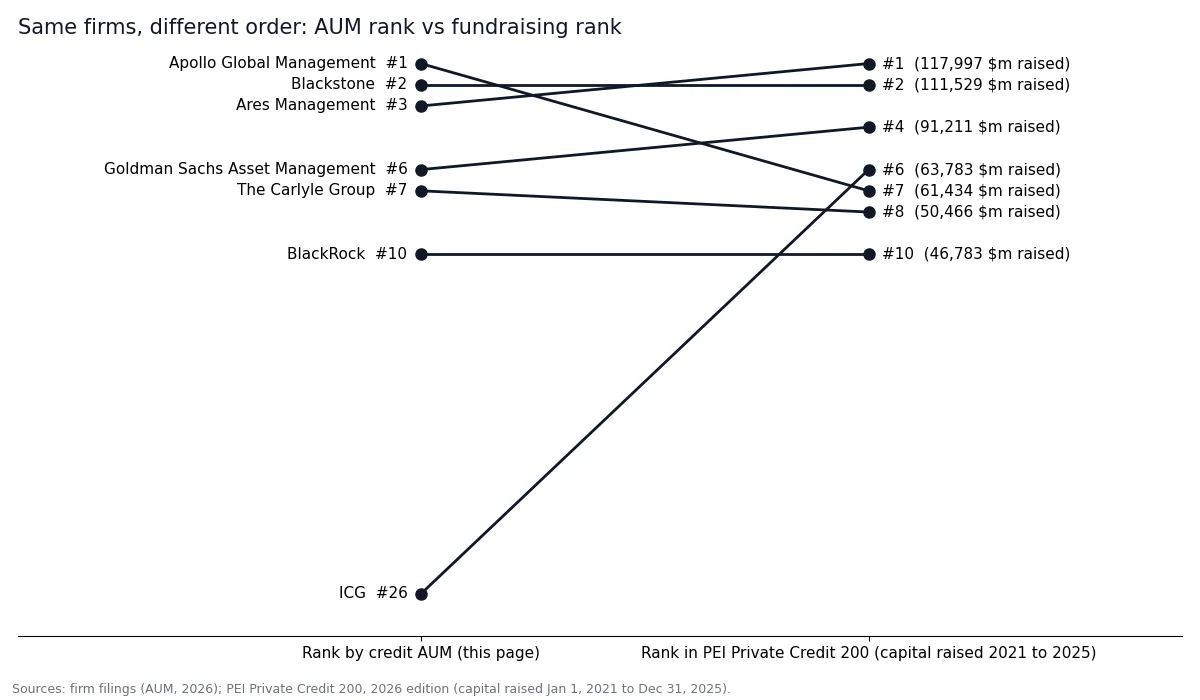
PEI also lists HPS Investment Partners ($107,495 million, third) and BlackRock ($46,783 million, tenth) as separate firms. Added together, the two would have raised $154,278 million from 2021 to 2025 and would top the 2026 list ahead of Ares; we rank them as one row because BlackRock has owned HPS since July 1, 2025.
Four errors to check in any private credit firms list
Before trusting any list of top private credit firms, check four things: whether a subsidiary is counted twice, whether the figures share one definition, how old each figure is, and whether each number links to a source. The GrowthCap list of 15 firms from November 2025 fails the fourth test.
- Counting a subsidiary twice. Oaktree reported $227 billion of AUM at June 30, 2026 (OCSL investor presentation), and that sits inside Brookfield’s $416 billion credit figure. The same applies to HPS inside BlackRock and Twin Brook inside TPG.
- Mixing definitions. PIMCO’s $182 billion Alternative Credit & Private Strategies line includes $79.1 billion of real estate. Brookfield’s own Oaktree release headlines a $365 billion credit platform, while its June 30, 2026 supplemental shows $416 billion including partner managers.
- Stale figures. Crescent managed about $29 billion at September 30, 2020 when Sun Life bought 51% (Sun Life release); its website shows $54 billion at September 30, 2026.
- Unsourced numbers. The GrowthCap list of 15 top private credit firms published in November 2025 assigns no ranks and cites no source for any AUM figure (GrowthCap). A figure without a date and a link cannot be checked.
Which private credit firms changed owners since 2021?
Eight deals since January 2021 folded independent credit managers into larger groups, the latest being Brookfield’s purchase of the rest of Oaktree on August 3, 2026 and BlackRock’s purchase of HPS on July 1, 2025. That is why HPS, Oaktree, Angelo Gordon, Alcentra and Atalaya no longer appear as separate rows in the ranking above.
| Private credit firm | Bought by | Closed | Source |
|---|---|---|---|
| Crescent Capital Group (51%) | Sun Life | January 5, 2021 | Sun Life release |
| Alcentra | Franklin Templeton | November 1, 2022 | Franklin Templeton release |
| Varagon Capital Partners | Man Group | September 7, 2023 | Man Group release |
| Angelo Gordon (incl. Twin Brook) | TPG | November 1, 2023 | TPG release |
| Fortress (SoftBank’s 90.01%) | Mubadala and Fortress management | May 2024 | Fortress release |
| Atalaya Capital Management | Blue Owl | September 30, 2024 | Blue Owl release |
| HPS Investment Partners | BlackRock | July 1, 2025 | BlackRock release |
| Oaktree (remaining interest) | Brookfield | August 3, 2026 | Brookfield release |
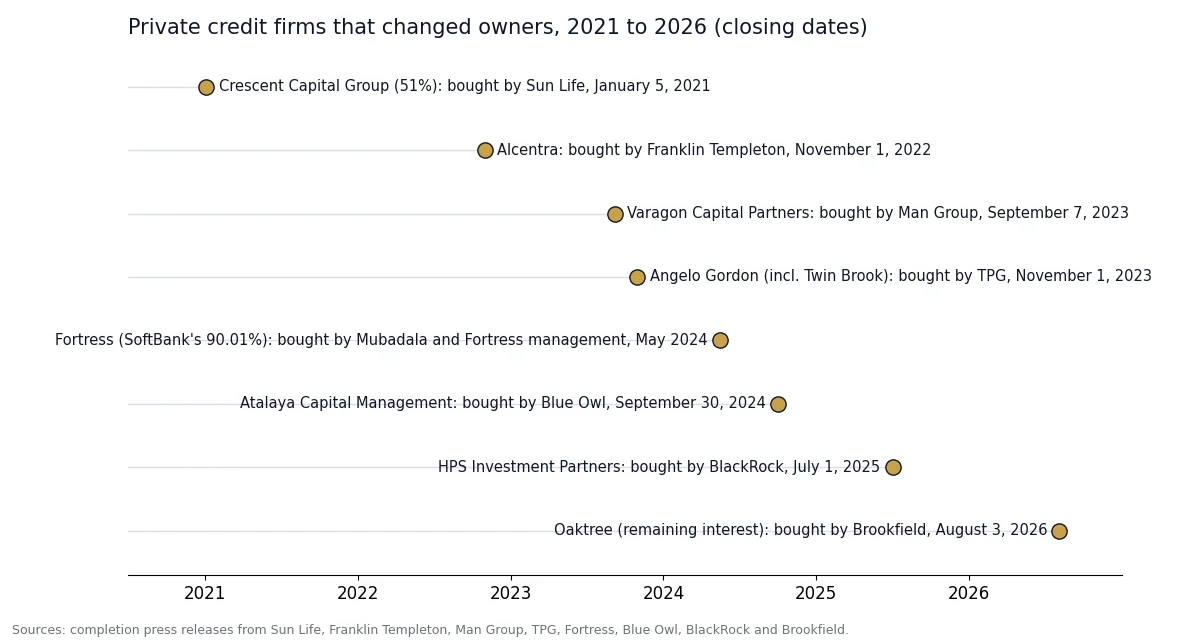
For a seller, an ownership change matters only if it changes who approves the loan. If the buyer’s lender is HPS, Oaktree or Twin Brook, ask whether the credit decision now runs through the parent (BlackRock, Brookfield or TPG) and whether that adds a committee step before a commitment letter is signed.
What do private credit firms lend, and to whom?
Private credit firms make loans that banks used to syndicate: senior and unitranche loans to companies being bought, junior or mezzanine debt behind them, asset-backed finance secured by pools of receivables or equipment, and opportunistic credit. The IMF April 2024 Global Financial Stability Report put the global market at about $2.1 trillion at the end of 2023.
| Strategy | Where it sits | When a sale of a founder-owned company uses it | Firms in this ranking that name it on their own pages |
|---|---|---|---|
| Senior direct lending and unitranche | First lien, repaid first | The buyer funds most of the debt with one lender or a small club | Churchill (first lien and unitranche), Golub (holds up to $1 billion), Twin Brook, Antares |
| Junior capital and mezzanine | Behind the senior loan, ahead of equity | Fills the gap between senior debt and the buyer’s equity, often next to a seller note | Churchill, Goldman Sachs Alternatives (mezzanine debt), Audax (junior debt up to $150 million) |
| Asset-backed finance | Secured by a pool of receivables, equipment or other assets | Companies whose value sits in equipment fleets or receivables | Fortress ($13 billion per KBRA), Blue Owl (Atalaya), Brookfield |
| Opportunistic and distressed credit | Anywhere in the capital structure | Stressed sellers, rescue financing, carve-outs | Oaktree and Brookfield (opportunistic credit) |
| Liquid credit and CLOs | Broadly syndicated loans that trade | Larger buyouts financed in the syndicated market | KKR (Credit and Liquid Strategies), Antares (Liquid Credit) |
Most acquisitions of founder-owned companies use the first two rows. A unitranche loan combines senior and junior debt into one facility with one lender, which shortens the lender list a seller has to vet; the mechanics are in our guide to unitranche debt for acquisition financing. When the senior lender stops short of the price, the gap is filled with mezzanine debt for acquisitions or a seller note.
A firm is not the same as a fund. Apollo, Ares and Blue Owl each run several funds and BDCs, so a ranking of individual vehicles orders the names differently; that view is in our list of the largest private credit funds. How direct lending relates to the wider private credit market is covered in private credit vs direct lending.
Which private credit firms lend to lower middle market and founder-owned companies?
Most of the 30 largest private credit firms do not lend to a company with $5 million of EBITDA. The lenders that publish lower middle market ranges start at $3 million of EBITDA (Twin Brook, Monroe Capital), and only some state that they finance non-sponsored or family-owned businesses: Monroe, Comvest, White Oak, Brightwood and Muzinich.
| Lender | Target EBITDA as stated | Hold or deal size as stated | Who it finances (as stated) | Source |
|---|---|---|---|---|
| Twin Brook (TPG) | $3 million to $50 million, emphasis on $25 million and below | Holds $25 million to $250 million; financings up to $400 million | Sponsor-led buyouts and recapitalizations | Lender website |
| Monroe Capital | $3 million to $35 million (website); Q3 2026 brochure says from $5 million | Up to $300 million hold (brochure) | Sponsored, privately held and independent sponsor deals | Lender website |
| Comvest Credit Partners | Above $5 million | Up to $300 million+ hold | Sponsored, non-traditionally sponsored and non-sponsored | Lender website |
| Brightwood Capital | $5 million to $75 million | Not stated | Focus on family-owned businesses | Lender website |
| Golub Capital | $5 million to $250 million+ | Hold up to $1 billion | Private equity sponsored | Lender website |
| White Oak Global Advisors | Below $50 million (enterprise value $50 million to $2 billion) | Senior debt $10 million to $500 million; typical hold $10 million to $150 million | Sponsored and non-sponsored | Lender website |
| Churchill (senior lending) | $10 million to $100 million | $50 million to $600 million target position | Private equity backed | Lender website |
| Audax Private Debt (senior) | $10 million to $100 million | Senior up to $350 million | Financial sponsors | Lender website |
| Kayne Anderson (KBDC) | $10 million to $75 million+ | Not stated | Not stated | Lender website |
| Deerpath Capital | Not stated | $25 million to $150 million per borrower | Primarily private equity sponsors | Lender website |
| Muzinich (private debt) | EUR 5 million to EUR 25 million | Target deal size $10 million to $50 million+ | Founder-owned and private equity owned | Lender website |
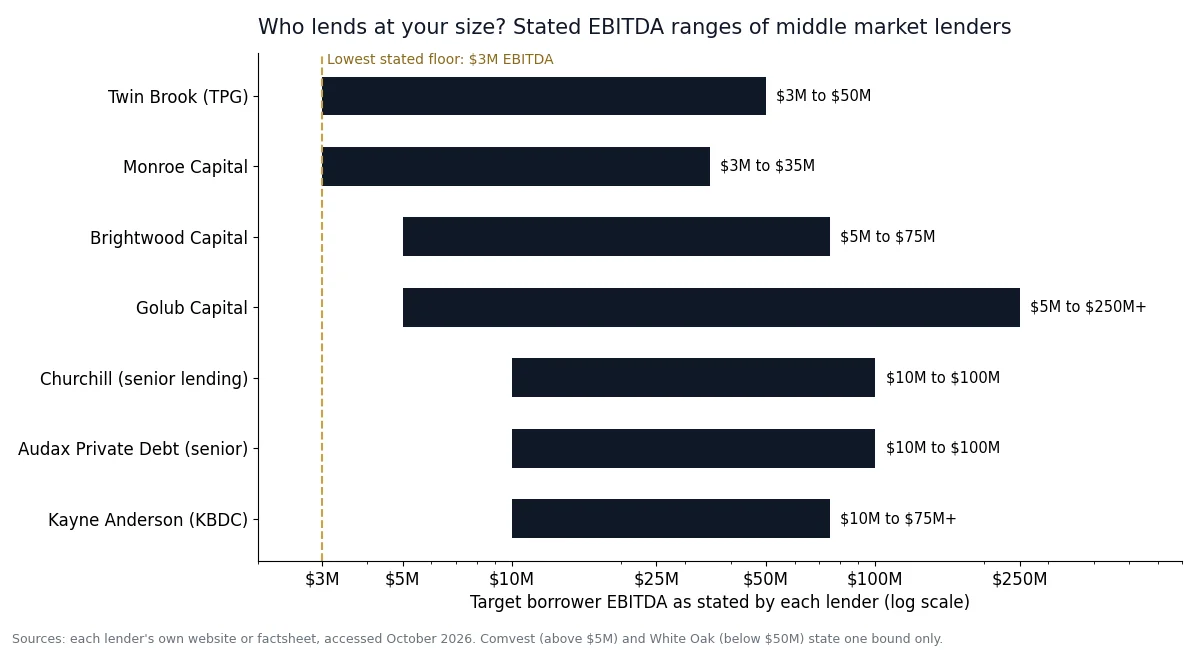
The sponsor column matters as much as the EBITDA column. Golub, Churchill, Audax and Twin Brook describe private equity sponsors as their borrowers, so a family office or independent sponsor bidding for your company will usually need a lender such as Comvest, which lists private equity sponsored, non-traditionally sponsored and non-sponsored deals, or Brightwood, which names family-owned businesses with $5 million to $75 million of EBITDA.
Monroe Capital’s own materials disagree on its floor: its financing page says $3 million to $35 million of EBITDA, while its Q3 2026 brochure says from $5 million. Ask the lender which number applies to your deal before you rely on it.
How should a seller check a buyer’s private credit lender?
Before granting exclusivity, find out who the lender is, whether it will hold the loan, whether your company fits the lender’s stated EBITDA range (from $3 million at Twin Brook and Monroe) and borrower type, and what the lender has signed. A named lender with a commitment letter is a financed bid; “customary financing” with no name is a price you have not been offered yet.
- Get the lender’s name. If the LOI only says “third-party debt”, ask in writing which lender has seen your numbers. Until you have a name, treat the headline price as provisional.
- Ask whether the lender holds or sells down. A lender that holds the loan, or leads a small club, controls its own decision to fund. A plan to syndicate makes the buyer depend on market appetite between signing and closing; in that case ask for a commitment letter before you sign the purchase agreement.
- Check fit against the lender’s own range. Compare your EBITDA with the ranges in the lender table above. A $4 million EBITDA company pitched to a lender whose floor is $10 million is a weak financing answer, whatever the price.
- Rank the paper. A signed commitment letter beats a term sheet, and a term sheet beats an email saying the lender is interested. If nothing is in writing by the purchase agreement stage, negotiate the financing condition and the outside date.
- Read the lender’s own book. If the lender manages a listed BDC such as ARCC, GBDC, TSLX, BCSF or OCSL, its latest 10-Q on SEC EDGAR lists loans on non-accrual. A rising count from one quarter to the next is a reason to expect tighter terms late in the process.
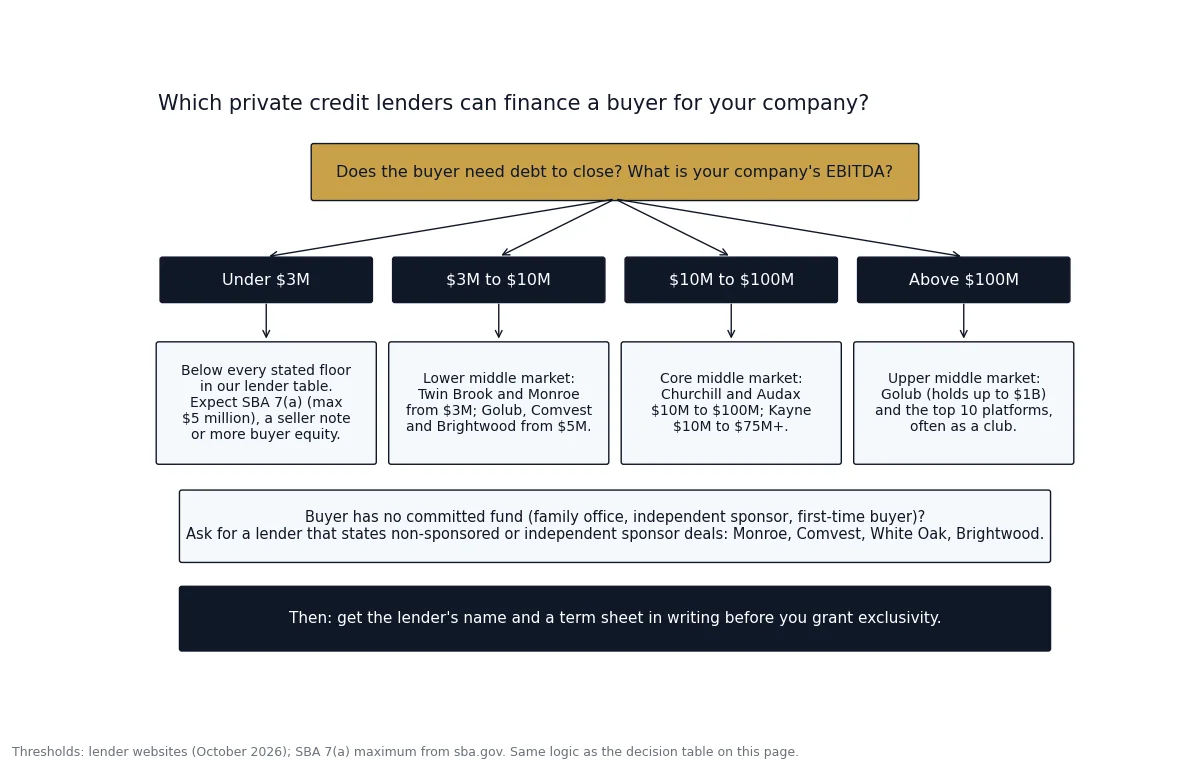
Decision table: which lender answer to expect at your size
Match your company’s EBITDA and the buyer’s type to the rows below. Each threshold comes from a lender’s own website or from the SBA, whose 7(a) loans top out at $5 million, so the table shows which financing answer is credible at your size before you compare prices across LOIs.
| If your situation is | Then | Threshold source |
|---|---|---|
| Your company has under $3 million of EBITDA and the buyer needs debt | Expect an SBA 7(a) loan (maximum $5 million), a seller note or more buyer equity; ask the buyer for an SBA lender pre-approval letter | SBA 7(a) page; lender floors in the table above |
| EBITDA of $3 million to $10 million and a private equity buyer | Ask which lower middle market lender is lined up (stated floors: Twin Brook and Monroe at $3 million, Golub, Comvest and Brightwood at $5 million) and whether it has closed with that sponsor before | Lender websites |
| EBITDA of $3 million to $50 million and a buyer without a committed fund | Choose bids backed by lenders that state non-sponsored or independent sponsor deals: Monroe, Comvest, White Oak, Brightwood | Lender websites |
| EBITDA of $10 million to $100 million | Core middle market lenders fit: Churchill and Audax state $10 million to $100 million, Kayne Anderson $10 million to $75 million+ | Lender websites |
| EBITDA above $100 million | Expect Golub (holds up to $1 billion) or a club of the top 10 platforms; ask who leads and who holds | Golub sponsor finance page |
| The LOI says “customary financing” with no lender named | Treat the price as provisional and ask for the lender’s name and term sheet in writing before exclusivity | CT Acquisitions process rule |
| The named lender manages a listed BDC | Read the non-accrual line in the BDC’s latest 10-Q on SEC EDGAR and compare it with the prior quarter | SEC EDGAR |
When two LOIs are close on price, weight financing certainty ahead of the last few hundred thousand dollars, because a deal that re-trades after exclusivity costs the seller months. Our checklist for that situation is in what to do if your buyer can’t get financing.
CT Acquisitions advises founder-owned businesses on sell-side mandates, buy-side searches and exit planning, with a network of 500+ buyers and the lenders behind them. No fee to you on buy-side introductions; sell-side mandates are paid on success at closing. How we compare bids on financing as well as price is described on our sell-side advisory page.
How do BDCs connect private credit firms to individual investors?
A business development company (BDC) is the fund format most large private credit firms use to raise money from individual investors. Listed BDCs trade daily on an exchange; non-traded BDCs offer periodic repurchases. To keep regulated investment company tax treatment, a BDC must pay out at least 90 percent of its investment company taxable income each year (26 U.S.C. 852(a)(1)).
| Private credit firm | Business development company | Ticker or format |
|---|---|---|
| Ares Management | Ares Capital Corporation | ARCC (listed) |
| Blackstone | Blackstone Private Credit Fund | BCRED (non-traded) |
| Blackstone | Blackstone Secured Lending | BXSL (listed) |
| Blue Owl Capital | Blue Owl Capital Corporation | OBDC (listed) |
| Blue Owl Capital | Blue Owl Credit Income Corp. | OCIC (non-traded) |
| BlackRock (HPS) | HPS Corporate Lending Fund | HLEND (non-traded) |
| Golub Capital | Golub Capital BDC | GBDC (listed) |
| Sixth Street | Sixth Street Specialty Lending | TSLX (listed) |
| Bain Capital Credit | Bain Capital Specialty Finance | BCSF (listed) |
| Brookfield (Oaktree) | Oaktree Specialty Lending | OCSL (listed) |
| Kayne Anderson | Kayne Anderson BDC | KBDC (listed) |
BDC filings are the most detailed public window into a private credit firm’s loan book, because each one lists its loans, their fair values and non-accruals every quarter. Our private credit BDC performance report compares them, and the two largest non-traded vehicles have their own pages: Blackstone Private Credit Fund (BCRED) and Blue Owl Credit Income Corp. (OCIC).
How we compiled this
We compiled this ranking in October 2026 from 56 primary documents: earnings releases and 10-Q filings on SEC EDGAR, firm websites, completion press releases and the PEI Private Credit 200 methodology page. No figure was estimated: where a firm publishes only a firm-wide or committed-capital number, the table says so. Third-party AUM estimates, undated league tables and forum posts were excluded.
Frequently asked questions
What are private credit firms?
Private credit firms are asset managers that lend directly to companies instead of buying bonds or syndicated bank loans. They fund those loans from closed-end funds, business development companies and insurance balance sheets. The IMF estimated the global private credit market at about $2.1 trillion of assets and committed capital at the end of 2023, with roughly three quarters of it in the United States.
Who are the top private credit firms in 2026?
By the credit figures they publish, the top five private credit firms in 2026 are Apollo Global Management ($849.3 billion at June 30, 2026), Blackstone ($480.0 billion at September 30, 2026), Ares Management ($440.5 billion), Brookfield including Oaktree ($416 billion) and KKR ($330.8 billion). Ranked by capital raised from 2021 to 2025 instead, the PEI Private Credit 200 puts Ares first.
What is the largest private credit firm in the world?
Apollo Global Management reports the largest credit figure of any manager: $849.3 billion of credit AUM at June 30, 2026, out of $1,047 billion in total AUM. A large part of it backs annuities written by Athene, Apollo’s retirement business. Measured by third-party capital raised from 2021 to 2025, Ares Management leads the PEI Private Credit 200 with $117,997 million.
Is Blackstone a private credit firm?
Yes. Blackstone’s Credit & Insurance segment managed $480.0 billion at September 30, 2026, after $35.8 billion of inflows in the third quarter, the second largest credit figure in this ranking. Blackstone also manages BCRED (Blackstone Private Credit Fund), a non-traded business development company, and BXSL (Blackstone Secured Lending), a business development company listed on the New York Stock Exchange.
Which private credit firms lend to small and lower middle market companies?
Lenders that publish lower middle market floors include Twin Brook ($3 million to $50 million of EBITDA), Monroe Capital ($3 million to $35 million), Brightwood Capital ($5 million to $75 million) and Comvest (above $5 million). Below $3 million of EBITDA, buyers usually rely on SBA 7(a) loans, which the SBA caps at $5 million, or on seller notes.
How do BDCs relate to private credit firms?
A business development company (BDC) is the fund structure most large private credit firms use to raise money from individual investors, for example Ares Capital (ARCC) at Ares or BCRED at Blackstone. To keep regulated investment company tax treatment, a BDC must pay out at least 90 percent of its investment company taxable income each year under 26 U.S.C. 852(a)(1).
Sources
- Apollo Q2 2026 earnings release (Apollo Global Management), accessed October 2026.
- Blackstone Q3 2026 results (Blackstone (Credit & Insurance)), accessed October 2026.
- Ares Q2 2026 earnings presentation (Ares Management), accessed October 2026.
- Brookfield Asset Management Q2 2026 supplemental (Brookfield (incl. Oaktree)), accessed October 2026.
- KKR Form 10-Q, Q2 2026 (KKR), accessed October 2026.
- Goldman Sachs Asset Management press release (Goldman Sachs Alternatives), accessed October 2026.
- Carlyle Q2 2026 earnings release (Carlyle (Global Credit)), accessed October 2026.
- PIMCO alternatives page (PIMCO), accessed October 2026.
- Blue Owl Form 10-Q, Q2 2026 (Blue Owl Capital), accessed October 2026.
- BlackRock Q3 2026 earnings release (BlackRock (incl. HPS)), accessed October 2026.
- Sixth Street website (Sixth Street), accessed October 2026.
- OHA press release, December 11, 2025 (Oak Hill Advisors (T. Rowe Price)), accessed October 2026.
- TPG Q2 2026 earnings release (TPG (incl. Angelo Gordon, Twin Brook)), accessed October 2026.
- Benefit Street Partners website (Benefit Street Partners (Franklin Templeton)), accessed October 2026.
- Antares Capital website (Antares Capital), accessed October 2026.
- Golub Capital website (Golub Capital), accessed October 2026.
- Bain Capital Credit About page (Bain Capital Credit), accessed October 2026.
- Barings press release (Barings (Global Private Finance)), accessed October 2026.
- Churchill website (Churchill Asset Management (Nuveen)), accessed October 2026.
- Fortress website (Fortress Investment Group), accessed October 2026.
- Crescent website (Crescent Capital Group (Sun Life)), accessed October 2026.
- CVC 2026 half-year results (CVC Credit), accessed October 2026.
- Hayfin website (Hayfin Capital Management), accessed October 2026.
- Kayne Anderson BDC website (Kayne Anderson), accessed October 2026.
- Partners Group H1 2026 AuM release (Partners Group (private credit)), accessed October 2026.
- ICG FY2026 results (ICG (Debt)), accessed October 2026.
- Neuberger Berman newsroom (Neuberger Berman (private debt)), accessed October 2026.
- Monroe Capital About page (Monroe Capital), accessed October 2026.
- Comvest website (Comvest Partners), accessed October 2026.
- Man Group completion release (Man Varagon (Man Group)), accessed October 2026.
- PEI Private Credit 200, 2026 edition, accessed October 2026.
- Brookfield, Brookfield Completes Acquisition of Oaktree (August 3, 2026), accessed October 2026.
- Oaktree Specialty Lending investor presentation (Oaktree AUM, June 30, 2026), accessed October 2026.
- KBRA, Fortress Investment Group report (August 2026), accessed October 2026.
- Official Journal of the EU, euro exchange rates for 30 June 2026, accessed October 2026.
- Sun Life release (Crescent Capital Group (51%)), accessed October 2026.
- Franklin Templeton release (Alcentra), accessed October 2026.
- TPG release (Angelo Gordon (incl. Twin Brook)), accessed October 2026.
- Fortress release (Fortress (SoftBank’s 90.01%)), accessed October 2026.
- Blue Owl release (Atalaya Capital Management), accessed October 2026.
- BlackRock release (HPS Investment Partners), accessed October 2026.
- BlackRock and HPS agreement announcement (December 3, 2024), accessed October 2026.
- Twin Brook (TPG) website, accessed October 2026.
- Monroe Capital website, accessed October 2026.
- Comvest Credit Partners website, accessed October 2026.
- Brightwood Capital website, accessed October 2026.
- Golub Capital website, accessed October 2026.
- White Oak Global Advisors website, accessed October 2026.
- Churchill (senior lending) website, accessed October 2026.
- Audax Private Debt (senior) website, accessed October 2026.
- Deerpath Capital website, accessed October 2026.
- Muzinich (private debt) website, accessed October 2026.
- U.S. Small Business Administration, 7(a) loans, accessed October 2026.
- IMF Global Financial Stability Report, April 2024, accessed October 2026.
- 26 U.S.C. 852, Cornell Legal Information Institute, accessed October 2026.
- GrowthCap, The Top Private Credit Firms of 2025, accessed October 2026.