Sell Your Electrical Business in California, 76+ Active PE Buyers, $0 Seller Fees
Quick Answer
Selling an electrical business in California typically yields multiples of 4x to 6x SDE for established operations, though specialty segments like data center electrical can command 6x to 7.5x SDE due to structural demand from hyperscale buildouts and semiconductor infrastructure. California electrical sales are significantly more complex than other states due to CSLB C-10 licensing restrictions, RMO/RME transfer barriers in asset deals, prevailing wage compliance on public projects, AB 5 misclassification exposure, and a 12.3-13.3% state capital gains tax that reduces after-tax proceeds. Buyers include public companies like IES Holdings, MYR Group, and EMCOR, plus regional Western consolidators and California-strategic acquirers, with 14 active bidders in the current market for operations between $1M and $50M revenue.
Thinking about selling your electrical business in California?
A 15-minute confidential call gives you a real valuation range and the California buyers most likely to compete for your business. No cost, no obligation.
Christoph Totter · Managing Partner, CT Acquisitions
20+ home services M&A transactions across HVAC, plumbing, pest control, roofing · Updated May 7, 2026
Selling an electrical contracting business in California in 2026 is the most regulatorily complex electrical M&A transaction in the country. California electrical contractor sales sit at the intersection of CSLB C-10 licensing with the RMO/RME structure, statewide prevailing wage on public projects, AB 5 misclassification exposure on 1099 use, and the highest state capital gains tax in the country. But California electrical also has structural demand drivers other states can’t match: Bay Area hyperscale data center buildouts (Microsoft, Google, Meta, Amazon, Equinix, Digital Realty), Silicon Valley semiconductor and biotech, Los Angeles aerospace (SpaceX, Boeing, Lockheed Martin), film and entertainment infrastructure, and the statewide EV charging buildout funded by the California Energy Commission.
This guide is for California electrical contractor owners running between $1M and $50M of revenue, with normalized earnings between $200K SDE and $8M EBITDA. We’ll walk through CSLB C-10 licensing under California Business and Professions Code Section 7000 et seq., the RMO/RME requirements that block clean license transfer in asset sales, California’s prevailing wage regime under Labor Code Section 1720 et seq., AB 5 misclassification risk under the ABC test in Labor Code Section 2775, the segment-specific premiums for data center / biotech / semiconductor / aerospace / film electrical, multiemployer pension withdrawal liability for IBEW Local 6, 11, 18, 234, 332, 595, 617 union shops, and the after-tax math when the state takes 12.3-13.3% on top of federal.
The framework draws on direct work with 76+ active U.S. lower middle market buyers, including PE-backed Western consolidators and California-strategic acquirers. We’re a buy-side partner. The buyers pay us when a deal closes, not you. Of our 76+ buyers, 14 actively bid on California electrical in 2024-2026: IES Holdings (NYSE: IESC), MYR Group (NASDAQ: MYRG, with substantial California T&D operations), EMCOR Group (NYSE: EME), Comfort Systems USA (NYSE: FIX), APi Group (NYSE: APG), strategic California acquirers like Cupertino Electric and Rosendin Electric, Sila Services West, Bernhard Capital Partners, plus 5 regional Western rollups. The California electrical market has fewer buyers than Texas or Florida but better multiples for proven specialty operators. Use our free valuation calculator below for a 90-second starting-point estimate, or read on for the full state-specific framework.
One realistic note before you start. California has the highest regulatory complexity and the highest state tax of any electrical M&A market in the country, but it also has the strongest specialty premiums. A California data center electrical specialist can clear 8-10x EBITDA. A California aerospace electrical contractor can clear 7-9x EBITDA. A California residential service shop without RMO/RME planning, sloppy AB 5 classification, and unresolved CSLB complaints will struggle to clear 3x SDE. The 18-24 month preparation playbook matters more in California than anywhere else.
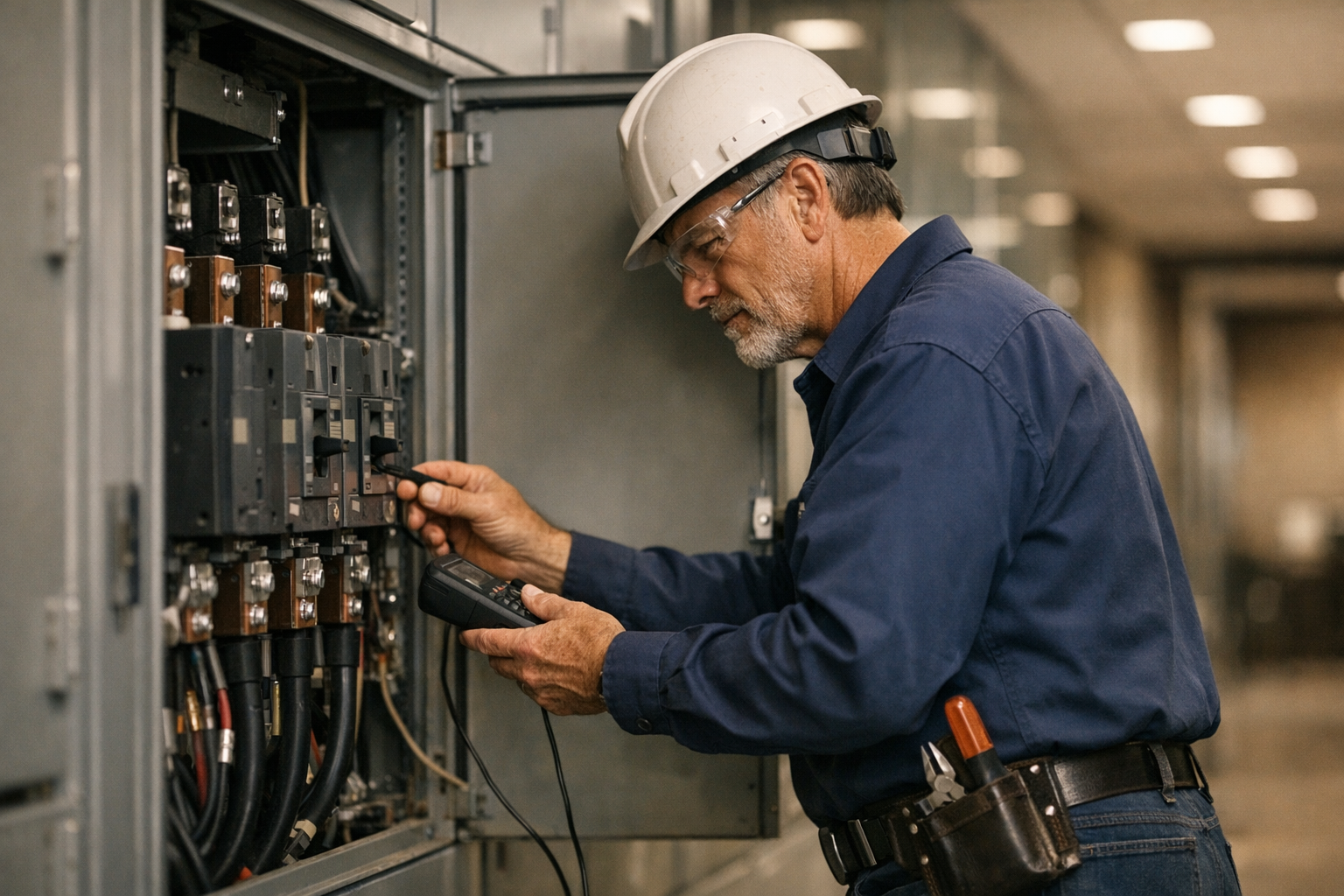
“California electrical sellers walk into the conversation worried about tax compression and walk out understanding that the right buyer pool, data center electrical specialists, biotech and semiconductor MEP contractors, aerospace electrical, pays California premiums that more than offset state tax. The mistake isn’t selling in California; it’s running a generic auction that misses the buyers who actually pay California premiums. We’re a buy-side partner working with 76+ active buyers, including 14 with current California electrical mandates, the buyers pay us, not you, no contract required.”
TL;DR, the 90-second brief
- California electrical contractor M&A faces the highest state-tax compression in the country. California’s 12.3-13.3% top marginal rate on capital gains takes $400K-$1.3M off after-tax proceeds on a $3-$10M sale versus a Texas or Florida seller. The compression matters, but doesn’t kill the deal for the right operator.
- CSLB C-10 license with RMO/RME structure is the deal-blocker most owners underestimate. California Contractors State License Board (CSLB) Classification C-10 (Electrical) requires a Responsible Managing Officer (RMO) or Responsible Managing Employee (RME) with 4 years of journey-level experience. The RMO/RME is personal, license does NOT transfer with the entity in an asset sale.
- California electrical demand drivers are real. Bay Area data center buildouts (hyperscale + colocation), Silicon Valley biotech and semiconductor manufacturing (Intel, Applied Materials, Lam Research), Los Angeles aerospace (SpaceX, Boeing, Lockheed), film/entertainment infrastructure, and statewide EV charging buildout under the CEC funding programs.
- Realistic 2026 California electrical multiples. Sub-$2M revenue residential service: 0.5-1.0x revenue or 3-4.5x SDE. $1M-$3M EBITDA commercial/industrial platforms: 5.5-7x EBITDA. $3M+ EBITDA industrial/data center/biotech specialists: 6.5-9x EBITDA. AB 5 misclassification exposure compresses 0.5-1x EBITDA where applicable.
- Of our 76+ buyers, 14 actively bid on electrical contracting in California in 2024-2026. That includes IES Holdings (NYSE: IESC), MYR Group (NASDAQ: MYRG), EMCOR Group (NYSE: EME), Comfort Systems USA (NYSE: FIX), APi Group (NYSE: APG), Cupertino Electric (privately held strategic), Rosendin Electric (employee-owned strategic), Sila Services West, Bernhard Capital Partners, plus 5 regional Western rollups. We’re a buy-side partner, the buyers pay us when a deal closes, not you. No retainer, no exclusivity, no contract.
Key Takeaways
- California electrical PE/strategic activity is concentrated but well-capitalized: 14 of our 76+ buyers actively bid on California electrical in 2024-2026, including IES Holdings (NYSE: IESC), MYR Group (NASDAQ: MYRG), EMCOR (NYSE: EME), Comfort Systems USA (NYSE: FIX), APi Group, Cupertino Electric, Rosendin Electric, Sila Services West, Bernhard Capital, plus 5 regional Western rollups.
- CSLB Classification C-10 (Electrical) requires a Responsible Managing Officer (RMO) or Responsible Managing Employee (RME) with 4 years journey-level experience. The RMO/RME is personal; license does NOT transfer with the entity in an asset sale.
- California top marginal capital gains rate is 12.3-13.3%, the highest in the country. On a $5M gain, California sellers keep $400K-$650K less than Texas/Florida sellers. State tax compression is real but offset for specialty operators by California-specific multiple premiums.
- California electrical multiples by segment: residential service 3-4.5x SDE; commercial 5.5-7x EBITDA; industrial/biotech/semiconductor 6.5-8.5x EBITDA; data center / aerospace specialty 7-10x EBITDA. Specialty premium is real and can offset California state tax compression entirely.
- AB 5 misclassification risk under Labor Code Section 2775 ABC test compresses California electrical multiples 0.5-1x EBITDA where 1099 electricians or specialty subcontractors are used. Cure 12-18 months pre-sale by reclassifying or documenting B-test exemption.
- California prevailing wage applies to all public works projects under Labor Code Section 1720 et seq., broader than federal Davis-Bacon. DIR enrollment, certified payroll filing through DIR’s eCPR system, and apprenticeship requirements all create diligence flags.
Why California electrical contractor M&A is the most regulatorily complex electrical market in the country
California electrical contractor M&A faces a stack of regulatory burdens no other state matches. CSLB C-10 licensing with the RMO/RME structure, statewide prevailing wage under Labor Code 1720 et seq. with DIR enrollment and certified payroll filing, AB 5 misclassification exposure under the ABC test, multiemployer pension withdrawal liability for IBEW union shops in Locals 6 (San Francisco), 11 (Los Angeles), 18 (Los Angeles utility), 234 (Castroville/Monterey), 332 (San Jose), 595 (Hayward/East Bay), and 617 (San Mateo), CalOSHA Section 2942 arc-flash rules that exceed federal NFPA 70E in some respects, and the highest state capital gains tax in the country. Each is manageable individually; together they require coordinated 18-24 month preparation.
The structural demand drivers more than offset the regulatory burden for the right operator. Bay Area hyperscale data center buildouts (Microsoft, Google, Meta, Amazon, Equinix, Digital Realty, QTS, CoreSite) create sustained electrical contractor demand. Silicon Valley semiconductor manufacturing (Intel Santa Clara, Applied Materials, Lam Research, KLA, NVIDIA, AMD operations) drives industrial electrical work. Bay Area biotech (Genentech, Gilead, biotech corridor) drives MEP contractor demand. Los Angeles aerospace (SpaceX, Boeing, Lockheed Martin, Northrop Grumman, JPL) drives industrial electrical. Film and entertainment infrastructure (studio facilities, post-production, sound stages) creates specialty electrical demand. And the California Energy Commission’s EV charging buildout funding creates statewide opportunity.
Active PE-backed and strategic California electrical buyers. Public strategic acquirers including IES Holdings (NYSE: IESC), MYR Group (NASDAQ: MYRG, with substantial California T&D operations), EMCOR Group (NYSE: EME, large California presence including University Mechanical & Engineering Contractors), Comfort Systems USA (NYSE: FIX), and APi Group (NYSE: APG) are highly active acquirers. Strategic California-headquartered acquirers including Cupertino Electric (San Jose, $700M+ revenue, frequently acquires) and Rosendin Electric (San Jose, employee-owned, $2B+ revenue, occasionally acquires) operate at the upper end. PE platforms include Sila Services West, Bernhard Capital Partners, plus 5 regional Western consolidators.
What this means for California electrical contractor sellers. If you’re running a $1M+ EBITDA specialty California electrical contractor (data center, biotech, semiconductor, aerospace), you should expect 4-7 indications of interest from a mix of public strategic acquirers and California-headquartered strategic operators. If you’re running a residential service shop without RMO/RME planning, the buyer pool is meaningfully narrower, primarily SBA buyers and small regional operators. The single biggest leverage point: CSLB licensing planning + AB 5 cleanup + prevailing wage compliance, executed 18-24 months pre-sale.
CSLB Classification C-10 with RMO/RME structure: California’s license transfer reality
California electrical contractor licensing is administered by the Contractors State License Board (CSLB) under California Business and Professions Code Section 7000 et seq. Classification C-10 (Electrical) is the relevant license category. Every C-10 contractor must have a Responsible Managing Officer (RMO) or Responsible Managing Employee (RME) who has at least 4 years of journey-level experience in the electrical trade and has passed the C-10 trade exam plus the law and business exam. The RMO is typically an officer of the entity (often the owner); the RME is an employee with managerial responsibility. The RMO/RME is personal.
What this means in a sale: the RMO/RME does not transfer with the entity in an asset sale. When you sell a California electrical business, the C-10 license stays with the entity in a stock sale (subject to CSLB notification of ownership change), but in an asset sale the buyer’s entity must obtain its own C-10 license. That requires the buyer’s entity to have a qualifying RMO or RME with 4 years of journey-level electrical experience and the passed exams. If you’re the seller and you’re the only RMO/RME, the buyer faces three choices: (1) the buyer designates an existing employee or new hire who already qualifies as RME; (2) the buyer’s qualifying party sits for and passes the C-10 trade exam (requires the underlying 4 years of journey-level experience, generally not feasible for first-time entrants); or (3) you, the seller, agree to remain employed as RMO/RME for a transition period of 6-24 months.
Stock sale vs asset sale license dynamics. In a stock sale, the C-10 license stays with the entity, but CSLB requires notification of any change in personnel of record (RMO/RME, qualifier) within 90 days. The buyer must continue to satisfy the bonding requirement ($25,000 contractor’s bond) and any disciplinary requirements. In an asset sale, the buyer’s entity must obtain its own C-10 license before performing any electrical work, which means the buyer’s qualifying party must already be lined up. This is a real reason California electrical deals trend toward stock sales versus asset sales (which is the opposite of most other states’ norms).
How to handle CSLB licensing 12-24 months before sale. If you’re the only RMO or RME at your business, your buyer pool is meaningfully narrower because most institutional buyers won’t accept a 24-month seller transition. The 18-month playbook is to identify a senior electrician with 4+ years of journey-level experience, support them through the C-10 trade exam and law/business exam (CSLB exam pass rate ~60-65%), and add them as an additional RME. Once you have a second qualifying party on staff, your buyer pool widens dramatically because the buyer is no longer dependent on you remaining employed post-close. This single action typically returns 0.5-1x EBITDA in higher offers.
CSLB disciplinary record and complaint history. Buyers will pull the CSLB licensee record for your C-10 contractor license. CSLB maintains publicly searchable records of complaints, citations, suspensions, and revocations. Pending complaints, prior disciplinary orders, unpaid administrative penalties, or open enforcement matters become the buyer’s problem post-close. CSLB also maintains a Construction Contractors’ Recovery Fund and a separate database for unsatisfied judgments, both checked by buyers’ counsel. Resolve any open matters before going to market.
California electrical segment dynamics: residential, commercial, industrial, data center, biotech/semiconductor, aerospace, film
California electrical M&A divides into seven segments with materially different buyer pools and multiples. Knowing which segment your business primarily serves is the most important positioning decision in the sale process. California has more specialty segments than any other state because of the diverse industrial base, data center, biotech, semiconductor, aerospace, and film/entertainment all have dedicated electrical contractor sub-markets with distinct buyer pools.
Residential service electrical: 3-4.5x SDE owner-op / 4.5-6x EBITDA platform. Service calls, panel upgrades, EV charging installation (heavily incentivized by CEC programs), solar interconnect, smart home work, residential remodels. Buyer pool: SBA individuals, regional rollups (Sila Services West, regional California operators), occasional search funder. California residential demand is steady but constrained by housing affordability and cost-of-living dynamics. Premium for shops with strong solar interconnect and EV charging recurring revenue, presence in SF Bay Area, LA Basin, San Diego, or Sacramento.
Commercial electrical: 5.5-7x EBITDA platform. Tenant fit-outs, retail buildouts, hospitality, office, healthcare facilities, light industrial. Buyer pool: Sila Services West, regional commercial-focused rollups, public strategic acquirers (IES, EMCOR, Comfort Systems). Multiples typically 5.5-7x EBITDA at platform scale. California commercial electrical is constrained by office vacancy in SF and downtown LA but strong in Bay Area suburban, Orange County, and San Diego. Premium for shops with recurring commercial maintenance and TI-focused operations.
Industrial / biotech / semiconductor electrical: 6.5-8.5x EBITDA platform. Bay Area biotech (Genentech, Gilead, biotech corridor along 101 and 280), Silicon Valley semiconductor (Intel Santa Clara, Applied Materials, Lam Research, KLA, NVIDIA), specialty manufacturing. Buyer pool: specialized industrial PE platforms, public strategic acquirers (IES Holdings has built dedicated semiconductor capability), strategic California operators (Cupertino Electric, Rosendin). Multiples typically 6.5-8.5x EBITDA at platform scale. Premium for documented cleanroom experience, biotech facility experience, and recurring service contracts with anchor industrial customers.
Data center electrical: 7-10x EBITDA platform. Bay Area hyperscale (Microsoft, Google, Meta, Amazon) and colocation (Equinix, Digital Realty, QTS, CoreSite, Iron Mountain) data center buildouts. Bay Area is one of the largest data center markets in the country alongside Northern Virginia. Buyer pool: specialized data center electrical platforms, IES Holdings (with dedicated data center capability), strategic California operators (Cupertino Electric is a dominant player here), PE platforms with infrastructure focus. Multiples typically 7-10x EBITDA at platform scale, the highest segment of California electrical. Premium for hyperscale relationships and recurring construction pipeline visibility.
Aerospace electrical: 6.5-9x EBITDA platform. Los Angeles aerospace (SpaceX Hawthorne, Boeing El Segundo / Long Beach, Lockheed Martin Palmdale / Sunnyvale, Northrop Grumman, JPL Pasadena, Aerojet Rocketdyne). Buyer pool: industrial-focused PE platforms, public strategic acquirers, PE platforms with defense theses. Multiples typically 6.5-9x EBITDA at platform scale. Premium for specialty aerospace certifications, classified facility clearances, and recurring service contracts.
Film and entertainment infrastructure electrical: 5-7x EBITDA platform. Studio facilities (Burbank, Hollywood, Culver City), sound stages, post-production facilities, theme park infrastructure (Disneyland, Universal Studios). Buyer pool: regional California operators, occasional specialty PE. Multiples typically 5-7x EBITDA at platform scale. Premium for studio relationships and union (IBEW Local 40) credentials, entertainment industry standard.
Selling a California electrical business? Talk to a buy-side partner who knows the buyers.
We’re a buy-side partner. Not a sell-side broker. Not a sell-side advisor. We work directly with 76+ active buyers, including 14 with active California electrical mandates: IES Holdings (NYSE: IESC), MYR Group (NASDAQ: MYRG), EMCOR Group (NYSE: EME), Comfort Systems USA (NYSE: FIX), APi Group (NYSE: APG), Cupertino Electric, Rosendin Electric, Sila Services West, Bernhard Capital Partners, plus 5 regional Western rollups, who pay us when a deal closes. You pay nothing. No retainer, no exclusivity, no 12-month contract, no tail fee. We’re a buy-side partner working with 76+ active buyers… the buyers pay us, not you, no contract required. A 15-minute call gets you a real read on what your California electrical business is worth, which buyers fit your segment (residential, commercial, industrial, biotech/semiconductor, data center, aerospace, film), and the option to meet one of them.
Book a 15-Min CallWho actually buys California electrical businesses in 2026: the five buyer archetypes
The California electrical buyer pool divides into five archetypes with materially different motivations, multiples, and deal structures. California has fewer total buyers than Texas or Florida (the regulatory complexity scares some out), but the buyers who are present are well-capitalized and pay specialty premiums for the right operators.
Archetype 1: Public strategic acquirers (IES, MYR, EMCOR, Comfort Systems, APi). IES Holdings (NYSE: IESC) is one of the most active public-company electrical-contractor acquirers and has substantial California operations. MYR Group (NASDAQ: MYRG) has substantial California T&D operations. EMCOR Group (NYSE: EME) has a strong California presence including University Mechanical & Engineering Contractors and other California-based operating companies. Comfort Systems USA (NYSE: FIX) acquires mechanical-electrical specialty contractors. APi Group (NYSE: APG) acquires industrial services including electrical. Typical target: $2M-$20M EBITDA. Multiples: 6-9x EBITDA at platform scale, paid mostly with cash. Close timeline: 90-180 days.
Archetype 2: Strategic California-headquartered operators (Cupertino Electric, Rosendin Electric). Cupertino Electric (San Jose, $700M+ revenue) frequently acquires California electrical businesses, particularly in data center, semiconductor, and Bay Area commercial. Rosendin Electric (San Jose, employee-owned, $2B+ revenue) occasionally acquires. Other regional California strategic operators include Helix Electric (Southern California, growth through acquisition), Walters Wholesale Electric Inc. portfolio companies, and various employee-owned regional operators. Typical target: $1M-$10M EBITDA with California operations and segment alignment. Multiples: 5.5-8x EBITDA. Close timeline: 90-150 days.
Archetype 3: PE-backed Western consolidators. Sila Services (Morgan Stanley Capital Partners) West Coast operations, Bernhard Capital Partners (with multi-trade industrial services platforms), and 5+ regional Western rollups. Typical target: $1M-$10M EBITDA with commercial or industrial electrical service revenue. Multiples: 5-7.5x EBITDA. Cash + 15-30% rollover + earnout. Close timeline: 90-150 days.
Archetype 4: Search funders pursuing California commercial/industrial electrical. Individual MBA-backed searchers and deal-by-deal investors targeting California commercial or specialty electrical. Search funders are somewhat less active in California than other states because of regulatory complexity, but specialty operators (data center adjacent, biotech-focused) attract search interest. Typical target: $750K-$3M EBITDA. Multiples: 4.5-6.5x EBITDA. Close timeline: 120-180 days.
Archetype 5: SBA 7(a)-financed individuals. First-time owner-operators using the SBA 7(a) program, primarily targeting residential service electrical shops. Typical target: $200K-$700K SDE residential service electrical with a transferable RMO/RME pathway. Multiples: 2.5-4x SDE. SBA 7(a) caps at $5M loan, so deal sizes top out around $7-8M total enterprise value. Close timeline: 60-120 days.
| California electrical buyer archetype | Typical multiple | Deal structure norms | Close timeline |
|---|---|---|---|
| Public strategic (IES, MYR, EMCOR, FIX, APi) | 6-9x EBITDA | Cash-heavy, smaller rollover, earnout common | 90-180 days |
| Strategic CA operator (Cupertino, Rosendin) | 5.5-8x EBITDA | Cash + segment-fit rollover | 90-150 days |
| PE rollup (Sila West, Bernhard, regional) | 5-7.5x EBITDA | Cash + 15-30% rollover + earnout | 90-150 days |
| Search funder | 4.5-6.5x EBITDA | Senior debt + 10-20% seller note + earnout | 120-180 days |
| SBA 7(a) individual (residential) | 2.5-4x SDE | 10% buyer equity, 20-30% seller note, training | 60-120 days |
California electrical multiples by size and segment: what 2026 deal data shows
California electrical multiples vary dramatically by segment. A $1M EBITDA residential service contractor and a $1M EBITDA Bay Area data center electrical specialist will sell at very different multiples, often 2-3x EBITDA apart. Within each segment, size still drives meaningful expansion as the business crosses key thresholds.
Sub-$1M revenue residential service: 0.4-0.7x revenue / 2-3x SDE. Micro-shops sold primarily through BizBuySell and California business broker listings to SBA buyers. Almost always owner-dependent. Multiples compress further if the owner is the only RMO/RME on staff, if AB 5 misclassification exposure exists, or if CSLB has any open complaints.
$1M-$3M revenue residential or light commercial: 0.5-1.0x revenue / 3-4.5x SDE. Core SBA buyer territory. Multiples improve materially with: (a) recurring service contracts (commercial maintenance is highest-leverage); (b) tech-enabled dispatch and project management (ServiceTitan, Procore); (c) documented systems and operations manager; (d) commercial revenue at 30%+ of mix; (e) clean AB 5 W-2 classification; (f) RMO/RME succession planning in place.
$3M-$10M revenue / $500K-$2M EBITDA commercial/industrial: 5-7x EBITDA. Wider buyer pool: search funders, independent sponsors, regional PE add-ons (Sila Services West, Bernhard), public strategic interest. Multiples accelerate with recurring service revenue, low customer concentration, tenure of second-tier management, clean prevailing wage compliance, and proven specialty (biotech-adjacent, semiconductor-adjacent, data center-adjacent).
$10M-$30M revenue / $2M-$5M EBITDA industrial/specialty: 6-8.5x EBITDA. Platform territory for PE rollups and prime acquisition target for IES Holdings, MYR Group, EMCOR Group (with University Mechanical), Comfort Systems USA, Cupertino Electric, and Rosendin Electric. Multiples premium for industrial specialty work (biotech, semiconductor, data center), aerospace experience, and recurring commercial maintenance contracts.
$30M+ revenue / $5M+ EBITDA specialty/data center: 7-10x EBITDA. Platform-of-the-platform deals. Strategic premium from public consolidators and California strategics willing to pay up for proven specialty platforms. California platforms at this size with hyperscale data center, biotech, or semiconductor specialty typically draw competitive bids from at least 4-6 PE and strategic buyers. Specialty data center work has reached 9-11x EBITDA on premier platforms in 2024-2026.
| California electrical business profile | Revenue multiple range | SDE/EBITDA multiple range | Dominant buyer pool |
|---|---|---|---|
| Sub-$1M revenue residential | 0.4-0.7x revenue | 2-3x SDE | SBA individual |
| $1M-$3M revenue residential/commercial | 0.5-1.0x revenue | 3-4.5x SDE | SBA + occasional search funder |
| $3M-$10M / $500K-$2M EBITDA | 0.7-1.2x revenue | 5-7x EBITDA | Search, indie sponsor, PE add-on, public strategic |
| $10M-$30M / $2M-$5M EBITDA | 0.8-1.4x revenue | 6-8.5x EBITDA | PE rollup, public strategic, CA strategic |
| $30M+ / $5M+ EBITDA specialty | 1.0-1.6x revenue | 7-10x EBITDA | Public strategic, CA strategic, PE platform-of-platform |
California state tax compression: the after-tax math sellers must understand
California has the highest state-level capital gains tax in the country. The top marginal rate is 12.3% (or 13.3% with the Mental Health Services Tax surcharge on income above $1M). On a $5M business sale where the seller’s gain is primarily long-term capital, federal capital gains tax (15-20% plus 3.8% NIIT) applies and California adds 12.3-13.3% on top. Compare this to Texas (0%), Florida (0%), Nevada (0%), Tennessee (0%). On a $5M gain, the California seller keeps $400K-$650K less than a Texas seller. On a $10M gain, the differential reaches $800K-$1.3M.
The California exit tax / Section 17951-4 sourcing rules. California taxes residents on worldwide capital gains and taxes non-residents on California-source income. The sourcing rules under California Revenue and Taxation Code Section 17951-4 and FTB Publication 1100 determine whether a business sale is California-sourced (if the business operations are in California, the gain is California-sourced regardless of seller residency). Some sellers attempt to relocate out of California pre-sale, but the California Franchise Tax Board scrutinizes these moves carefully and pursues them aggressively when the business is California-located. A real, sustained relocation 24+ months pre-sale combined with proper structuring can reduce California exposure on the goodwill component but rarely eliminates it entirely.
Why specialty premiums offset California state tax compression for the right operators. A California data center electrical specialist clearing 8-9x EBITDA on $3M EBITDA ($24-27M enterprise value) versus a Texas equivalent clearing 7-8x EBITDA ($21-24M) recovers the entire California state tax differential through higher gross multiple. The specialty premium is real. Generic California residential service contractors face the full state tax compression without offsetting premium, which is why the buyer pool is shallower at that segment and multiples compress further.
Asset allocation negotiation matters more for California sellers than most. In an asset sale, allocation of purchase price between equipment (ordinary income recapture, taxed at federal ordinary rates up to 37% plus California 12.3-13.3%), inventory (ordinary income), goodwill (long-term capital gains, 15-20% federal + 12.3-13.3% California), and non-compete (ordinary income to seller) determines after-tax proceeds. California’s high tax rate means the federal allocation matters even more, and California’s parallel state tax on ordinary income vs capital gains creates additional complexity. California sellers should engage a tax attorney early in the LOI process to optimize allocation; a skilled negotiation can shift $100K-$500K of after-tax proceeds in the seller’s favor on a typical mid-size deal.
AB 5 misclassification and California prevailing wage compliance
California Assembly Bill 5 (codified at Labor Code Section 2775) imposes the strictest worker-classification standard in the country. Under the ABC test, a worker is presumed to be an employee unless the hiring entity establishes: (A) the worker is free from control and direction in performance of the work; (B) the worker performs work outside the usual course of the hiring entity’s business; and (C) the worker is customarily engaged in an independently established trade, occupation, or business. The B-test is the killer for electrical contractors, an electrical contractor hiring 1099 electricians fails the B-test almost automatically because the work is in the usual course of the business.
What this means for California electrical sellers. Buyers will scrutinize 1099 vs W-2 classification carefully. 1099 electricians are misclassified under the ABC test and create exposure for: back wages, overtime, meal and rest break premiums, EDD audit liability for unpaid payroll taxes, workers’ comp premium audits, EDD penalties (up to $25,000 per violation under SB 459 willful misclassification), and successor liability. Buyers will reduce purchase price by 0.5-1x EBITDA where AB 5 misclassification exposure exists and may require escrow holdbacks of 5-15% for 18-36 months.
How to cure AB 5 exposure 12-18 months pre-sale. Reclassify all 1099 electricians as W-2 employees. Yes, payroll costs will increase 20-40% (workers’ comp, payroll taxes, benefits eligibility). Yes, this will reduce trailing-12-month EBITDA. But the multiple uplift typically more than offsets: 4.5-5x EBITDA on misclassification-exposed business becomes 5.5-6.5x on cleaned-up business, and the buyer’s diligence runs cleaner. Engage California labor and employment counsel for the reclassification; document the exemptions if any apply (business-to-business exemption under Labor Code 2776 has strict requirements).
California prevailing wage on public works projects. California Labor Code Section 1720 et seq. requires prevailing wage on all public works projects (state, county, city, school district, special district). California prevailing wage is broader than federal Davis-Bacon, it applies to any project funded with public money, not just federally-funded. DIR (Department of Industrial Relations) enrollment is required, certified payroll must be filed through DIR’s eCPR online system, and apprenticeship requirements (DAS-140 / DAS-142 forms) must be satisfied for projects above $30,000. Buyers will request 4 years of public works history with certified payroll records, DIR investigation history, and apprenticeship compliance documentation.
California-specific union dynamics: IBEW Locals and multiemployer pension exposure. California has strong IBEW union presence in major metros: Local 6 (San Francisco), Local 11 (Los Angeles), Local 18 (LA utility), Local 234 (Castroville/Monterey), Local 332 (San Jose), Local 595 (Hayward/East Bay), Local 617 (San Mateo), Local 40 (Burbank/entertainment), and others. Union electrical contractors face multiemployer pension withdrawal liability under ERISA Section 4203 on sale, calculated based on the National Electrical Benefit Fund or regional NEBF-affiliated plan’s unfunded vested benefits. California union shops often face withdrawal liability of $1M-$10M+ depending on size and tenure. The Section 4204 sale-of-assets exception requires careful structuring; engage ERISA counsel 12+ months pre-sale.
Service mix and recurring revenue: the highest-leverage multiple driver in California electrical
Recurring service revenue is the highest-leverage multiple driver in California electrical M&A. An electrical contractor with 30%+ of revenue from recurring service contracts (commercial property management agreements, multi-year industrial service contracts, biotech facility service contracts, data center service contracts, EV charging maintenance contracts) trades at a 0.5-1.0x EBITDA premium versus an otherwise identical project-only contractor. California specialty buyers (Cupertino Electric, Rosendin, IES) value recurring revenue dramatically because California construction cycles can be volatile.
What California electrical buyers value most. (1) Recurring service contract count and aggregate annual value, especially with biotech, semiconductor, data center, or aerospace customers; (2) master service agreements with hyperscale data center operators (Microsoft, Google, Meta, Amazon, Equinix); (3) service revenue percentage versus project revenue; (4) replace/repair gross margin on residential service work; (5) project gross margin on commercial/industrial; (6) customer retention rate; (7) geographic density (Bay Area, LA Basin, Orange County, San Diego); (8) specialty certifications (cleanroom, hyperscale data center, NFPA 70E arc-flash, OSHA 30, manufacturer certifications); (9) electrician retention and tenure (California electricians are expensive and scarce); (10) RMO/RME succession planning.
Why project-only revenue compresses California multiples. Project-only revenue is high-variance, low-visibility, and dependent on continued project pipeline development. California construction cycles can be volatile (interest rate sensitivity, regulatory permitting delays, economic concentration). Buyers discount project-only contractors more in California than in faster-growing states. PE rollups and public strategic buyers explicitly target California electrical contractors with 30-50%+ recurring revenue.
How to reposition mix in 18-24 months pre-sale. Aggressively grow recurring service contracts: pursue commercial property management agreements with REITs and California commercial property managers; pursue biotech and semiconductor facility maintenance contracts; pursue hyperscale data center service relationships; build out preventative electrical maintenance programs targeting industrial customers; develop EV charging maintenance contract base. Owners who execute this shift see their pre-sale California multiple improve by 1-2x EBITDA, often $1M-$5M of additional enterprise value on a mid-size deal.
What California electrical buyers diligence: the checklist that determines your final price
California electrical diligence is the most thorough in the country because of regulatory complexity. Buyers want to verify earnings (SDE/EBITDA quality), validate revenue mix and customer concentration, confirm electrician retention and productivity, validate CSLB licensing and RMO/RME succession, validate AB 5 worker classification, validate California prevailing wage compliance, assess multiemployer pension withdrawal liability if union, evaluate CalOSHA compliance, and assess warranty exposure. California-specific overlays apply to every section.
Earnings quality and add-back validation. 24-36 months of monthly P&Ls. California Franchise Tax Board filings matching financials. Documented add-backs with receipts. CPA-prepared annual financial statements. Bank reconciliations. AR aging and bad debt history. Job costing reports by project type. WIP schedule for project work. Backlog with contract details. California-specific: California sales tax (CDTFA) compliance, EDD payroll tax compliance, FTB business income tax compliance.
Revenue mix, customer concentration, and AB 5 classification. Service vs project breakdown by year. Recurring contract count, retention rate, and average annual value. Top 10 customers as percentage of revenue. Commercial vs industrial vs residential breakdown. Public works vs private project breakdown with prevailing wage history. AB 5 / Labor Code 2775 worker classification audit: 1099 vs W-2 status, B-test analysis, business-to-business exemption documentation, prior misclassification claims or EDD audits. California-specific: data center, biotech, semiconductor, aerospace, or film customer concentration disclosure.
Electrician headcount, productivity, retention, and CSLB licensing. Electrician roster with tenure, comp, certifications (CSLB Electrician Trainee Program registration if applicable, journeyman certification, OSHA 30, NFPA 70E arc-flash, manufacturer certifications), W-2 vs 1099 status, and I-9 documentation. Electrician retention rate over 24 months. Productivity metrics. California-specific: CSLB RMO/RME documentation for license, contractor’s bond status, any CSLB complaints or disciplinary actions, apprentice pipeline through DAS (Division of Apprenticeship Standards) approved program.
Fleet, equipment, warranty, and California regulatory exposure. Service van count, age, mileage, replacement schedule. Specialty equipment list. Outstanding warranty exposure on installations. Inventory levels. Real estate ownership and lease terms. California-specific: CARB (California Air Resources Board) compliance for fleet emissions, CalOSHA history including any 300 logs or serious injury reports, California workers’ comp claim history (California has higher claim severity than national average), CalRecycle hazardous waste manifests for any e-waste.
License, prevailing wage, insurance, and California regulatory. CSLB C-10 license documentation with RMO/RME information, contractor’s bond status, and DIR (Department of Industrial Relations) registration as a public works contractor if applicable. Prevailing wage compliance history with eCPR records. CalOSHA / NFPA 70E compliance documentation. General liability and California workers’ comp coverage status. Past lawsuits or claims (California is a litigious state for construction defect claims). California Franchise Tax Board compliance. Federal Davis-Bacon compliance for any federal projects. Surety bond status. Multiemployer pension plan participation disclosure if applicable.
The 18-24 month preparation playbook for California electrical sellers
California electrical contractors who do real 18-24 month preparation routinely sell for 1.5-3x EBITDA more than unprepared sellers. California has more structural risks (CSLB RMO/RME succession, AB 5 classification, prevailing wage compliance, multiemployer pension exposure for union shops) than any other state, and they all take 12+ months to materially fix. Owners who skip prep don’t exit faster, they exit at 30-50% lower after-tax proceeds, or worse, can’t close at all because of CSLB or AB 5 issues.
Months 24-18: financial cleanup and segment positioning. Move to monthly closes by the 15th of the following month. CPA-prepared annual financial statements. Job costing system tied to accounting. Document all add-backs with receipts. Begin segment positioning analysis: data center, biotech, semiconductor, aerospace, commercial, residential, or specialty. Address California Franchise Tax Board, CDTFA, and EDD compliance. Resolve any open CSLB complaints or disciplinary matters.
Months 18-12: CSLB licensing, AB 5 cleanup, prevailing wage compliance. Identify a senior electrician with 4+ years of journey-level experience to support through the C-10 trade exam (RMO/RME succession). Reclassify all 1099 electricians as W-2 employees and document any business-to-business exemptions claimed. Audit prevailing wage compliance on all public works projects in prior 4 years, cure any open issues. For union shops: get a current actuarial valuation of multiemployer pension withdrawal liability and engage ERISA counsel. Resolve any open litigation, CalOSHA citations, or environmental matters.
Months 12-6: reduce owner dependency and build management depth. Identify what only you do today. Document SOPs. Promote or hire a general manager or operations manager. Take a 30-day extended absence 9 months before going to market. Build out second-tier management for estimating, project management, and field supervision. Strengthen recurring service contract base aggressively.
Months 6-0: data room, CIM, and buyer-pool targeting. Compile 36 months of tax returns, P&Ls, balance sheets, bank statements, payroll registers (W-2 only post-cleanup), vendor invoices, customer contracts, master service agreements, public works prevailing wage records, CSLB licensing documentation, insurance policies, and equipment lists. Build a CIM emphasizing your segment’s buyer-relevant story: data center for IES/Cupertino, biotech for Cupertino/Rosendin, aerospace for IES/EMCOR, commercial for Sila/Bernhard. Engage tax counsel for asset allocation strategy and California-specific sourcing rules.
California electrical sale process timeline: what actually happens month by month
California electrical sale processes run 8-12 months for sub-$1M EBITDA deals and 11-15 months for $1M+ EBITDA platform or strategic deals. California timelines run 1-2 months longer than Texas or Florida because of regulatory diligence complexity (CSLB, AB 5, prevailing wage, multiemployer pension). Add 18-24 months on the front for proper preparation if your books, CSLB licensing, AB 5 classification, and prevailing wage compliance aren’t already buyer-ready.
Months 1-2: positioning and outreach. Build the CIM (15-25 pages for sub-$1M; 35-60 pages for $1M+ EBITDA). Identify target buyer archetype mix carefully by segment. Reach out to public strategic acquirers (IES Holdings, MYR Group, EMCOR, Comfort Systems USA, APi Group), strategic California operators (Cupertino Electric, Rosendin Electric, Helix Electric), PE-backed Western consolidators (Sila Services West, Bernhard Capital), California-focused search funders, and SBA buyers via specialized California brokers. Sign NDAs. Target 6-12 serious initial conversations.
Months 2-4: management meetings and indications of interest. Take 4-7 buyer meetings. Receive 3-5 IOIs. Negotiate to a single LOI.
Months 4-9: LOI, diligence, financing, and CSLB planning. Sign LOI with 60-90 day exclusivity. Buyer-side diligence: financial QoE for $1M+ EBITDA deals; California labor and employment review for AB 5 classification; CSLB license transfer review with California contractor licensing counsel; prevailing wage compliance review; CalOSHA review; multiemployer pension withdrawal liability analysis if union shop; environmental review; customer interviews; project portfolio review.
Months 9-11: definitive agreement and close. Negotiate purchase agreement: working capital target, indemnification caps, R&W insurance for $1M+ EBITDA deals, non-compete (typically 2 years and 50-mile radius given California Business and Professions Code Section 16600 enforceability constraints), seller employment agreement if RMO/RME transition requires. CSLB change-of-control filings. Final walkthrough. Employee notification. Customer notification.
Months 11+: transition and CSLB compliance. Post-close transition typically 90-180 days. Seller often available by phone for an additional 6-12 months. CSLB RMO/RME transition monitoring. Earnout periods 12-36 months post-close depending on structure.
Sell Your Electrical Business in Other States: Sibling Guides
Sibling state guides for selling a electrical business. Each guide below covers state-specific licensing, multiple ranges, tax considerations, and named PE buyers active in that geography. If you operate in multiple states, the multi-state premium typically adds 0.5-1.5x to EBITDA multiple at exit (buyers value contiguous coverage).
State-by-state guides: Sell Your Electrical Business in Texas · Sell Your Electrical Business in Florida · Sell Your Electrical Business in New York · Sell Your Electrical Business in Pennsylvania · Sell Your Electrical Business in Illinois · Sell Your Electrical Business in Ohio · Sell Your Electrical Business in Georgia · Sell Your Electrical Business in North Carolina
For valuation context that applies regardless of state: See our electrical business valuation guide for nationwide multiple ranges and PE buyer pool. Run our free 90-second valuation calculator for a starting-point estimate. Or browse the full sell-your-business hub for all verticals and states.
Common mistakes California electrical sellers make (and how to avoid them)
Mistake 1: ignoring CSLB RMO/RME succession until LOI. California buyers walk from deals when the licensing complications surface mid-diligence. Address this 18-24 months in advance: meet with California contractor licensing counsel, document the RMO/RME transfer pathway, and start grooming a senior electrician through the C-10 trade exam if you’re the only RMO/RME.
Mistake 2: not curing AB 5 misclassification 12-18 months pre-sale. 1099 electricians create AB 5 exposure that compresses multiples 0.5-1x EBITDA and may force escrow holdbacks of 5-15%. Reclassify to W-2 12-18 months pre-sale even though it costs 20-40% in payroll cost. The multiple uplift more than offsets.
Mistake 3: ignoring prevailing wage compliance on public works. California prevailing wage applies to all public works (state, county, city, school district). Sloppy DIR enrollment, missing eCPR filings, or apprenticeship non-compliance create back-wage exposure that buyers will price into the deal.
Mistake 4: positioning your business as the wrong segment. A $1.5M EBITDA California biotech-adjacent electrical contractor positioned as a residential service business gets 4-5x EBITDA. The same business positioned correctly as a biotech specialist gets 6.5-7.5x EBITDA. California has more specialty segments than any other state, the positioning leverage is enormous.
Mistake 5: ignoring multiemployer pension withdrawal liability for union shops. California IBEW union shops face withdrawal liability of $1M-$10M+. The Section 4204 sale-of-assets exception requires careful structuring with ERISA counsel. Sellers who don’t engage ERISA counsel 12+ months pre-sale lose 1-2x EBITDA in either escrow holdbacks or buyer walk-aways.
Mistake 6: assuming California state tax compression kills the deal. California state tax is real ($400K-$1.3M differential on a $3-$10M deal versus Texas/Florida) but specialty premiums for California data center, biotech, semiconductor, and aerospace electrical typically offset the entire differential. Don’t price your business based on Texas comparable multiples; price it based on California specialty buyer activity.
Mistake 7: running a generic California broker auction. Generic California business brokers don’t have relationships with IES Holdings, MYR Group, EMCOR, Cupertino Electric, or Rosendin Electric. A targeted, relationship-led process to the specialty California buyer pool consistently produces 1-2x EBITDA more than auction processes.
Curious what your California electrical business would sell for?
A 15-minute confidential call gives you a real valuation range and tells you which buyers would compete for your business. No cost, no obligation, no pressure to sell.
Sell Your Electrical Business in California: 2026 Outlook and Key Takeaways
Selling an electrical business in California in 2026 is the most regulatorily complex electrical M&A market in the country, but also one of the highest-multiple markets for the right specialty operator. CSLB C-10 licensing with RMO/RME succession is the deal blocker most owners underestimate, address it 18+ months in advance. AB 5 misclassification cleanup is non-negotiable; reclassify to W-2 12-18 months pre-sale. California prevailing wage compliance on public works requires DIR enrollment, eCPR filing, and apprenticeship documentation. California state tax compression of 12.3-13.3% is real but offset by specialty premiums in data center, biotech, semiconductor, aerospace, and film electrical. Realistic 2026 multiples: 2-3.5x SDE for sub-$1M residential service; 5-7x EBITDA for $1M-$3M commercial/industrial; 6.5-9x EBITDA for biotech/semiconductor/aerospace specialists; 7-10x EBITDA for data center electrical specialists. Of our 76+ buyers, 14 actively bid on California electrical contracting in 2024-2026. We’re a buy-side partner, the buyers pay us, not you, no contract required.

About the Author
Christoph Totter is the founder of CT Acquisitions, a buy-side partner headquartered in Sheridan, Wyoming. We work directly with 100+ buyers, search funders, family offices, lower middle-market PE, and strategic consolidators, including direct mandates with the largest consolidators that other intermediaries cannot access. The buyers pay us when a deal closes, not the seller. No retainer, no exclusivity, no contract until close. Connect on LinkedIn · Get in touch
Sell Your Electrical Business in California: Frequently Asked Questions
How much is my electrical business in California worth?
Sub-$1M revenue residential service: 0.4-0.7x revenue or 2-3x SDE. $1M-$3M revenue residential/commercial: 0.5-1.0x revenue or 3-4.5x SDE. $3M-$10M revenue / $500K-$2M EBITDA commercial/industrial: 5-7x EBITDA. $10M-$30M revenue / $2M-$5M EBITDA industrial/specialty: 6-8.5x EBITDA. $30M+ revenue with data center, biotech, semiconductor, or aerospace specialty: 7-10x EBITDA. AB 5 misclassification compresses 0.5-1x EBITDA where applicable.
How does CSLB C-10 license transfer in a California electrical business sale?
The C-10 license stays with the entity in a stock sale (subject to CSLB notification of ownership change within 90 days). In an asset sale, the buyer’s entity must obtain its own C-10 license, which requires its own RMO or RME with 4+ years of journey-level experience and passed exams. If you’re the only RMO/RME, the buyer must designate an existing employee, hire a qualifying party, or have you remain as RMO/RME for 6-24 months. Address 18-24 months pre-sale by grooming a senior electrician through the C-10 exam.
How does AB 5 affect my California electrical business sale?
California Labor Code Section 2775 (AB 5) imposes the ABC test for worker classification. Electrical contractors using 1099 electricians fail the B-test almost automatically. Buyers will reduce purchase price 0.5-1x EBITDA and require escrow holdbacks of 5-15%. Cure 12-18 months pre-sale by reclassifying all 1099 electricians as W-2 employees and documenting any business-to-business exemptions under Labor Code 2776.
Why are California electrical multiples not as bad as the state tax suggests?
California state tax compression of 12.3-13.3% on capital gains is real ($400K-$1.3M differential vs Texas/Florida on a $3-$10M sale). But California specialty premiums in data center (Bay Area hyperscale), biotech (Genentech, Gilead corridor), semiconductor (Intel, Applied Materials, Lam Research), aerospace (SpaceX, Boeing, Lockheed), and film/entertainment electrical typically deliver 1-2x EBITDA premium that offsets the state tax differential entirely for the right operator.
Who actually buys California electrical contractors in 2026?
Five archetypes: public strategic acquirers (IES Holdings NYSE: IESC, MYR Group NASDAQ: MYRG, EMCOR Group NYSE: EME, Comfort Systems USA NYSE: FIX, APi Group NYSE: APG); strategic California operators (Cupertino Electric, Rosendin Electric, Helix Electric); PE-backed Western consolidators (Sila Services West, Bernhard Capital, regional rollups); search funders pursuing $750K-$3M EBITDA commercial/specialty; SBA 7(a)-financed individuals (residential service). Of our 76+ buyers, 14 actively bid on California electrical contracting in 2024-2026.
What about California prevailing wage on public works projects?
California Labor Code Section 1720 et seq. requires prevailing wage on all public works (state, county, city, school district, special district), broader than federal Davis-Bacon. DIR (Department of Industrial Relations) enrollment is required. Certified payroll must be filed through eCPR. Apprenticeship requirements (DAS-140 / DAS-142) apply for projects above $30,000. Buyers will request 4 years of records; cleanup typically takes 60-180 days.
How does multiemployer pension withdrawal liability work for California IBEW union electrical contractors?
California IBEW union shops (Locals 6, 11, 18, 234, 332, 595, 617, 40 and others) participating in the National Electrical Benefit Fund or regional NEBF-affiliated plan face withdrawal liability under ERISA Section 4203 on sale. Liabilities typically range from $1M to $10M+ for California industrial electrical contractors. The Section 4204 sale-of-assets exception requires careful structuring with ERISA counsel 12+ months pre-sale.
What’s the difference between residential, commercial, industrial, data center, biotech, semiconductor, aerospace, and film California electrical multiples?
Residential service: 3-4.5x SDE owner-op / 4.5-6x EBITDA platform. Commercial: 5.5-7x EBITDA. Industrial / biotech / semiconductor: 6.5-8.5x EBITDA. Data center: 7-10x EBITDA (the highest). Aerospace: 6.5-9x EBITDA. Film/entertainment infrastructure: 5-7x EBITDA. Segment positioning is the highest-leverage decision in California electrical M&A, specialty premium can be 2-3x EBITDA above generic commercial.
How long does it take to sell an electrical business in California?
Sub-$1M EBITDA: 8-12 months from launch to close. $1M+ EBITDA platform or strategic deals: 11-15 months. California timelines run 1-2 months longer than Texas/Florida because of regulatory diligence complexity (CSLB, AB 5, prevailing wage, multiemployer pension). Add 18-24 months on the front for proper preparation if your books, CSLB licensing, AB 5 classification, and prevailing wage compliance aren’t already buyer-ready.
Should I sell my California electrical business to a public strategic, a California strategic, or a PE rollup?
Public strategic acquirers (IES, MYR, EMCOR, Comfort Systems, APi) typically pay 6-9x EBITDA, mostly cash. Strategic California operators (Cupertino Electric, Rosendin Electric) pay 5.5-8x EBITDA with segment-fit rollover. PE rollups (Sila West, Bernhard) pay 5-7.5x EBITDA with cash + 15-30% rollover + earnout. Right answer depends on whether you want clean exit, segment fit and continued involvement, or rollover upside with PE platform build.
What about non-compete enforceability in California?
California Business and Professions Code Section 16600 voids most employee non-competes, but Section 16601 carves out a narrow exception: non-competes ancillary to a sale of a business are enforceable when reasonable in scope. Practical effect: California seller non-competes are typically 2-5 years with 50-100 mile radius, narrowly tailored to specific service lines, shorter and tighter than non-competes in other states.
What recurring revenue or service mix do California electrical buyers want?
30%+ recurring service revenue is the threshold where multiples step up by 0.5-1.0x EBITDA. Recurring revenue includes commercial property management agreements with California REITs, biotech facility service contracts, semiconductor facility service contracts, hyperscale data center service relationships (Microsoft, Google, Meta, Amazon, Equinix), and EV charging maintenance contracts. Project-only contractors trade 1-2x EBITDA below recurring-revenue contractors in California.
How is CT Acquisitions different from a California electrical broker or M&A advisor?
We’re a buy-side partner, not a sell-side broker. Sell-side brokers represent you and charge you 8-12% of the deal plus monthly retainers, run a 9-12 month auction, and require 12-month exclusivity. We work directly with 76+ buyers, including 14 with active California electrical mandates: IES Holdings (NYSE: IESC), MYR Group (NASDAQ: MYRG), EMCOR Group (NYSE: EME), Comfort Systems USA (NYSE: FIX), APi Group (NYSE: APG), Cupertino Electric, Rosendin Electric, Sila Services West, Bernhard Capital Partners, plus 5 regional Western rollups, who pay us when a deal closes. You pay nothing. No retainer, no exclusivity, no contract until a buyer is at the closing table. We move faster (60-120 days from intro to close at the right tier) because we already know who the right buyer is.
Sources & References
All claims and figures in this analysis are sourced from the publicly available references below.
- https://www.cslb.ca.gov/About_Us/Library/Licensing_Classifications/C-10_-_Electrical.aspx
- https://www.dir.ca.gov/Public-Works/PublicWorks.html
- https://www.dir.ca.gov/dlse/faq_independentcontractor.htm
- https://investors.ies-co.com/
- https://investors.emcor.net/
- https://www.cupertinoelectric.com/
- https://www.rosendin.com/
- https://www.pbgc.gov/prac/multiemployer
- California Contractors State License Board
- California Franchise Tax Board
- California Census QuickFacts
Related Guide: How to Sell an Electrical Contracting Business, The complete framework: licensing, multiples, buyer pools, prep timeline.
Related Guide: Electrical Business Valuation: SDE and EBITDA Multiples, How residential, commercial, and industrial electrical contractors are valued in 2026.
Related Guide: How to Sell an Industrial Electrical Contractor, Premium multiples in semiconductor, data center, and biotech electrical.
Related Guide: Sell Your Electrical Business in Nevada, No-tax-state alternative for California electrical sellers exploring relocation.
Related Guide: 2026 LMM Buyer Demand Report, Aggregated buy-box data from 76 active U.S. lower middle market buyers.
Want a Specific Read on Your Business?
15 minutes, confidential, no contract, no cost. You leave with a read on your local buyer market and a likely valuation range.